7 Best Ad to Landing Page Personalization Tools for Audience Segmentation in 2026
Clicks are easy to buy. Conversions are what you actually need.
The gap between the two, the place where ad spend quietly disappears almost always comes down to the same problem: your landing page doesn't know who just arrived. It treats the enterprise buyer from a LinkedIn Sponsored Content click the same as the small business owner who found you through a Google Search ad. Same headline, same CTA, same offer. Different people, different needs, same undifferentiated experience.
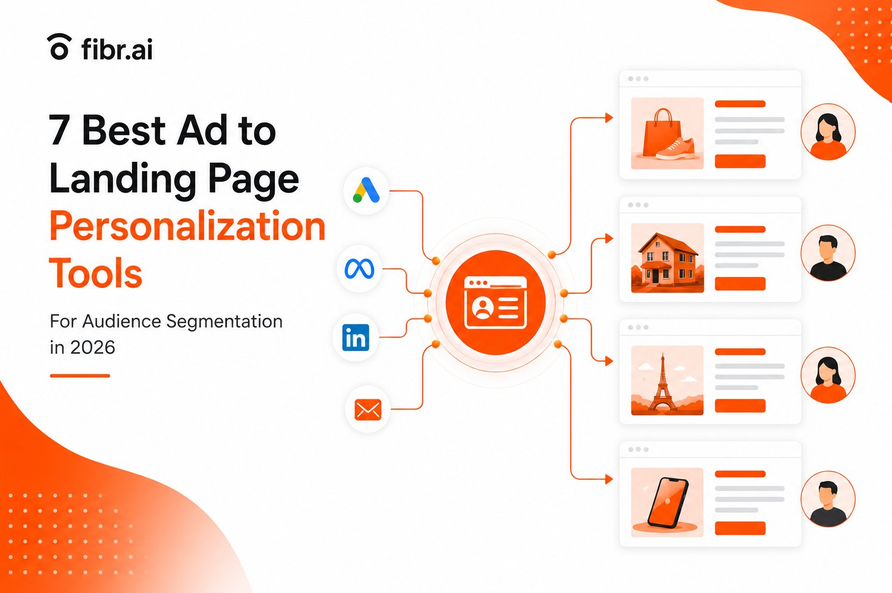
Ad,to,landing page personalization built around audience segmentation fixes this. Instead of serving a single static page to every visitor, it uses what you already know about each audience, their segment, their source, their intent signal to dynamically deliver a landing page experience that speaks directly to them.
This guide covers the seven best tools making that possible in 2026, and what to look for before choosing one.
Why Audience Segmentation Is the Foundation of Post,Click Personalization
Most marketers segment their audiences at the ad level. They build separate campaigns for enterprise versus SMB, for cold versus retargeted traffic, for different industries or personas. The targeting is precise. The creative is tailored. And then every segment clicks through to the same landing page.
That's where the investment in upstream segmentation breaks down. All the signals collected about who someone is ,their company size, their role, their buying stage ,gets ignored the moment they arrive on the page.
Post,click personalization is the practice of carrying that segmentation logic through to the landing page itself. When a visitor's audience segment informs not just which ad they see, but what the landing page says to them, the entire funnel achieves message consistency. And message consistency is what converts.
The conversion rate impact is well documented across industries: personalized landing pages consistently outperform their static counterparts because they eliminate the moment of mismatch that causes visitors to doubt whether they're in the right place.
What to Look for in Landing Page Personalization Software for Segmentation
Not every platform handles audience-based personalization with the same depth. Here's what separates the tools worth evaluating from the ones that overpromise.
Segment,level content control ,Can you personalize headlines, CTAs, body copy, imagery, and social proof independently for each audience segment? Or are you limited to swapping a single text field? True segmentation,based personalization requires full creative control at the page section level.
Native integration with ad platforms ,The segment data that matters most lives in your ad platforms: Google Ads audience lists, Meta custom audiences, LinkedIn matched audiences. Tools that connect directly to these sources make segment-based personalization more accurate and faster to deploy.
No,code operation for marketing teams ,Audience segmentation strategies evolve constantly. If every new segment rule requires a development resource, your personalization program will always lag behind your campaign strategy. The best landing page personalization software puts control in the hands of the marketer.
Scalability across campaigns ,A tool that works for three segments needs to work equally well for thirty. Evaluate how platforms handle increasing complexity: do they become unwieldy at scale, or does the architecture support growth cleanly?
7 Best Tools for Ad to Landing Page Personalization and Audience Segmentation
1. Fibr AI
Fibr AI is built around a straightforward premise: every audience segment your campaign targets deserves a landing page experience that speaks directly to it. That premise shapes everything about how the platform works.
Where most tools treat audience segmentation as one trigger among many, Fibr treats it as a core input using segment data from ad platforms, UTM parameters, and campaign signals to dynamically assemble landing page content for each visitor. Headline, subheading, CTA, imagery, and social proof can all shift based on which segment a visitor belongs to, creating a post,click experience that continues the conversation the ad started.
The AI layer is what makes this scalable. Rather than requiring marketers to manually author content for every audience variant, Fibr uses AI to generate contextually relevant copy for each segment meaning teams running campaigns across ten or twenty distinct audiences can deliver genuinely differentiated landing experiences without ten or twenty times the content workload.
For growth teams, performance marketers, and demand generation leads who invest heavily in audience segmentation upstream, Fibr ensures that investment doesn't evaporate the moment someone clicks. It's one of the most focused solutions available for teams that take ad,to,landing page personalization seriously.
2. Instapage
Instapage approaches post,click personalization with a strong emphasis on the structural relationship between ads and landing pages. Their AdMap feature allows marketers to visually connect every ad variation to a corresponding landing page ,making it easier to maintain segment-level alignment as campaigns scale.
Their audience personalization capabilities let teams serve different content experiences based on segment membership, device, and acquisition source. For larger marketing teams managing complex multi,segment PPC campaigns, Instapage provides both the personalization features and the collaboration infrastructure to run them at scale.
3. Optimizely
Optimizely operates at the enterprise tier of the personalization market. Its audience targeting engine supports multi,dimensional segmentation ,combining behavioral signals, firmographic data, geographic attributes, and CRM,based properties into sophisticated audience rules that drive dynamic page experiences.
For organizations with the technical resources to deploy it fully, Optimizely offers depth that few platforms match. It's particularly well,suited for enterprise teams where personalization is embedded in a broader digital experience program rather than managed as a standalone campaign tactic.
4. Mutiny
Mutiny is purpose,built for B2B post,click personalization, with audience segmentation anchored in firmographic and account,level data. Teams can personalize landing page experiences based on industry, company size, revenue range, or named account ,making it especially powerful for account,based marketing programs where segment precision directly impacts pipeline.
Its AI-generated copy suggestions reduce the content creation burden when building out experiences for multiple B2B segments ,a practical advantage for teams managing ABM campaigns across a large target account list.
5. VWO (Visual Website Optimizer)
VWO combines visitor segmentation with rigorous experimentation infrastructure in a platform accessible to non,technical marketing teams. Segments can be defined by traffic source, campaign, behavioral history, device, or geographic attributes ,and each segment can be served a distinct landing page experience.
What distinguishes VWO in this context is the testing layer. Rather than assuming that a personalized experience outperforms the default, VWO allows teams to validate segment,specific personalization with structured A/B and multivariate tests ,building an evidence base that makes the case for continued investment.
6. Unbounce
Unbounce's combination of Dynamic Text Replacement and Smart Traffic provides a practical foundation for audience,based personalization. Smart Traffic uses machine learning to route visitors to the variant most likely to convert based on their attributes ,including audience segment signals ,without requiring marketers to manually define routing rules for every scenario.
For teams that want audience,aware personalization without the complexity of building explicit segment rules from scratch, Unbounce offers a lower,friction entry point backed by a mature, well,supported platform.
7. AB Tasty
AB Tasty brings personalization and experimentation together with an audience targeting framework that supports segment,based content delivery across landing pages. Teams can define segments based on acquisition source, behavioral patterns, geographic location, or custom attributes ,and serve differentiated experiences to each.
Its focus on the visitor journey as a whole, rather than the landing page in isolation, makes it a strong fit for teams thinking about segmentation across the full funnel rather than just the post,click moment.
Building a Segmentation,First Personalization Strategy
Choosing the right tool is only part of the equation. The teams that see the largest conversion gains from personalized landing pages approach segmentation strategically before touching any platform.
Start by auditing where your audience segments are most meaningfully different. Not every dimension of segmentation warrants a distinct landing page experience ,but the segments where buyer motivation, language, pain points, or stage diverge significantly will reward personalization most. Enterprise versus SMB, industry verticals, retargeted versus cold traffic, and branded versus non,branded keyword intent are typically the highest,value starting points.
Then map what changes for each segment. Is it the headline framing? The proof points? The CTA? The product use case that leads? Getting specific about what needs to change ,rather than rebuilding the entire page ,makes personalization faster to deploy and easier to test.
Finally, connect the segment logic in your ads directly to your landing page personalization rules. The audience lists you've built in Google Ads or Meta, the UTM parameters you're already passing through campaigns ,these are the signals your personalization platform should be reading. The closer the alignment between your ad segmentation and your landing page segmentation, the more complete the post,click experience becomes.
Conclusion
Ad to landing page personalization built around audience segmentation is one of the most direct paths to conversion rate improvement available in 2026. The tools in this list make it achievable ,from accessible platforms like Unbounce to AI,native solutions like Fibr that carry segment intelligence from ad click to landing page experience.
The visitors arriving on your landing pages are not a homogenous group. The sooner your pages reflect that, the sooner your conversion rates will too.
Author Bio
Meenal Chirana is the Content & Social Media Manager at Fibr, with 5+ years of experience in content marketing. She specializes in creating SEO-driven content, social media campaigns, and brand storytelling that simplify complex ideas into engaging, audience-focused narratives. Her work centers on crafting content that informs, engages, and drives meaningful connections.

.jpg)