AI cannot replace a therapist. It can help more people reach one
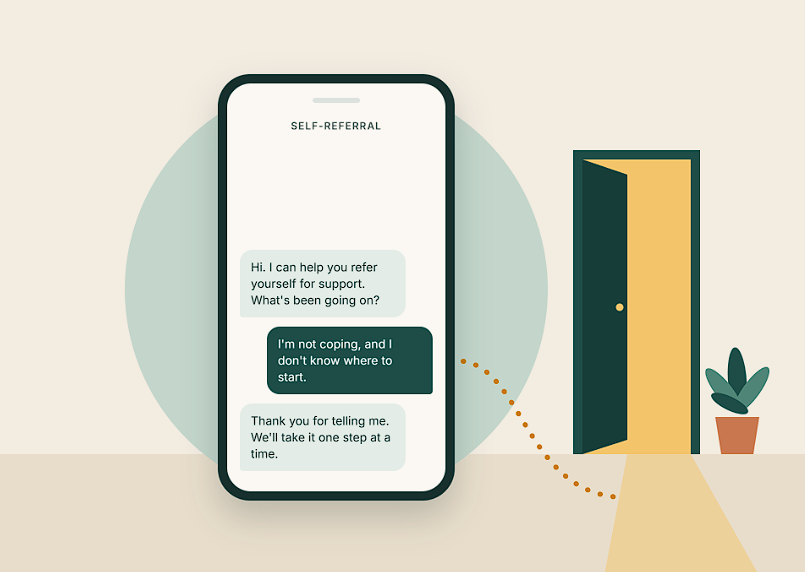
Can AI help more people get mental healthcare? Yes. Some of the largest real-world studies so far look at the steps around therapy, such as asking for help in the first place, rather than at replacing the therapist. So the answer depends on where the AI sits. Inside a clinical service, with clinicians making the treatment decisions, AI is helping more people get seen. Used as a general-purpose chatbot in place of a therapist, AI raises safety problems that researchers have documented. And if you're wary of the claims made for AI in healthcare, plenty of clinicians share that caution.
The treatments exist. Most people do not receive them
Talking therapies such as cognitive behavioural therapy (CBT) are a standard NHS treatment for depression and anxiety. Reaching them is the hard part. Surveys of 51,547 people in 21 countries, run under the World Health Organization's World Mental Health initiative, found that only 1 in 5 people with major depression in high-income countries received even minimally adequate treatment.¹
The gap opens before anyone sees a clinician. In the same surveys, only 56.7 per cent of people with major depression said they needed treatment.¹ Many people never ask for help at all. Those who do ask often start with a phone call they have to fit around work.
Services cannot close that gap quickly by hiring, because training a therapist takes years. And every hour a clinician spends collecting basic information is an hour not spent on treatment. That's where AI has started to help.
AI can make it easier to ask for help
One of the largest studies looked at the referral itself. Researchers studied 129,400 patients referred to NHS Talking Therapies services in England. Services that added an AI chatbot to their self-referral process saw referrals rise by 15 per cent, compared with 6 per cent in comparison services.² The rise was largest among groups who often have less access to care. Referrals from non-binary people rose by 179 per cent, and referrals from people in ethnic minority groups rose by 29 per cent.²
The researchers also analysed written feedback from 42,332 people, and two possible reasons stood out. People valued that no human was on the other end, and the conversation helped them recognise that they needed treatment.² If saying 'I'm not coping' to another person feels hard, typing it can feel easier.
The same kind of tool can save clinicians time. It collects symptom questionnaires during the referral, so the clinician has that information before the assessment starts. In a study of 64,862 patients across nine NHS Talking Therapies services, assessments for people referred through the AI tool took 12.7 minutes less on average: 41.6 minutes rather than 54.4.³ In a service running thousands of assessments a year, those minutes become clinical hours that can go to treatment.
Support between sessions, and before the first one
Getting into treatment is only part of access. CBT relies on exercises that people practise between sessions, and many people find those exercises hard to keep up with a worksheet alone. Someone who drops out has lost access to care as surely as someone who never started.
A study in five NHS Talking Therapies services looked at 244 patients in group CBT. The 150 who chose to use an AI tool for their between-session exercises were compared with 94 who used standard worksheets. In the AI group, dropout was 23 percentage points lower and recovery rates were 25 percentage points higher.⁴ Clinicians still led every session and assigned the exercises.
Randomised trials are starting to report results too. In a trial published in NEJM AI, researchers randomly assigned 210 adults with clinically significant symptoms either to four weeks with a generative AI chatbot built for mental health treatment or to a waiting list. Symptoms fell significantly more in the chatbot group for all three conditions tested, including depression.⁵ The comparison was with waiting, not with a therapist, and waiting is what many people face.
Some services now offer support that starts before any appointment. In the US, one such service offers AI-guided CBT over an ordinary phone call, with licensed clinicians reviewing each person's progress.⁶
General chatbots are not built for this
None of this means any chatbot will do. Researchers from Stanford and other US universities tested general-purpose large language models, including GPT-4o, against standards drawn from therapy guides used by major medical institutions. The models showed stigma towards people with mental health conditions. They also responded inappropriately to some common and serious situations, for example by encouraging a client's delusional thinking.⁷ The problems persisted in larger and newer models, and the authors concluded that these models should not replace therapists.⁷
The tools in the NHS studies above worked differently. Each one sat inside a clinical service and left treatment decisions with clinicians. That's the arrangement to look for. The evidence is also still early, and much of it comes from real-world comparisons rather than randomised trials. So be sceptical of any claim that AI can replace a therapist.
What to ask before backing an AI mental health tool
If you're choosing a mental health tool for your staff, or investing in one, four questions separate tools built for clinical care from the rest:
- Does a qualified clinician oversee the tool and make the treatment decisions?
- What happens when someone says they're at risk, and how quickly does a person respond?
- If the tool assesses or treats people, is it regulated as a medical device where you'll use it?
- Has it been tested in published, peer-reviewed research with people like the ones who'll use it?
If a supplier can't answer all four clearly, the tool may end up as another app your staff stop opening.
If you're struggling right now, you can call Samaritans free on 116 123, day or night.
References
- Thornicroft G, Chatterji S, Evans-Lacko S, et al. Undertreatment of people with major depressive disorder in 21 countries. British Journal of Psychiatry. 2017;210(2):119–124. https://doi.org/10.1192/bjp.bp.116.188078
- Habicht J, Viswanathan S, Carrington B, et al. Closing the accessibility gap to mental health treatment with a personalized self-referral chatbot. Nature Medicine. 2024;30(2):595–602. https://doi.org/10.1038/s41591-023-02766-x
- Rollwage M, Habicht J, Juechems K, et al. Using conversational AI to facilitate mental health assessments and improve clinical efficiency within psychotherapy services: real-world observational study. JMIR AI. 2023;2:e44358. https://doi.org/10.2196/44358
- Habicht J, Dina LM, McFadyen J, et al. Generative AI–enabled therapy support tool for improved clinical outcomes and patient engagement in group therapy: real-world observational study. Journal of Medical Internet Research. 2025;27:e60435. https://doi.org/10.2196/60435
- Heinz MV, Mackin DM, Trudeau BM, et al. Randomized trial of a generative AI chatbot for mental health treatment. NEJM AI. 2025;2(4). https://doi.org/10.1056/AIoa2400802
- Limbic. C CBT over the phone, with licensed clinicians reviewing progress. Available in the US; availability varies by state. https://www.limbic.ai/ai-therapy
- Moore J, Grabb D, Agnew W, et al. Expressing stigma and inappropriate responses prevents LLMs from safely replacing mental health providers. In: Proceedings of the 2025 ACM Conference on Fairness, Accountability, and Transparency (FAccT '25). 2025. https://doi.org/10.1145/3715275.3732039
Byline
Written by Jephonie Villegas
Jephonie works with Limbic, which makes AI tools used by NHS Talking Therapies services. Limbic employees co-authored three of the studies cited in this article (references 2, 3 and 4).