Five Questions to Ask Before You Pay for an AI Video Ad Tool

A founder holding a credit card and hesitating in front of a screen full of candidate video ads
Most founders arrive at AI video ad tools the same way. A competitor starts running creator-style ads at a pace that seems impossible for a team their size. Someone in a founder group mentions they have stopped booking creators altogether. A quick search turns up a dozen products promising scroll-stopping ads from a single product link, each with a slick demo and a pricing page designed to get a card number before lunch.
The category is genuinely useful. It is also young, crowded and inconsistent, and the gap between a good tool and a disappointing one rarely shows up in the demo. It shows up three weeks later, when the ads are live, the credits have run out and somebody asks whether the business actually owns what it has been publishing.
Before paying for anything, it helps to ask five fairly unglamorous questions. None of them require technical knowledge. All of them will tell you more than the showreel.
1. How does it charge, and what does testing really cost?
AI ad tools price in very different ways. Some charge a monthly subscription with a fixed number of videos. Some sell credits that are consumed at different rates depending on length, resolution or the presenter you pick. Some offer an attractive entry plan that turns out to cover only a handful of finished videos.
The number that matters is not the headline price. It is the cost of the way you will actually use the tool. Creator-style advertising works through volume: several hooks, several presenters, several versions of the same message, most of which will be switched off within a week. A founder who plans to test properly might need thirty or forty variations a month, not four.
So do the arithmetic before signing up. Work out how many finished ads a realistic month of testing requires, then check what that costs on each plan, including whether unused credits roll over and whether draft versions count against your allowance. A tool that looks cheap per month can be expensive per usable ad.
2. Where do the faces come from?
This is the question founders most often forget to ask, and the one with the longest tail.
Synthetic presenters are built in different ways. Some are modelled on real performers who agreed to it and were paid. Some are synthetic composites that do not correspond to any real individual. A small number of questionable tools have been known to produce faces that look uncomfortably like identifiable people. From a business point of view, those are three very different levels of risk.
Ask the vendor directly how its presenters are created and whether the underlying performers consented. Then ask the practical follow-up: what happens to your right to use the ads if you cancel? Some licences end with the subscription, which means ads still running in your account could suddenly be unlicensed. Others grant commercial rights that continue after you stop paying. That distinction rarely appears on the pricing page, and it matters a great deal once an ad starts performing and you want to keep it running for months.
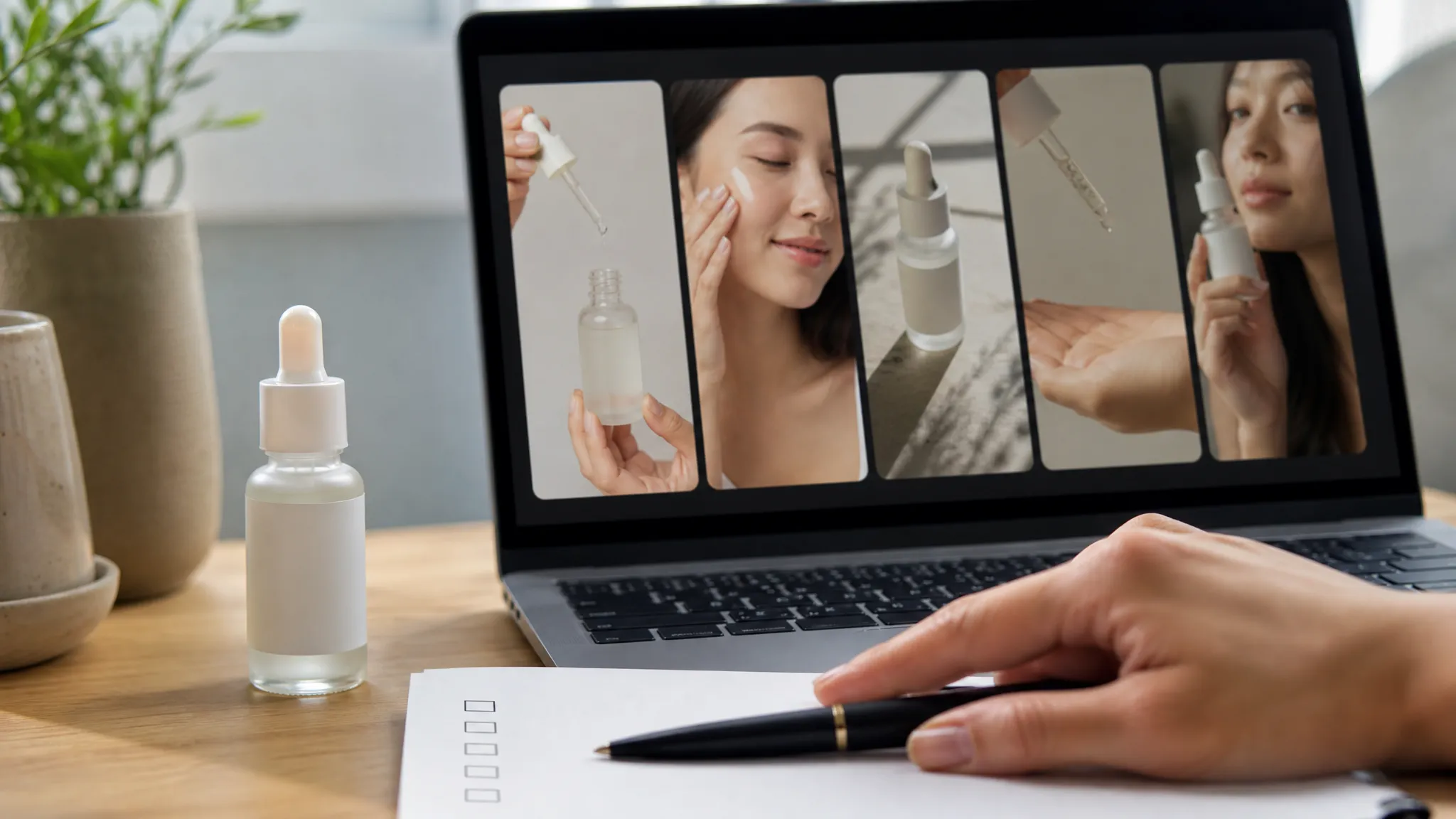
A real product on the desk beside test ads generated from it, with a five-point checklist ready to fill in
3. Does it understand your product, or just your prompt?
Many tools start with a blank box and expect you to write the script. That is fine if you already know what to say. Most small teams do not, which is exactly why they are shopping for help.
The more useful tools begin with the product page itself. They read what the page says about benefits, objections and use cases, and turn that into several distinct angles: a problem-led version, a demonstration, a routine, a comparison. This matters for two reasons. It saves the founder from staring at a blank script, and it keeps the ad anchored to claims the store already makes, which is better for conversion and far safer legally.
A quick test during any trial is to paste in your own product link and see whether the angles that come back are specific to your product or could have been written for anything in the category. A free ai ugc video generator is a low-risk way to run that check before a card number is involved.
4. What stops it writing something you cannot say?
Generative tools are very good at persuasive language, which is precisely the problem. Left alone, they will happily promise results, invent statistics or imply a medical benefit that no small brand should be claiming.
British advertising rules, enforced by the ASA, treat AI-written copy exactly like any other copy, and the responsibility sits with the advertiser rather than the software. Supplements, skincare, finance and anything health-adjacent are particularly exposed, but every category has claims it cannot make without evidence.
Ask what the tool does about this. Does it flag risky claims or soften them? Can you set restrictions for your category? Does it avoid presenting a synthetic presenter as a genuine customer describing personal results? A tool with no answer to these questions is quietly transferring the compliance work back to you.
5. Will the output run without another round of editing?
The final question is the most practical. Short-form platforms have specific expectations about aspect ratio, safe zones for captions, length and file format, and they are not identical across TikTok, Instagram and Meta's ad products.
If every export needs resizing, recaptioning or re-encoding before upload, the time saved on production disappears into post-production. Check whether captions are burned in or editable, whether the exports match each platform's placement requirements, and whether the videos can be used directly in paid formats rather than only as organic posts.
Try it on your own product first
Every one of these questions is easier to answer with your own product in front of you than with a vendor's showcase. Most serious tools now offer some way to test before committing, and it is worth taking.
UGCfy AI, for instance, will take the URL of a store page and show the angles and hooks it would build from it before any credits are spent, and it includes commercial usage rights that do not lapse if the subscription ends. Whatever tool you try, run the same exercise: use a real product, read the scripts carefully, look for claims you would not be comfortable defending, and judge whether the output sounds like your customer or like a template.
The founders who get the most from this category tend to treat the first month as an experiment rather than a commitment. They pick one product, generate a small batch of variations, run them against whatever creative is already live, and let the numbers decide whether the tool deserves a bigger budget. That is slower than buying the annual plan on day one. It is also much less likely to end with a folder of ads nobody can use.