Helium Leak Testing: Improving Manufacturing Quality and Controlling Costs
Leak tightness is a property that cannot be assessed by sight. Refrigerant escaping from a heat exchanger, moisture entering a battery module enclosure, or pressure loss in a fuel system may only become apparent after the product has been installed. Manufacturers therefore use tracer-gas testing, often with helium, when conventional methods are not sufficiently sensitive. Helium methods can detect much smaller leaks than water immersion or pressure-decay testing and provide a quantitative leak-rate measurement.
Helium testing also has a cost: the gas is expensive, and supply can be disrupted. Many factories therefore use helium–nitrogen mixtures and recover test gas for reuse. In both cases, test reliability depends on the actual helium concentration. A helium gas analyzer installed on the filling line or in the recovery loop can continuously monitor that concentration.
This article examines when helium leak testing is justified, which parameters affect test quality, where costs arise, and how to reduce them without compromising the reliability of the results.
Why Helium Is Used for Leak Testing
Helium is an effective tracer gas for several reasons:
- Small atomic size. Helium can pass through very small leak paths; the practical detection limit, however, depends on the test method and conditions, not solely on atomic size.
- Low atmospheric background. Ambient air contains about 5 ppm helium, allowing leak signals to be distinguished from background under controlled conditions.
- Chemical inertness. Helium is non-flammable and chemically inert under normal test conditions. As with any compressed gas, appropriate handling and ventilation are required.
- Selective detection. A helium mass-spectrometer leak detector monitors ions at mass-to-charge ratio 4, making it highly selective for helium, although background and instrument interferences still need to be controlled.
A properly calibrated test can provide a numerical helium leak rate that can be compared with a product-specific acceptance limit.
Comparison With Other Leak Testing Methods
Method selection starts with the maximum permissible leak rate, commonly expressed in mbar·L/s or Pa·m³/s. Sensitivity also depends on product volume, test time, pressure, equipment and the test setup.
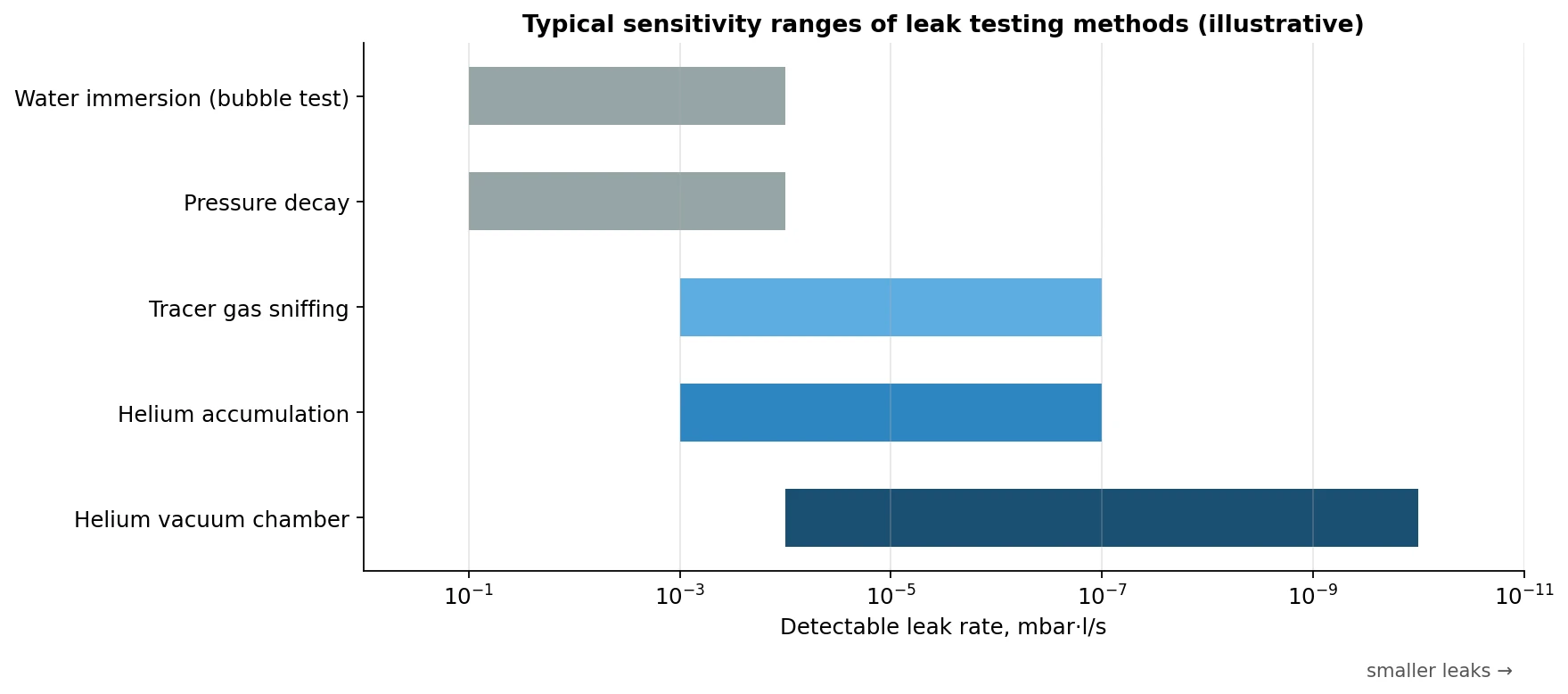
Figure 1. Illustrative sensitivity ranges for leak testing methods. Actual detection limits depend on the product, test conditions and equipment.
Helium testing is justified when a leak-rate limit is below the practical capability of simpler methods, when a traceable quantitative result is required, or when volume and thermal effects make pressure-decay testing unreliable.
Where Helium Leak Testing Is Used
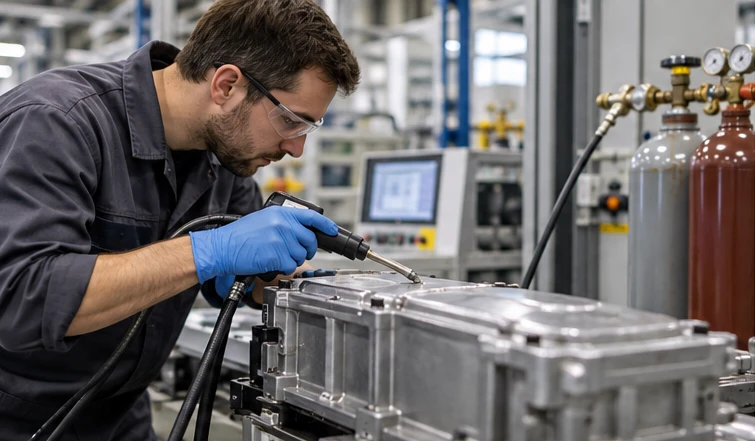
Figure 2. Technician inspecting a manufactured component for leaks.
- Refrigeration and air conditioning: heat exchangers, compressors and refrigerant lines, where small leaks can cause refrigerant loss over the service life.
- Automotive manufacturing: fuel systems, brake and air-conditioning circuits, and electronic enclosures.
- Batteries and electric vehicles: battery housings, cells and liquid-cooling circuits, where moisture ingress and coolant leakage must be controlled.
- Medical devices and packaging: selected sealed devices and packages where validated integrity testing is required; the appropriate method depends on the product and standard.
- Aerospace and vacuum equipment: fuel and hydraulic systems, vacuum chambers and cryogenic assemblies.
What Determines Test Quality
The accuracy of helium leak testing depends on the entire procedure, not just the detector sensitivity.
Helium concentration in the product. A leak detector measures the helium component of the escaping gas, not necessarily the total test-gas flow. For example, with a mixture containing 10% helium in nitrogen, converting a helium leak-rate reading into a total gas leak rate requires knowledge of the actual helium fraction and the test conditions. The simple inverse-concentration correction is an approximation and is not universal across all leak regimes. If the true helium fraction is lower than assumed, an unacceptable leak may be mistakenly accepted.
Uniform filling. Air remaining inside the product can dilute the tracer gas locally. Before testing, air is removed by evacuation or purging, depending on the validated procedure, so that the intended test-gas composition reaches potential leak paths.
Ambient helium. Releasing test gas into the work area raises background helium levels. This can impair sniffing and accumulation tests and produce false rejects. Exhaust routing, ventilation and background checks help control the problem.
Calibration. The leak detector is checked against a calibrated reference leak with a known rate. Check frequency follows manufacturer recommendations and the site’s quality procedure.
Test time. Helium needs time to travel through a leak path and reach the detector. An excessively short cycle increases throughput but can miss defects.
Where the Costs Come From
- Helium consumption. This depends on product volume, fill pressure, helium fraction and production throughput. Without recovery, gas removed after testing is lost.
- Cycle time. Evacuation, filling, dwell time, measurement and gas removal all affect line capacity.
- False rejects and retesting. Incorrect rejection adds inspection, rework or scrap costs.
- Undetected leaks. A faulty product reaching the customer can lead to warranty claims, recalls and reputational damage.
- Maintenance and calibration. Vacuum pumps, detectors and reference leaks require ongoing service.
Reducing Costs Without Sacrificing Quality
Helium–Nitrogen Mixtures
Instead of pure helium, manufacturers often fill products with a helium–nitrogen mixture. The helium used per fill decreases with its fraction in the mixture, all else being equal. The helium signal also decreases, so the concentration must still allow the specified leak limit to be detected reliably. Its actual value should remain known and sufficiently stable throughout production; otherwise the interpretation of detector readings may be wrong.
Helium Recovery
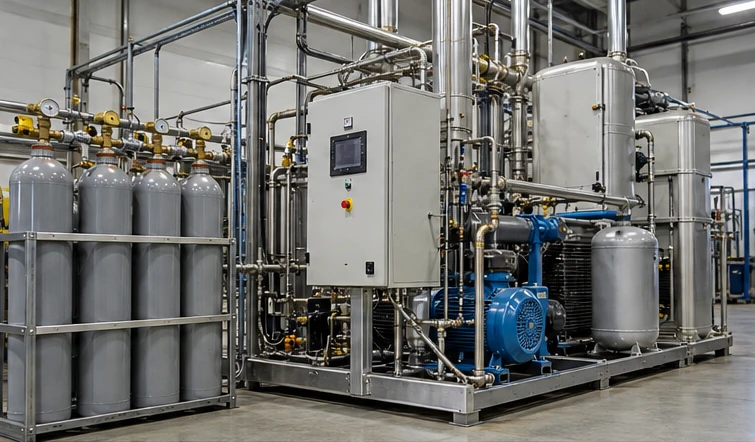
Recovery systems collect test gas removed from products, compress it, purify it where needed and return it to the filling line. Fresh helium is added to replace losses. Air can enter during gas collection and handling, so the recovered mixture may change composition over successive cycles.
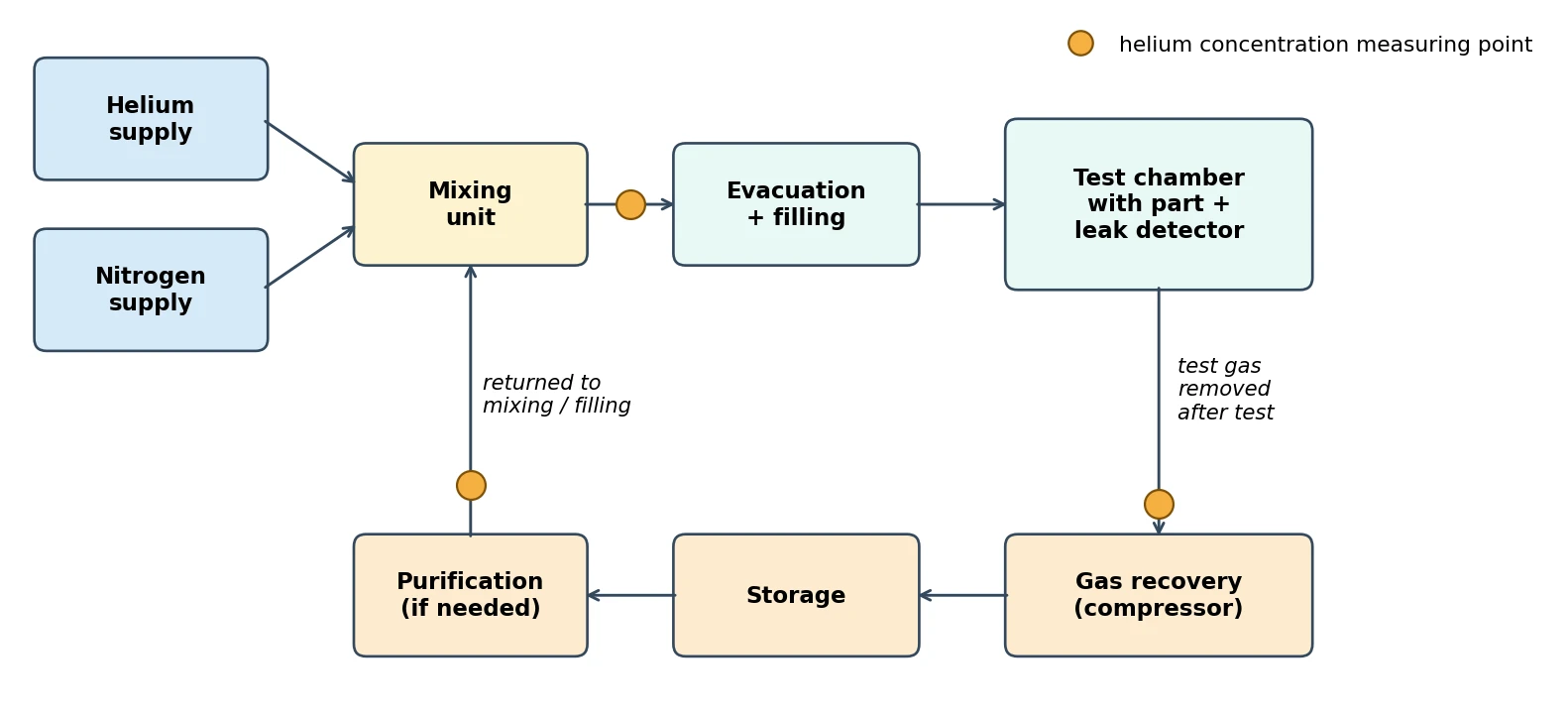
Alt text: process diagram showing helium and nitrogen supplies, mixing, product evacuation and filling, test chamber with leak detector, gas collection, compression, storage, optional purification and return to the filling line, with helium concentration measurement points.
Process Optimisation
- Fill pressure and volume. Use the pressure required by the product specification rather than an unnecessary margin. Partial filling or local test fixtures may be considered where the validated method permits.
- Cycle time. Set dwell and measurement times using qualification tests and reference leaks.
- Gas exhaust. Route discharged gas away from the test area to reduce background helium and false rejects.
- Alternative tracer gas. Some applications use a mixture of approximately 5% hydrogen in nitrogen, commonly sold as forming gas. Its classification and safe use depend on the exact composition and applicable standards, and its suitability depends on the test method.
Monitoring Helium Concentration on the Production Line
Where mixtures or recovery are used, helium concentration may be checked at several points:
- After mixing, to verify the target test-gas composition.
- In the recovered stream, to detect dilution from air entering the recovery loop.
- Before filling, to ensure that products are tested with a known helium concentration.
Thermal conductivity is one suitable measurement method. Helium conducts heat much more effectively than nitrogen or air, so its fraction in a mixture can be inferred from heat transfer at a heated sensor. Depending on sensor design, gas pair and calibration, the technique can provide continuous measurements from relatively low helium concentrations to nearly pure gas. Its principal limitation is that it works best with binary or quasi-binary mixtures, such as helium in nitrogen or air. Pressure at the measurement point must be stabilised or compensated.
Two instruments have distinct roles. A helium leak detector measures helium escaping through a defect in a product. A helium concentration analyzer measures the helium fraction in the test gas. A production line using mixtures and recovery may need both.
Questions Before Introducing or Upgrading Helium Testing
1. What is the maximum permissible leak rate? This determines the appropriate method and equipment.
2. Is it necessary to locate the leak, or is an overall pass/fail and leak-rate result enough? A sniffer localises leaks; chamber and accumulation methods provide overall results.
3. What are the internal volume and filling pressure? These drive gas consumption and cycle time.
4. Can a helium–nitrogen mixture be used? What helium fraction still provides reliable detection at the acceptance limit?
5. Will recovery pay for itself? Consider helium usage, production volume, gas prices and system costs.
6. How is helium concentration verified, particularly when mixtures or recovery are used?
7. How will calibration and results be documented? Traceability matters for audits and warranty investigations.
Frequently Asked Questions
Can pressure-decay testing replace helium testing?
Sometimes. For products with moderate leak-tightness requirements and relatively small volumes, pressure decay may be adequate. Very low permissible leak rates or large product volumes can make it insufficiently sensitive.
Why does helium concentration matter if the leak detector can detect helium?
The detector measures helium leakage. Interpreting that signal against the total test-gas leak requirement requires knowledge of helium fraction and test conditions. An unexpectedly low fraction can lead to an underestimated leak.
Why did false rejects increase after helium testing was introduced?
Elevated helium background from vented test gas is one possible cause. Better exhaust routing, ventilation and background checks can help.
How often should the leak detector be checked?
Follow the equipment manufacturer’s instructions and the facility’s quality procedure, using a calibrated reference leak.
How much helium can be recovered?
Recovery depends on system design, product volume and operating practices. Some gas is lost during connections, disconnections and leakage from the products themselves.
Conclusion
Helium leak testing can detect and quantify leaks that simpler methods may miss, while providing documented results for each product. Its costs depend on helium consumption, cycle time and incorrect accept/reject decisions. Helium–nitrogen mixtures and gas recovery reduce consumption but make test reliability dependent on the actual helium concentration in the test gas. Thermal conductivity measurement is particularly useful for continuous concentration monitoring when the mixture is binary or quasi-binary, such as helium in nitrogen, and pressure effects are accounted for.
.jpg)