The hidden cost of manual video editing in scaling content teams
Every business that scales its content output eventually hits the same wall. It is not a creative wall. Nobody runs out of ideas for videos. The wall is execution, and it shows up quietly, in review queues, in editors buried under raw footage, in publishing calendars that slip by a week and then two.
It is worth being precise about what is actually breaking here, because the instinct is usually to blame the wrong thing.
Craft was never the bottleneck
Ask any experienced editor what they are good at, and the answer is judgement. Knowing which take carries the emotion. Knowing where a cut should land. Knowing when a scene has run a beat too long. That is craft, and it does not scale badly. A good editor can apply that judgement to ten projects a month or a hundred; the skill itself does not degrade.
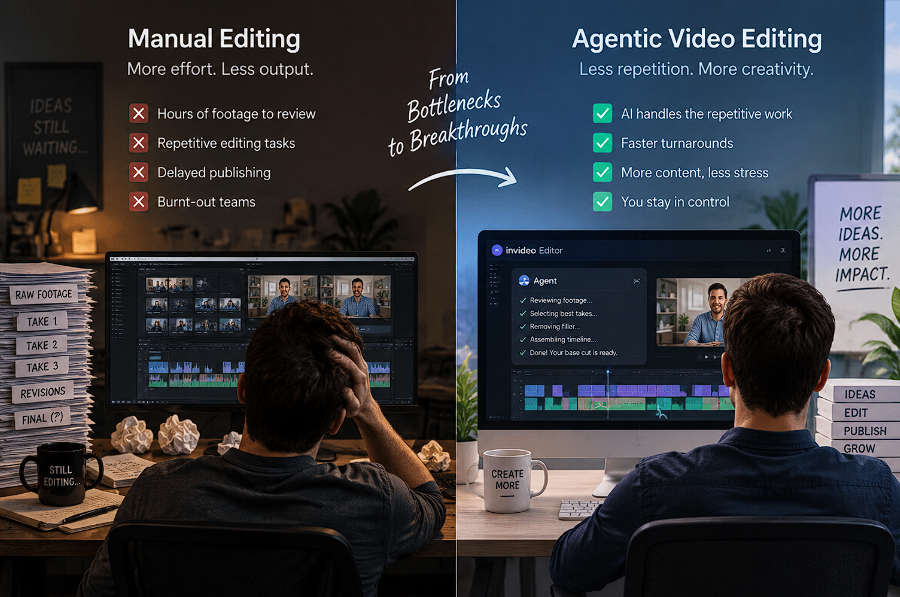
What scales badly is everything underneath the judgement. Reviewing hours of footage before you even get to the interesting decisions. Comparing five takes of the same line to find the clean one. Cutting false starts. Arranging clips in a rough order before the real editing begins. Fixing audio levels. Making a second version for a different platform. None of that is craft. It is execution, and execution is where content teams actually lose their weeks.
This distinction matters because most attempts to fix editing bottlenecks target the wrong layer. Teams hire more editors, assuming the problem is headcount. They buy faster hardware, assuming the problem is rendering speed. They shorten review cycles, assuming the problem is process. All of that helps a little. None of it touches the actual cost, which is the hours spent on repetitive work that has nothing to do with skill.
What scaling video output actually exposes
A single creator making one video a week can absorb the grunt work personally. It is annoying but manageable. The moment a business tries to scale that same workflow, across ten videos a week, across a content team, across multiple formats and languages, the repetitive layer stops being a background cost and becomes the whole job.
Editors end up spending most of their time on the part of the work that requires the least judgement. Talented people are doing take selection instead of storytelling. Teams making platform versions by hand instead of refining the core edit. Localisation queued up behind a backlog because dubbing and re-syncing take real hours per language. This is the hidden cost. It rarely shows up on a budget line, but it shows up everywhere else, in missed publishing dates, in burnt-out editors, and in ideas that never make it past the raw footage stage because nobody has the time to touch them.
Where agentic video editing actually fits
This is precisely the layer that agentic video editing is built to address, and it is worth being clear about what that means before assuming it is another automation buzzword. The point is not to remove editors from the process or hand creative decisions to software. The point is to separate execution from judgement so a team can direct the repetitive work instead of performing it manually and still keep full control of the result.
This is where invideo editor becomes genuinely useful for scaling teams, particularly through its agentic video editing, which lets you assign the execution layer, footage review, take selection, rough assembly, and cleanup to an AI agent while keeping the editing timeline fully in your hands. You give the agent your footage and your direction, it works through the material the way an assistant editor would, and it hands back a cut you can inspect, redirect and refine. Nothing is locked away in a black box. Every decision the agent makes stays visible and editable on the timeline.
For a content team managing multicam interviews, long-form recordings, or a weekly publishing schedule across platforms, that shift changes the maths entirely. The hours that used to go into reviewing footage and building a rough cut from scratch go instead into directing an agent in plain language, and the editor's time moves back to where it belongs, on pacing, tone and story.
The real fix is not more hands; it is less repetition
Scaling video output was never supposed to mean scaling the grunt work along with it. Invideo editor approach treats the repetitive layer as a problem worth solving directly, not a cost to be absorbed with more headcount or longer hours. Teams that make this shift are not editing less. They are simply spending their editing time on the parts of the job that actually needed a person in the first place.
That is the part of scaling content production that most teams get backwards. The craft was never the expensive part. The execution always was.