How Advanced Technology Improves Business IT Support Systems

Let's be honest, when your IT breaks down, everything breaks down. Deadlines slip. Customers notice. Revenue bleeds out quietly while your team scrambles. And yet, most businesses are still running support systems built for a world that no longer exists.
Business IT support has moved far beyond the old helpdesk model, and the companies that understand this aren't just surviving, they're pulling ahead. Here's what that shift actually looks like in practice.
The Evolving Role of Advanced Technology in Business IT Support
This isn't a gradual evolution. It's a full-on rethink of what IT support is supposed to do. The old model was reactive, slow, and expensive. The new model, built around advanced technology in IT support, is precise, fast, and genuinely strategic.
Bridging Traditional IT and Modern IT Support Systems
Legacy systems were built around manual monitoring, disconnected tools, and a "fix it when it breaks" philosophy. That worked fine when technology moved slowly. It doesn't work now. According to the Stonebranch 2024 Global State of IT Automation Report, 82% of respondents plan to replace legacy IT automation tools or add new automation tools entirely. That's not a niche trend, that's an industry-wide wake-up call. Companies building IT support systems on modern frameworks aren't just more efficient; they're more resilient in ways their competitors can't easily replicate.
Emerging Tech Trends Reshaping IT Support Systems
AI, machine learning, IoT, these aren't buzzwords anymore. They're running live inside productive IT environments right now, catching problems before users even file a ticket. Cloud platforms have matured enough to support serious enterprise workloads while remaining flexible enough for growing teams. Real-time data from connected devices gives IT teams something genuinely valuable: time to act before things go sideways.
Summerville, SC is one of South Carolina's fastest-growing communities, drawing businesses across healthcare, retail, and professional services. The rising demand for IT services Summerville SC reflects what both established organizations and newer startups need, partners who bring cutting-edge tools and a real understanding of the local business landscape.
The bottom line? Advanced technology isn't optional anymore. It's the entry fee for running a competitive operation. Let's dig into what that looks like day to day.
Boosting Efficiency and Productivity Through Advanced IT Support
Understanding the landscape is one thing. Seeing where it translates into actual gains, faster resolutions, fewer fires, more productive teams, is where this gets interesting.
Automating the Repetitive Stuff
Ticketing. Patch management. System monitoring. Incident routing. These tasks used to chew up enormous chunks of IT staff time every single week. Automation handles them now, quietly, consistently, without complaint.
Self-healing systems can detect anomalies and apply fixes before anyone even notices. Teams running automation report faster resolution times and far fewer escalations. That ripples outward into the whole organization: less downtime, better productivity, fewer frustrated employees shooting off complaints at 9 a.m.
How AI Changes the Problem-Solving Game
Automation handles the repetitive load. Artificial intelligence handles the harder stuff, and it handles it at a level that fundamentally changes what business IT support can deliver. AI-powered virtual agents resolve common issues around the clock without waiting for a human to pick up the ticket.
Machine learning engines dig through historical incident data, identify root causes faster, and flag which systems are trending toward failure before they get there. The financial case is strong too, AI customer support deployments average $3.50 in value per $1 invested. That's not a rounding error. That's a meaningful ROI.
Real-Time Monitoring and Predictive Analytics
Here's the thing about predictive analytics, it's only useful if the underlying monitoring is actually continuous. Modern platforms track performance metrics in real time, flagging irregularities the moment they appear. Predictive layers sit on top of that data and forecast disruptions before they escalate.
Dashboards surface all of this in formats that both technical teams and business leadership can use immediately. No more waiting for the post-mortem. You see problems coming, and you fix them first.
Strengthening Security, Compliance, and Business Continuity
Efficiency gains mean nothing if your environment is wide open to threats. Technology for business IT now plays a central role in building defenses that actually match what modern attackers are capable of.
Proactive Cybersecurity That Doesn't Flinch
AI and automation sit at the core of any serious cybersecurity posture today. Threat intelligence platforms analyze global attack patterns continuously, updating defenses in real time. Zero trust architecture eliminates the assumption that any user or device is automatically safe, which dramatically shrinks the potential damage from any single breach.
Pair that with ongoing employee training, and security stops being an afterthought. It becomes part of how your organization actually operates.
Automated Compliance Without the Headaches
Manual compliance tracking is a mess. It's time-consuming, error-prone, and genuinely risky. Automated compliance tools monitor your systems continuously, generate audit-ready reports, and alert your team the moment something drifts outside acceptable boundaries.
Cloud-based backup and disaster recovery mean that even worst-case scenarios, ransomware, hardware failure, natural disasters, don't have to mean catastrophic data loss. That's what real business continuity looks like: not just surviving disruptions, but bouncing back fast.
Customizing IT Support Systems for Scalability and Growth
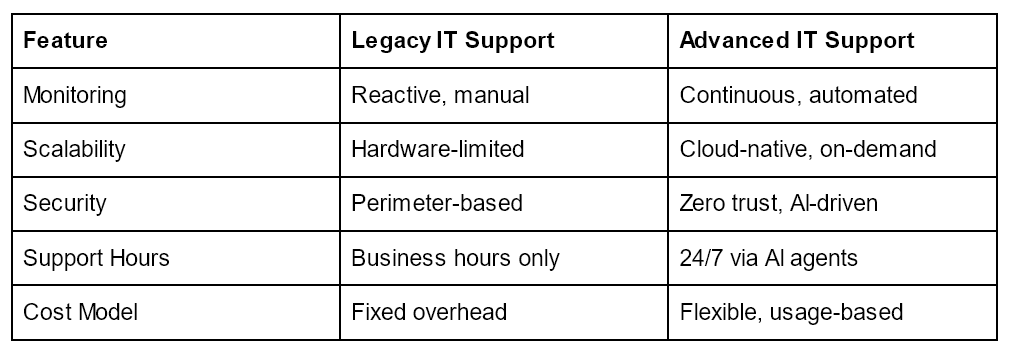
Improving IT support means building systems that grow with your business, not systems that create ceilings. Here's a direct comparison of what that difference looks like in practice.
Cloud-First Infrastructure for Growing Businesses
Cloud platforms let you provision resources in hours, not months. Remote and hybrid teams get the same reliable experience regardless of where they're working. New applications can be tested without massive infrastructure investments upfront. In some cases, managed IT services built on cloud-native tools can make that flexibility easier to maintain as a business adds users, applications, devices, and locations. Instead of treating cloud infrastructure, monitoring, security, backups, and everyday support as separate concerns, teams can manage them as parts of the same technology environment. That makes scaling more practical without forcing internal teams to rethink their entire setup every time operational demands change.
IoT and Connected Devices in Modern Business IT
IoT devices are generating real operational intelligence across retail environments, manufacturing floors, and smart offices. Asset tracking, environmental monitoring, predictive maintenance, all of this becomes possible when devices communicate continuously.
Managing that expanded surface area requires advanced tools capable of enforcing consistent security policies across hundreds, sometimes thousands, of endpoints at once.
Future Innovations Worth Preparing For Now
Hyperautomation and Smart Orchestration
Robotic process automation combined with AI creates end-to-end workflows that handle complex IT tasks with minimal human input. Adaptive environments can reconfigure themselves as conditions change, reducing burden on IT staff while improving consistency. Future-proofing IT support systems means designing for this kind of intelligent orchestration from the start, not retrofitting it in later.
Sustainable and Green IT Practices
Advanced monitoring tools now track energy consumption at the device level, surfacing inefficiencies that would otherwise go unnoticed. Extending hardware lifecycles and reducing waste cuts costs meaningfully over time. Businesses that align technology strategy with sustainability goals create value that resonates beyond the balance sheet, with customers, employees, and investors who care about where their organizations are headed.
Common Questions About Advanced Business IT Support Technology
- What are the essential features of advanced IT support systems?
Real-time monitoring, AI-driven diagnostics, automated ticketing, cloud-based backup, and endpoint security are the core features businesses should prioritize when building or upgrading their IT support infrastructure.
- How can small and mid-sized businesses embrace advanced technology without breaking the bank?
Start with cloud-based services and managed IT support. Both reduce upfront costs significantly while delivering enterprise-grade capabilities. Pay-as-you-go models let smaller teams scale without committing to expensive long-term contracts.
- Which AI and automation tools deliver the fastest productivity gains in IT support?
AI-powered virtual agents and automated ticketing systems typically show the fastest returns. They reduce resolution times immediately, freeing technical staff to focus on higher-priority work that actually requires human judgment.
Final Thoughts on Advanced Technology in Business IT Support
Here's the honest summary: business IT support has become a genuine growth driver, not just a cost to manage. AI, automation, real-time monitoring, cloud platforms, these aren't future considerations. They're current competitive advantages, available right now, to businesses willing to move. The gap between organizations that invest in modern IT infrastructure and those that don't is widening every quarter. If you're serious about building a resilient, scalable operation that performs under pressure and grows without friction, there's no better time to start than today.