How Can Schools Create a Digital Legacy That Future Generations Can Access?
.jpg)
Schools already have a legacy. The problem is that much of it lives in places students won’t ever see. Yearbooks sit in storage. Trophies collect dust in locked cases. Photos are scattered across hard drives, social media accounts, and old school servers that nobody wants to touch. Over time, names, milestones, and traditions get harder to find.
A useful digital legacy is not just an archive. It’s a system schools can maintain without turning every update into a special project. If future students, staff, alumni, and families are going to access school history, the content has to be organized, visible, and easy to update. Otherwise, the school ends up with another forgotten folder labeled “final_v2_revised.”
Start With What Deserves to Be Preserved
Most schools have more history than they realize. Academic awards, athletic records, performing arts recognition, student leadership, major campus milestones, alumni achievements, retired staff honors, historical photos, and event footage all have value. The issue is usually not a lack of material. It’s a lack of structure.
The first step is deciding what belongs in the digital record. In practice, schools do better when they separate content into a few clear categories:
- Student achievement: including scholarships, championships, honor rolls, and notable awards.
- Staff and faculty recognition: such as years of service, retirements, and leadership milestones.
- Alumni history: including distinguished graduates and long-term community impact.
- Institutional memory: like campus expansions, anniversaries, and historical event coverage.
This sounds basic, but it matters. When schools skip this step, their digital archive becomes a random mix of uploads with no long-term logic behind it.
Build a System, Not a One-Time Project
A digital legacy fails when it depends on one enthusiastic staff member who eventually changes roles. Schools need a repeatable process with clear ownership.
That usually means assigning responsibility across a small group rather than one person. A communications lead may manage publishing standards. An athletic director may own sports records. Fine arts staff may contribute performance archives. School IT may control storage, access, and backups. Someone still needs final oversight, but the work should not bottleneck at a single desk.
A workable process usually includes:
- A standard format for names, graduation years, titles, and dates.
- Rules for file naming and media storage.
- Approval steps for public-facing content.
- A schedule for updates, often quarterly or by semester.
- A backup plan so records do not disappear during staff turnover or platform changes.
If the school can’t explain how a record gets added six months from now, the system isn’t ready yet.
Make History Visible, Not Hidden
Access matters just as much as preservation. A digital legacy that lives only inside an internal drive is technically stored, but it’s not doing much for school culture.
This is where schools are making smarter use of public-facing displays. A well-planned hall of fame digital signage installation can bring historical recognition into the daily life of the campus. Instead of limiting honors to a plaque wall near the gym, schools can rotate achievements, alumni spotlights, championship teams, and academic recognition in spaces where students and visitors actually spend time.
That visibility changes behavior. Students see what the school values. Families see evidence of continuity. Alumni feel remembered. Staff have a current, attractive way to show the school’s story without dragging guests down a hallway lined with faded frames from 1998.
The best displays are not overloaded. They present curated recognition clearly, with readable text, strong images, and an update plan that doesn’t require a design emergency before every open house.
Don’t Let the Website Carry Everything
Many schools assume the website should be the main home for institutional memory. It should play a role, but it shouldn’t carry the whole burden.
School websites change. Navigation gets redesigned. CMS platforms get replaced. Pages get archived, redirected, or accidentally deleted by someone trying to “clean things up.” It happens more often than schools like to admit.
A better approach is to treat the website as one access point within a broader ecosystem:
- A central media archive with organized source files.
- Public display systems on campus.
- Website pages for searchable access.
- Cloud storage with documented permissions and backup rules.
- Exportable records that can survive vendor or platform changes.
That last point matters. If a school’s history only exists inside one proprietary platform, it’s not much of a legacy. It’s a subscription risk.
Use Recognition Tools That Can Evolve
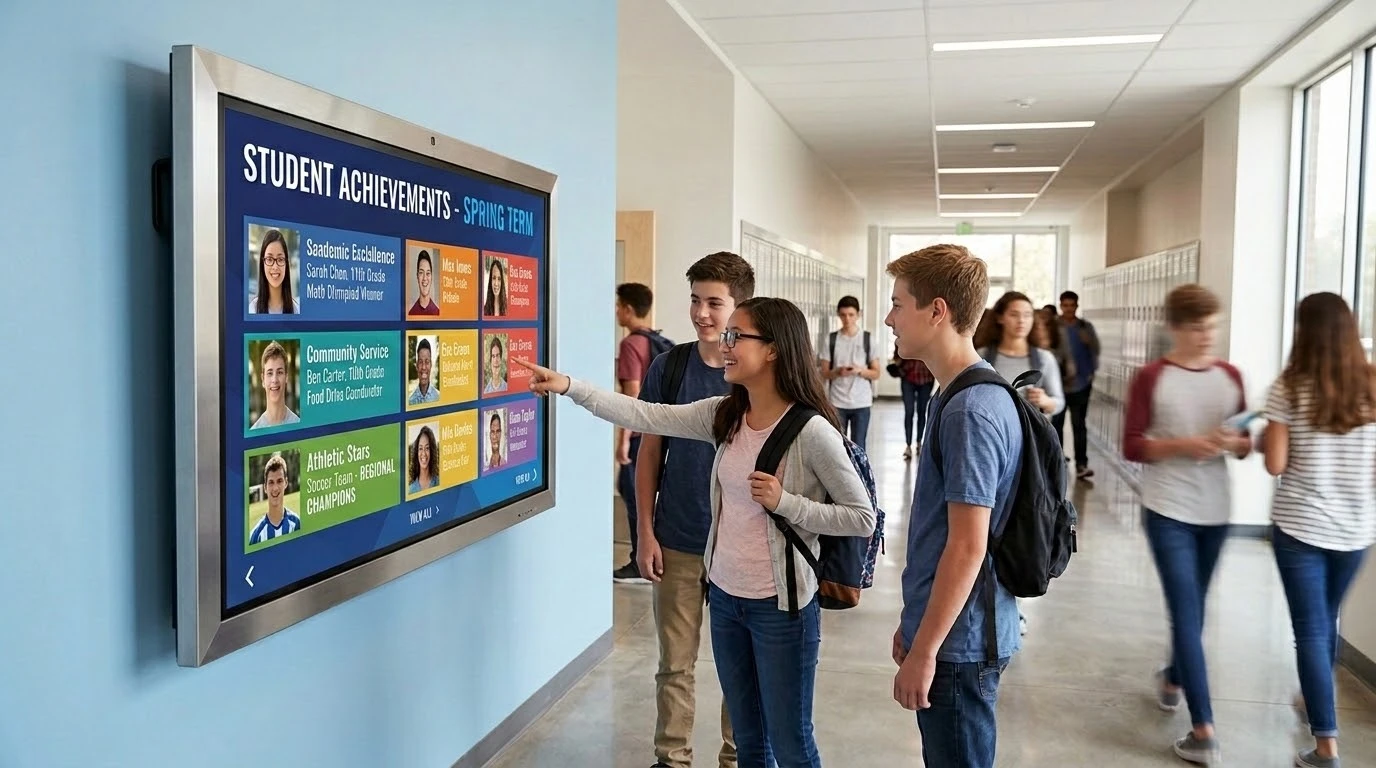
Static memorial walls still have a place, but they are hard to expand, expensive to replace, and limited in what they can show. Schools grow. New accomplishments happen every semester. Space does not.
A digital hall of fame board gives schools more flexibility because it can hold far more than names on a plaque. Schools can include photos, bios, video clips, team records, archived programs, and milestone timelines in one organized experience. Done well, it becomes part recognition tool, part storytelling platform, and part historical record.
That flexibility also helps schools avoid a common problem such as deciding which achievements deserve permanent wall space and which ones do not. Digital formats remove some of that pressure. A school can honor athletic, academic, artistic, and community contributions without pretending the building has endless wall capacity.
There’s also a practical budget angle. Expanding a physical display every year adds up. Reprinting panels, matching materials, and reworking layouts is rarely cheap. Digital systems still require investment, but they’re easier to maintain over time when the content strategy is solid.
Focus on Metadata Before Design
Schools often get excited about screens, layout, and visual style before they clean up the underlying data. That’s backwards.
The long-term value of a digital legacy depends on metadata, names spelled correctly, graduation years consistent, titles standardized, dates verified, and media labeled in a way future staff can understand. Searchability, filtering, and reporting all depend on clean records.
At a minimum, each entry should include:
- Full name.
- Graduation year or service years.
- Category of recognition.
- Date of award or milestone.
- Supporting media, if available.
- Source or verification reference.
This isn’t glamorous work. It’s also the part that keeps a system useful five years later instead of becoming a pretty mess.
Plan for Privacy and Permissions
Not every piece of school history should be published in the same way. Student records, minors images, and personal details require careful handling. American schools already operate in an environment where privacy, consent, and records management need attention, especially when student information is involved.
That means schools should decide early:
- What content is appropriate for public display.
- What requires parent or guardian permission.
- What should remain internal.
- Who approves publication.
- How long content remains active.
For alumni and historical content, schools should still verify what can be shared and how it will appear. A simple review policy saves a lot of cleanup later.
Involve Alumni, But Keep Standards Tight
Alumni are often the best source of missing photos, archived programs, newspaper clippings, and historical context. They can help fill gaps that current staff cannot. But open submissions without standards can create a mess fast.
Schools should invite contributions through a structured process. Ask for dates, names, context, and source details. Use a submission form. Require enough information to verify what’s being added. If the school accepts every unlabeled photo and half-remembered championship story, someone eventually has to sort it out.
This is one of those areas where good intentions create bad archives.
Think Beyond Celebration
Recognition is important, but a digital legacy also supports enrollment, fundraising, and community trust. Prospective families want to see continuity and evidence of a strong school culture. Donors want proof that the institution values its history. Alumni are more likely to engage when they can actually find themselves, their classmates, or their former teachers represented well.
None of this requires flashy language or oversized claims. It requires good records, clear presentation, and consistency over time.
Schools that do this well usually make one smart shift, they stop treating history as decoration and start treating it as an asset. Once that happens, the rest gets easier.
What Lasts
The schools that preserve their legacy best are not always the ones with the biggest budgets. They’re usually the ones that build a practical process and stick with it. They know where their records live, who updates them, what gets published, and how people will access it years from now.
That’s the real goal. Not just storing the past, but making it usable.

.jpg)