How Many Videos Do You Actually Need to Market an App?

Short answer: three to five posts a week, so roughly 40 to 60 pieces a quarter, and each one has a shelf life of about a week. You do not need 40 original shoots to get there. You need a handful of durable assets and 40 openers, which is a completely different shopping list and a completely different budget.
Plan on that number and plan on the shelf life. That is the honest answer, and it is the answer almost nobody gives you, because the number is uncomfortable and every guide would rather talk about strategy.
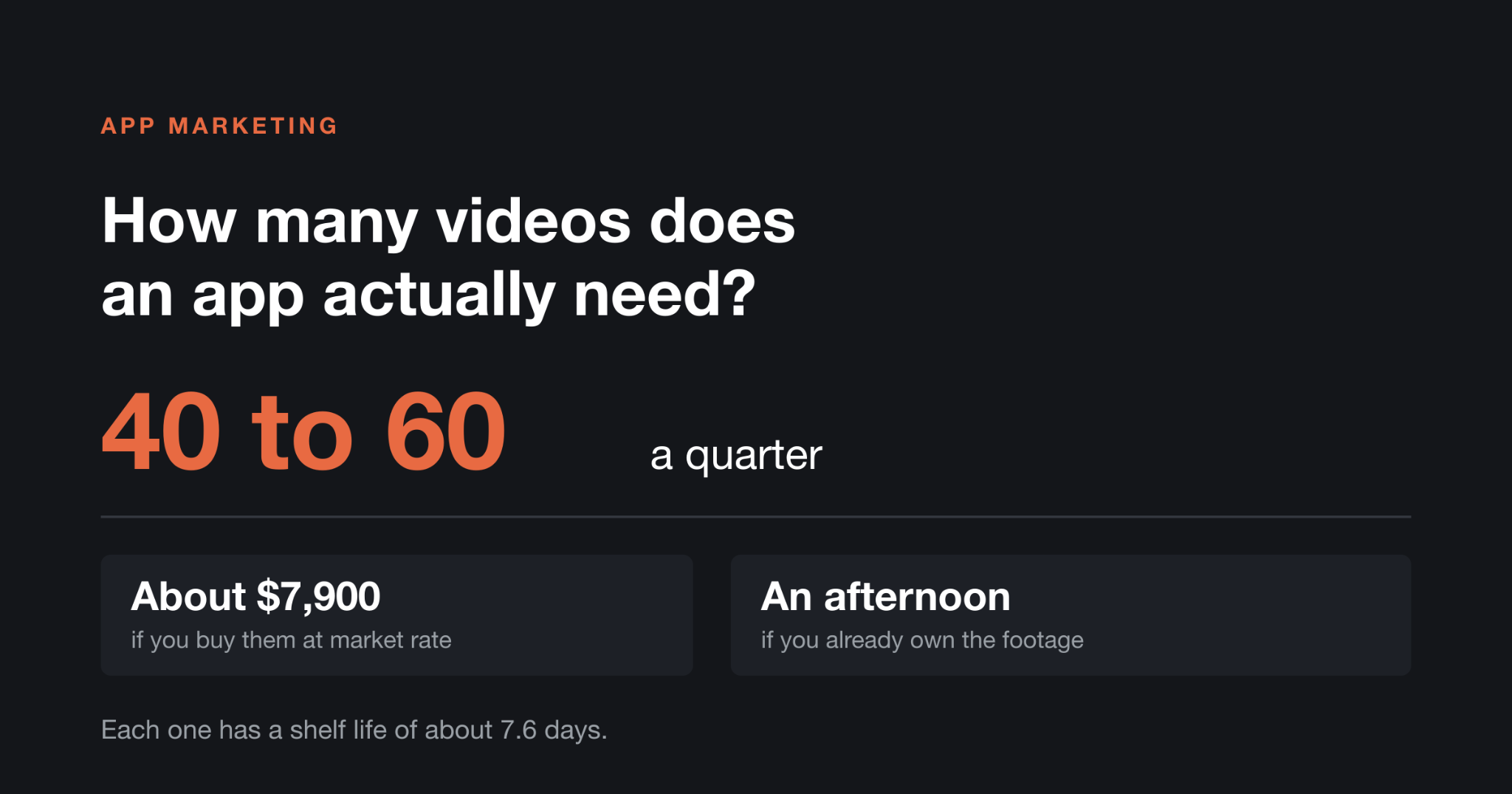
The reason it is that high has nothing to do with your product being complicated. It is that short-form creative in the user-generated style fatigues in roughly 7.6 days. Not the message, not the offer. The specific piece of video. Run it past that and the same audience scrolls straight past the thing it already decided to ignore.
So the real question is not how many videos you need. It is what you are willing to pay per video, because 40 of anything expensive is a budget and 40 of anything cheap is a Tuesday.
Why does one good video stop working?
Because the part that does the work expires faster than the part you paid for.
Take one product demo and put a different opening in front of it. Same footage, same offer, same everything after the first three seconds. Cost per install can move by a factor of two to four on that change alone. The demo is the durable half. The three seconds in front of it is the consumable half, and it is consumable in days.
Almost every marketing budget gets this backwards. The money goes into the durable half, which was never really the problem, and no thought at all goes into the half with the shelf life.
Once you see it that way, the maths stops being frightening. You do not need 40 videos. You need a handful of durable assets and 40 openers, which is a completely different shopping list.
What does 40 videos a quarter cost if you buy them?
This is where most founders quietly abandon the plan.
The 2026 rate guides (JoinBrands, Influee) put user-generated content creators between $50 and $500 per video, with the commonly quoted benchmark landing near $198 per deliverable. Beginners sit around $150 to $300. Product demos and unboxings, which is what software actually needs, run higher than talking heads because of the setup and the B-roll, usually $200 to $350. On top of that, charging 50 to 100 percent of the base fee for a year of ad usage rights is now standard practice.
Run the arithmetic on the modest end. Forty videos at $198 is $7,920 a quarter, before usage rights, before briefing time, before the fortnight of back-and-forth on the first batch. Call it north of $30,000 a year to keep a feed alive.
That is not an outrageous number for a funded company. It is an impossible one for most software businesses, and it is why most software businesses post twice a month and then conclude that short-form video does not work for their category.
There are only three ways to cover the number.
Disclosure, because vague is worse than biased: I run ClipMyApp, which turns an app screen recording into a week of short videos, so I have an obvious stake in the third row. A single upload produces twelve videos, five memes and three carousels, and the only reason that number is twenty rather than one is the 7.6 days.
How do the companies posting constantly afford it?
They do not spend that. This is the part worth staring at.
Ryanair's social media operation runs on a team of eight. Michael Corcoran, who ran it for years, split those eight into two groups: always-on, and react and community. Read that structure again. It is not a production department. It is a newsroom with a shift rota. The output is deliberately lo-fi, self-deprecating about the airline's own seats, and heavy on reposted passenger complaints. It has north of 1.9 million TikTok followers doing exactly that.
Surreal, the British cereal brand started in late 2021 by Kit Gammell and Jac Chetland, has four people on marketing in total. They went hard on LinkedIn, where consumer brands mostly do not bother, and now sit around 110,000 followers there against roughly 69,000 on Instagram. Four people, in a category dominated by companies with actual advertising departments. Their announcement that the cereal had reached Sainsbury's read: "Now stocked in Sainsbury's because our mum said we should grow up." That is not a line that survives a brand approval process, which is rather the point.
Worth being honest about the detail that spoils a tidy story: Surreal does outsource video production. So the lesson is not that you should never pay anyone to make anything. The lesson is that production must never set your cadence. Four people can post daily. Four people cannot commission a film daily, so they built a daily habit that does not require one.
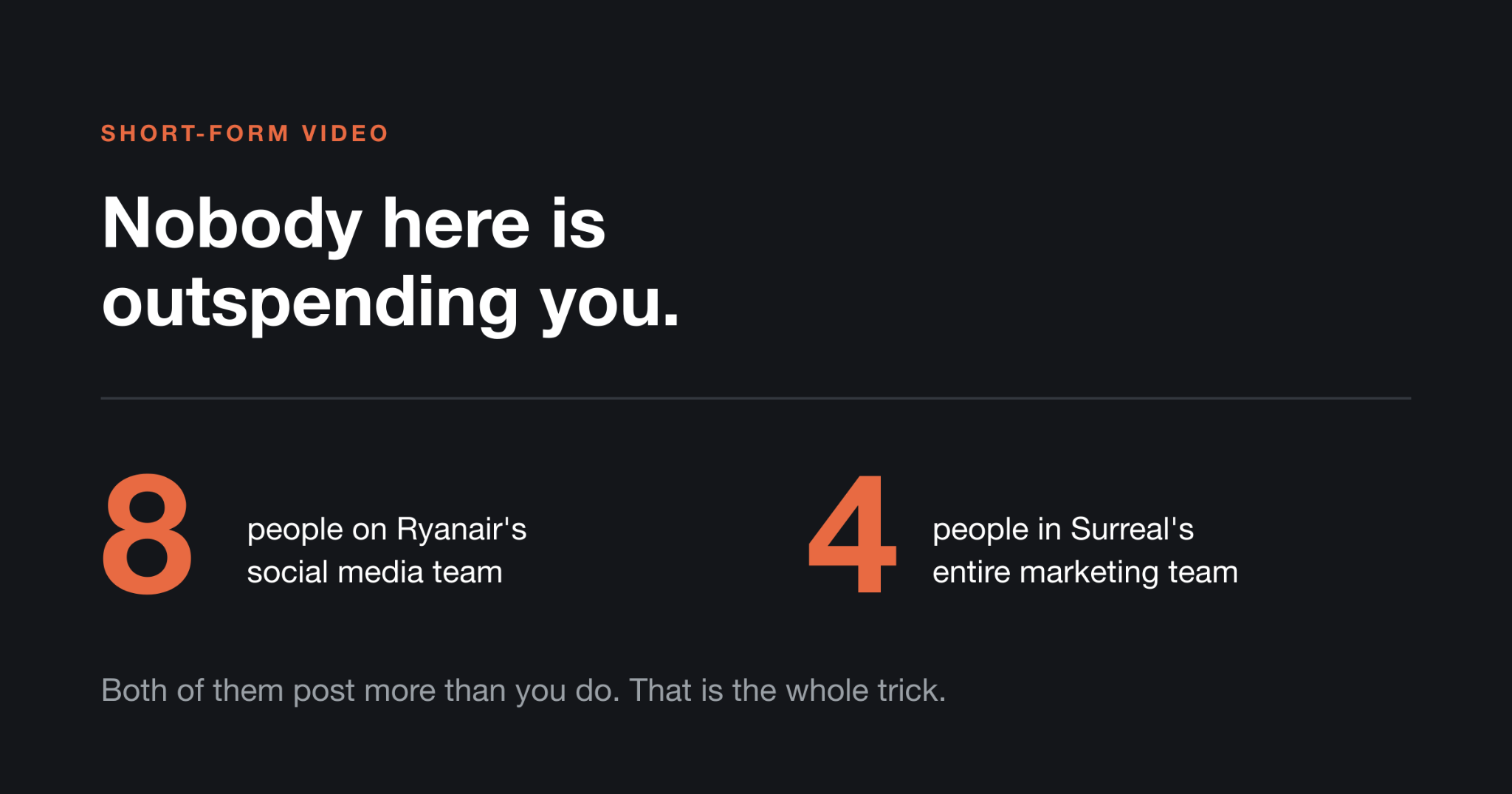
Neither company is funnier than your team. They are just structurally capable of posting on Tuesday the thing they thought of on Tuesday.
Where does a software company get that much footage?
From the product. This is the bit that gets missed constantly.
Ryanair has an endless supply of cheap raw material because a plane is a set. A cereal box can be filmed on a desk in four minutes. Software companies own raw material that is better than either and use it almost never: the product, on screen, doing the thing.
Not a description of the thing. The thing. Everyone in your category writes the same six adjectives on their homepage, adjectives cost nothing to write, and so nobody believes any of them. Footage of software actually working is evidence rather than assertion, and evidence is rare enough that people stop for it.
Capturing it takes about four minutes. No crew, no studio, and no requirement that you appear on camera, which matters more than people admit, because a good share of founders would rather do almost anything than be in their own marketing.
What most software companies have instead is one demo video made two years ago, a logo animation, and nothing else. The cheapest asset they own is the one they never point a recorder at.
What is the smallest version of this that works?
Sort everything you make into two piles and treat them completely differently.
Durable. The screen recording. Capture the single most satisfying thing your product does. One screen, one job. Resist covering four features, because a tour of an interface teaches a stranger nothing about why they should care. You build this pile slowly and you keep it.
Consumable. The three to six seconds in front of it that give somebody a reason to watch, and the caption. You burn through this pile constantly.
When a post stops performing, and it will inside a fortnight, do not remake the video. Keep the recording, swap the opener, post it again. That single habit is the whole difference between publishing weekly and publishing daily, and it costs nothing but attention.
Four practical rules while you are in there:
Assume the sound is off, because most of the feed is watched muted, so the on-screen text is not a caption on the video, it is the video. If the meaning collapses without audio, the post is not finished.
Get the product on screen inside the first six seconds. Openers that run longer stop being setup and become a different video that happens to end with your product.
Keep the whole thing under about forty five seconds.
And keep a running note of openers. When something stops you in your own feed, write down its structure, not its words. After a month you will have thirty, which is more rotation than most funded marketing teams get through in a quarter.
What you cannot fake
Never let the text on screen claim a number the screen does not show. Not a percentage, not a user count, not hours saved. It reads perfectly well and it is a lie, and one screenshot from an unimpressed customer makes it a public one. If a claim cannot be grounded in the footage, cut the line rather than soften it.
The same applies to the people in your openers, if you generate them. What gives generated video away is almost never resolution. It is composition. Real selfie footage is shot with the phone about thirty to forty centimetres from the face, slightly off axis, with fragments of a room behind it. Generated footage defaults to portrait distance, level with the eyes, against a tidy composed background. Photoreal, and obviously fake, for reasons a viewer feels before they can name.
So: 40 to 60 a quarter. Bought at market rate that is a line item you will not approve. Built from footage you already own, it is an afternoon and a habit.
The companies winning your category are not outspending you. They just stopped treating video as something you commission and started treating it as something you run.
Quick answers
How many videos does an app need per week? Three to five posts a week is a realistic floor for an app with no audience, which works out at 40 to 60 pieces a quarter. The number matters less than the fact that the set expires, so plan for rotation rather than for one launch film.
How much does a short-form marketing video cost in 2026? Buying it from a creator runs $50 to $500 per video, with the benchmark near $198 and product demos at $200 to $350, plus 50 to 100 percent of the base fee again for a year of usage rights. Producing it from footage you already own costs an afternoon.
How long should an app marketing video be? Under about forty five seconds, with the product visible on screen inside the first six.
Do you have to appear on camera to market an app? No. A screen recording of the product carries the video, and the opening seconds can be carried by something else entirely. Platforms rank on watch time and completion, not on whether a face is in frame.
Why do app videos stop working after a week? Short-form creative in the user-generated style fatigues in roughly 7.6 days. The demo behind it stays useful, so the fix is to change the opening seconds rather than remake the video.