How Small Online Stores Can Build Social Media Presence Without a Big Budget

How Small Online Stores Can Build Social Media Presence Without a Big Budget
Small online store owners assume social media requires large budget. Assume paid ads. Assume influencer partnerships. Assume expensive tools. This assumption is false. Social media presence can be built on zero budget. Presence can be built on minimal budget. Presence can be built efficiently. Efficiency is what separates successful small stores from struggling ones. Budget matters less than allocation. Allocation matters more than size. Small stores with smart allocation outperform large stores with dumb allocation. This is the reality small store owners need to understand.
The Budget Reality: What Really Works for Small Stores
Large stores have budget to waste. Large stores buy followers inefficiently. Large stores run ads blindly. Large stores optimize slowly. Small stores cannot waste. Small store budget must work. Every dollar must deliver results. This constraint forces efficiency. Efficiency is competitive advantage. Small stores that master efficiency beat large stores that rely on budget. This is the small store advantage in 2026.
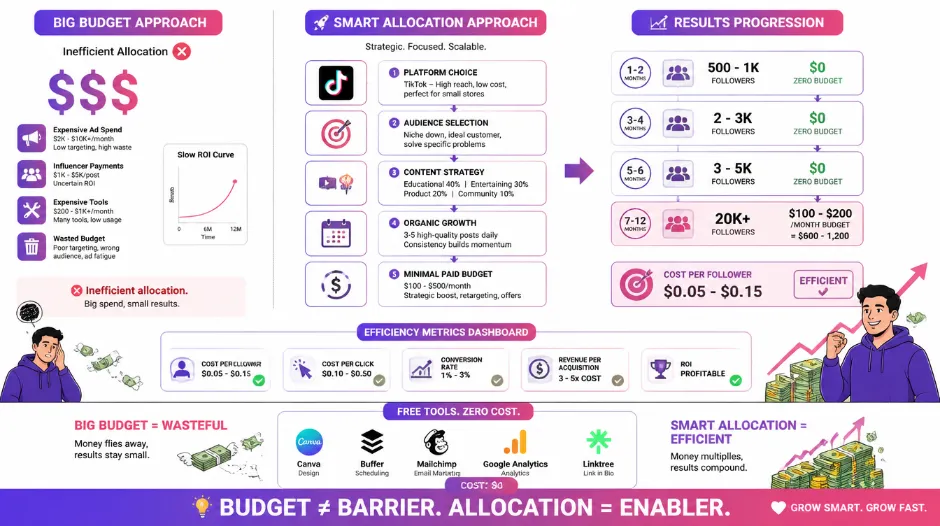
Budget hierarchy for small stores: Platform choice > Audience selection > Content quality > Paid acceleration. Get platform choice right (cheapest growth). Get audience selection right (most responsive audience). Get content quality right (free but valuable). Then allocate small paid budget to accelerate. This hierarchy transforms zero budget into meaningful presence.
The Platform Choice: Highest Organic Growth Potential
Different platforms have different organic growth potential. TikTok: algorithm shows content to new users regardless of follower count. Organic growth is free and fast. Instagram: algorithm shows content to followers. Organic growth is slow and requires already having followers. Facebook: organic reach is near-zero. Paid ads required. Pinterest: organic reach is high but slow. YouTube: organic reach depends on algorithm but takes months.
For small stores on budget: TikTok is superior. Algorithm removes budget barrier. Content can go viral with zero followers. New store can reach 50,000 followers in 3-6 months organically. Same store on Instagram would take 12-24 months. Same store on Facebook would need $5,000+ budget. TikTok is budget-conscious platform. Choose TikTok as primary platform.
The Audience Selection: Targeting Highest Intent Customers
Small stores cannot afford to buy audience broadly. Must target narrowly. Must target highest intent. Must target customers already interested in product category. This targeting is free. Use existing customer data. Look at who already buys from you. Build audience around that demographic. Use hashtags relevant to target audience. Use keywords relevant to target market. This is free targeting that large stores overlook.
Example: Small jewelry store sells handmade rings. Instead of targeting "jewelry" broadly (which is huge), target "#etsyjewelry #handmaderings #minimalistjewelry #alternativering". Targeting 10,000 people interested in alternative rings converts better than reaching 1,000,000 people interested in jewelry broadly. Conversion from targeted audience is 10-20x higher. Small stores win through targeting, not volume.
The Content Strategy: Free Content That Builds Audience
Content Type 1: Educational Content (40% of posts)
Teach audience something related to your product category. Not about your product. About the space. This content is free to create. Free to post. High engagement. Attracts audience. Examples: "5 mistakes when buying [product]" "How to care for [product type]" "What experts don't tell you about [category]" Educational content builds authority without selling.
Content Type 2: Behind-the-Scenes (30% of posts)
Show product creation process. Raw footage. Mistakes. Learning. Audience loves behind-the-scenes because it's authentic and free to produce. Smartphone video is sufficient. Editing is minimal. Production cost is zero. Engagement is high.
Content Type 3: Customer Stories (20% of posts)
Feature customer using your product. Ask happy customers to submit photos or videos of them using product. Repost their content. User-generated content is free to create. Authenticity is high. Engagement is high. Customers love being featured. This builds community.
Content Type 4: Promotional (10% of posts)
Show product. Show offer. Show link. Keep promotional content minimal. If promotional content exceeds 15-20%, engagement collapses. Small stores fail because they post too much promotion, not enough value. Inverse the ratio: 70-80% value, 20-30% promotion.
The Minimal Paid Budget: Smart Allocation ($100-500/Month)
Once organic foundation is built (5,000 followers, consistent engagement), allocate small paid budget. Budget allocation depends on platform and goal.
Allocation 1: TikTok Creator Fund ($50-100/Month)
Run small ad campaigns on TikTok promoting top-performing organic content. Take videos that got 50,000+ views organically. Boost them with $50-100 budget. Cost per view drops to $0.001-0.005. Clicks to store are cheap. ROI is high. This is most efficient paid spend for small stores.
Allocation 2: Instagram Engagement Acceleration ($25-50/Month)
Use buy Instagram likes for stores strategically. Not to fake engagement. To amplify real posts. Post content. If content is good (high organic engagement), boost with $25-50 of engagement. This pushes post to explore page. Explore page traffic drives organic followers. Strategic engagement amplification is investment in organic reach, not vanity metric.
Allocation 3: Facebook Ads Targeting ($25-50/Month)
Facebook ads are expensive per click but highly targetable. Use affordable social media growth approach: run micro-targeted ads to specific demographic. Spend $25 on 1,000 impressions to right audience. If conversion rate is 1%, that's 10 clicks for $25. For $0.25/click cost. ROI depends on product price but micro-targeting keeps cost low.
Allocation 4: Influencer Micro-Partnerships ($25-100/Month)
Do not spend on large influencers. Find micro-influencers (10K-50K followers) in your niche. Offer free product for honest review. One micro-influencer partnership reaches 10K-50K people for free product (cost: $10-50 depending on product). This is 5-10x more efficient than large influencer.
The Organic Growth Timeline: Building Presence on Zero Budget
Month 1-2: Foundation Building
Post 3-5 times daily on TikTok. Post educational and behind-the-scenes content. No promotion. Build to 500-1,000 followers purely through organic content. This takes 4-8 weeks depending on niche. Cost: $0. Time commitment: 1-2 hours daily creating and posting.
Month 3-4: Growth Acceleration
Continue 3-5 daily posts. One post goes viral (10,000+ views). Viral post brings 500-1,000 new followers. Momentum starts. Channel grows to 2,000-3,000 followers. Cost: $0. Growth is purely algorithmic.
Month 5-6: Audience Engagement
Audience reaches 3,000-5,000 followers. Engagement rate improves (comments, shares increase). Introduce customer story posts. User-generated content increases. Community is forming. Cost: $0. Growth is organic + network effects.
Month 7-12: Paid Acceleration (First $100-200 Budget)
Audience is 5,000-10,000 with engaged community. Introduce minimal paid budget. Allocate $100-200 monthly across platforms. Amplify top posts. Run small targeted ads. Budget extends organic reach. Audience reaches 20,000+ by month 12. Cost: $100-200 × 6 months = $600-1,200 total investment for 20,000 followers. Cost per follower: $0.03-0.06.
The Niche Reality: Different Stores Have Different Strategies
Fashion stores: TikTok + Instagram dual approach. Styling content is currency. User-generated styling content is goldmine. Budget allocation: 70% TikTok ads, 30% Instagram engagement boost.
Beauty stores: Instagram + TikTok equally important. Before-after content is gold. Tutorial content is valuable. Budget allocation: 50% Instagram engagement, 50% TikTok ads.
Tech/niche stores: TikTok for discovery, YouTube for education. Product reviews and tutorials drive sales. Budget allocation: 60% TikTok ads, 40% YouTube sponsorships with micro-creators.
Home/decor stores: Pinterest + Instagram. Pinterest has high organic reach for home decor. Budget allocation: 50% Instagram engagement, 50% Pinterest ads (cheapest platform per impression).
Service stores: TikTok for awareness, email for conversion. Educational content about your service category. Budget allocation: 70% TikTok ads, 30% email platform tools (Mailchimp free tier).
The Efficiency Metrics: What Actually Matters
Small stores measure wrong metrics. Count followers. Count likes. Count comments. These are vanity metrics. Real metrics: Cost per follower gained. Cost per click to store. Conversion rate from traffic. Revenue per customer acquired. ROI on budget spent. Track these metrics. Only these metrics matter.
Target cost per follower: $0.05-0.15 (anything under $0.20 is good). Target cost per click: $0.10-0.50 (varies by niche). Target conversion rate: 1-3% (varies by product). Target revenue per customer: 3-5x cost per acquisition. If you acquire customer for $1 and they spend $5, that is profitable. Efficiency is profitability.
The Tools That Save Money: Free Tools for Small Stores
Canva: Free design tool. Create social posts without hiring designer. Cost: $0. Saves $500+/month on design costs. Buffer: Free social media scheduling. Schedule posts in advance. Cost: $0. Saves time. Mailchimp: Free email marketing. Free email list building. Cost: $0. Builds repeat customer base. Google Analytics: Free website traffic analysis. Understand where customers come from. Cost: $0. Informs strategy. Linktree: Free link aggregation. Multiple links in one bio. Cost: $0. Drives traffic efficiently.
Using free tools, small store can build professional presence costing $0-200/month instead of $2,000-5,000. This is small store advantage.
The Growth Ceiling Without Budget: When You Need to Invest
Small stores can reach 50,000 followers on zero budget if content is good and niche is responsive. Beyond 50,000 followers requires paid budget. Growth plateaus without investment. This is natural. Once audience is established and engaged, small paid budget extends reach exponentially. Budget becomes more efficient with larger audience. Early stage (0-50K followers) is free/cheap. Growth stage (50K-500K followers) requires budget. Scale stage (500K+ followers) requires significant budget or viral content.
The Bottom Line: Budget Is Not Barrier, Allocation Is
Small online stores can build significant social media presence on zero budget if allocation is smart. Choose right platform (TikTok). Create right content (70% educational/value, 30% promotional). Target right audience (narrow, high intent). Execute consistently (daily posting). Small paid budget ($100-500/month) accelerates growth. Cost per follower is low ($0.05-0.15). Cost per customer is reasonable ($1-5). Budget is not barrier. Smart allocation is enabler. Small stores that understand allocation beat large stores that rely on budget. This is 2026 reality.