Why on-demand manufacturing is becoming viable for small businesses across 3D industries
The logic of on‑demand manufacturing has always been attractive: produce something only after someone has ordered it. No inventory risk. No minimum order quantities. No money tied up in products that might never sell.
For physical goods, this model remained elusive. The cost of creating a single unique item, whether a 3D‑printed prototype, a custom mould or a short‑run production part, was simply too high. The economics demanded scale.
A similar logic applies to digital assets. A game needs hundreds of unique characters. An AR experience needs multiple scene variants. An e‑commerce site needs 3D models for every product SKU. In each case, the bottleneck is the same: creating a usable 3D model has historically required specialised software, skilled labour and significant time.
AI 3D model generators are now unpicking this bottleneck. By compressing the time from concept to usable geometry, they are making on‑demand production viable across multiple industries that depend on 3D assets.
The traditional bottleneck: 3D assets are hard to make
Consider the range of businesses that depend on 3D models:
- A game studio needs characters, props and environments. Each one must be modelled, textured and rigged. Outsourcing is expensive. Building an in‑house team takes time.
- An AR agency creating filters or visualisers needs to adapt assets for different contexts. Every variation means new modelling work.
- An e‑commerce brand wanting 3D product views faces a simple arithmetic problem: if modelling one SKU costs several hundred pounds, a catalogue of thousands becomes unaffordable.
- A product designer or maker seeking a single 3D‑printed part finds that the model often costs more than the print itself.
In every case, the underlying problem is the same. The act of creating a 3D model is a fixed cost, incurred before anything else can happen. That cost limits experimentation, reduces variety and pushes businesses toward safer, more generic choices.
How AI changes the equation
AI 3D model generators approach this differently. They do not require the user to understand topology, edge flow or UV mapping. They take a photograph or a text description and return a complete, usable 3D model.
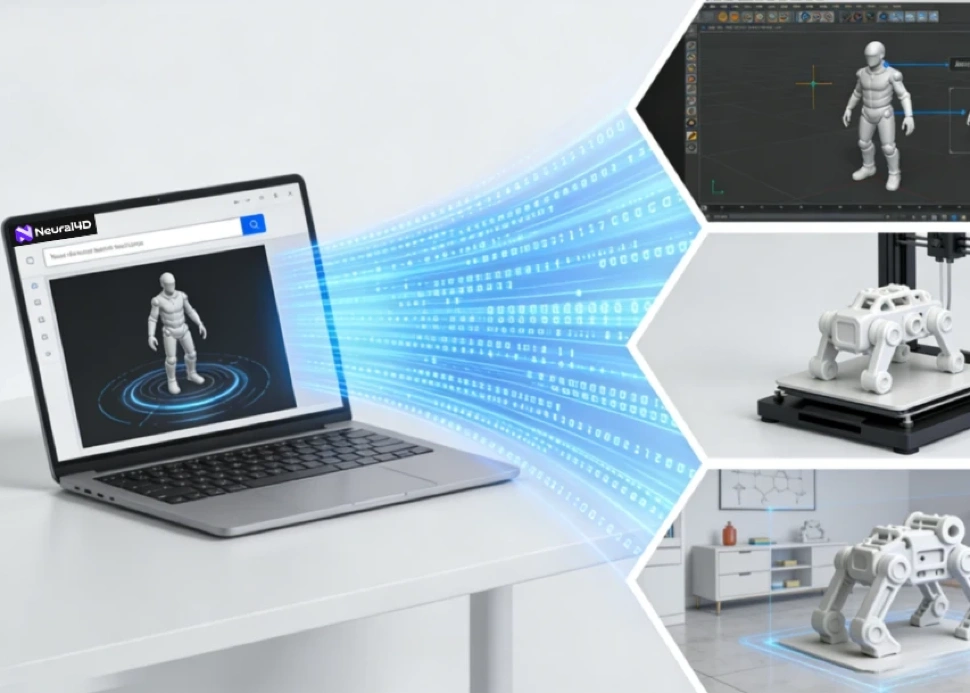
Take Neural4D as an example. A user uploads a reference image or writes a short description. Within 90 seconds, the platform returns a model that is watertight, structurally coherent and exportable in standard formats such as STL, OBJ or GLB.
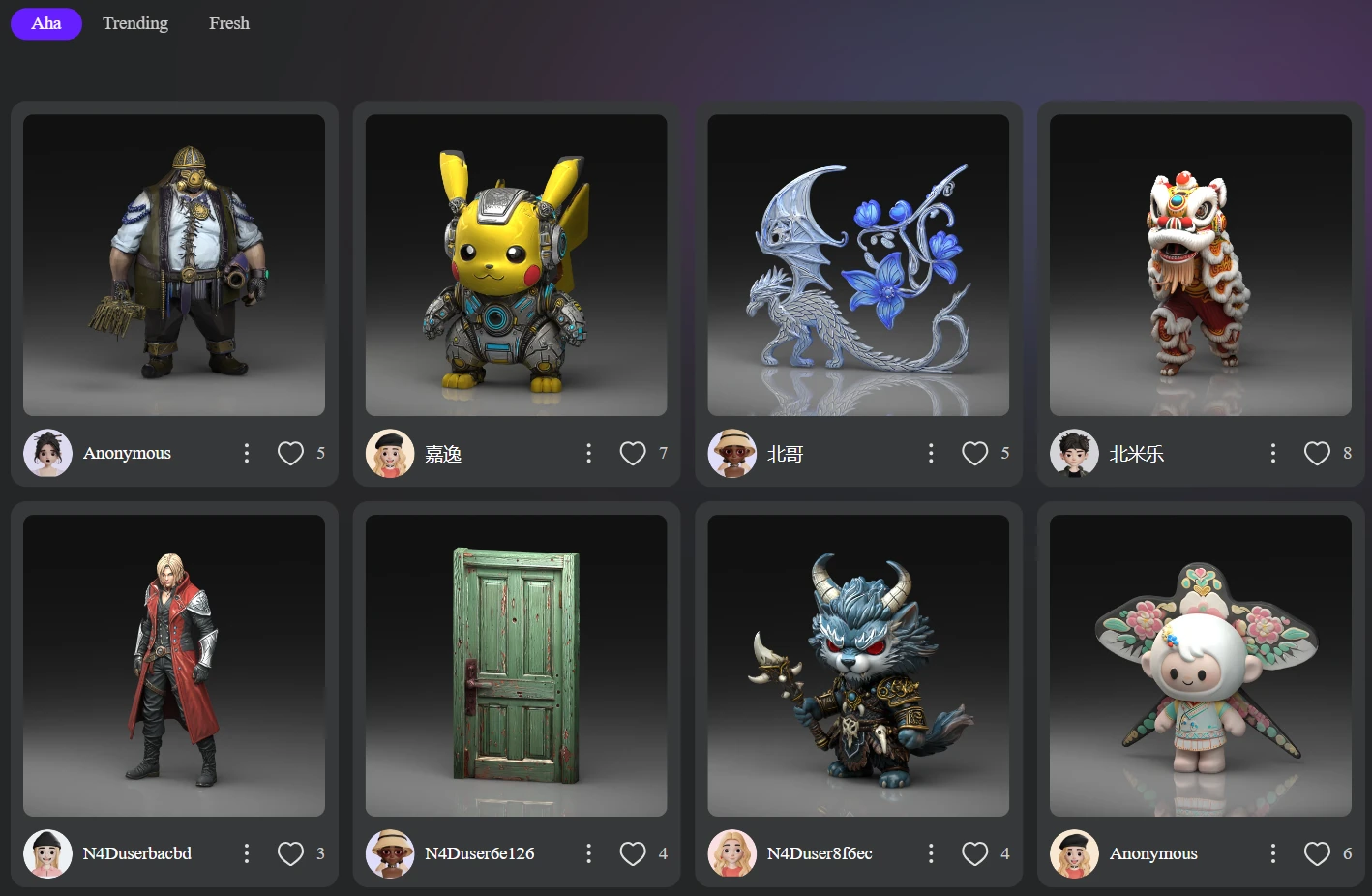
For different industries, this output lands differently:
- For a game developer, the model can be generated with a pre‑built skeleton, reducing the time from concept to animated character.
- For a 3D printing service, the model arrives ready for slicing. No manual repair, no non‑manifold errors, no failed prints caused by bad geometry.
- For an AR/VR creator, the model can be imported directly into engines like Unity or Unreal, accelerating content iteration.
- For an e‑commerce team, generating a 3D view for a new product becomes a matter of minutes, not weeks.
What “on‑demand” now means across industries
The phrase “on‑demand manufacturing” has traditionally referred to physical production. But the same logic applies wherever 3D assets are required.
In 3D printing, on‑demand means a customer can describe a custom part, have it generated instantly and sent to print. No design fees. No back‑and‑forth. No minimum run.
In game development, on‑demand means assets can be generated as needed. A procedurally generated world no longer needs a library of pre‑made parts. The parts themselves can be created on the fly, each one unique.
In AR and VR, on‑demand means rapid iteration. A designer can generate multiple stylistic variants of a scene, test them in context and refine the ones that work.
In e‑commerce, on‑demand means every product can have a 3D view. The marginal cost of generating a model for a new SKU approaches zero.
This shift is made possible by two capabilities that tools like Neural4D-2.5 provide:
- Speed. A model in 90 seconds, not days.
- Editability. Once a model exists, it can be refined through natural language instructions. “Increase wall thickness by 0.5 mm.” “Change the material to brushed metal.” “Add a mounting bracket to the rear face.” The model changes deterministically, without starting over.
What this means for small businesses
For a small business operating in any of these spaces, the implications are practical rather than theoretical.
- Lower cost of experimentation. A new product idea, a new game character, a new AR scene - each can be tested for the cost of a few API calls. If it doesn't work, nothing is lost.
- Faster time to market. The gap between concept and usable asset shrinks from weeks to minutes. That speed translates directly into competitive advantage.
- Broader product lines. When the cost of creating a new variant is negligible, offering more choice becomes viable. A business can test what customers actually want by making multiple versions available.
- Zero inventory risk. For physical products, this is obvious. For digital assets, the principle is the same. Assets are created when they are needed, not held in anticipation of demand.
- Personalisation as default. When generating a unique model costs the same as generating a standard one, offering custom variants becomes a normal part of the proposition, not a premium add‑on.
Conclusion
The traditional economics of 3D asset production forced businesses to think in terms of fixed costs and minimum viable runs. A model had to be worth the investment, whether it was destined for a printer, a game engine or a website.
That logic is now shifting. AI 3D model generators are turning asset creation from a capital expense into an operational one. The cost of a unique model is no longer a barrier. It is a marginal line item.
For small businesses across games, AR/VR, e‑commerce and product design, this means the question is no longer “can we afford to make this?” It is “What should we make next?”
On‑demand manufacturing, in its fullest sense, is no longer a future concept. It is a workflow that can be adopted today.