What's the best platform to monitor and control AI crawler access (robots.txt enforcement, rate limiting, CDN/WAF rules)?
AI crawlers generate over 50 billion requests per day across Cloudflare's network alone. GPTBot, ClaudeBot, PerplexityBot, and dozens of other AI user agents are hitting your site right now, and most companies have zero visibility into which bots are doing what. Worse, a misconfigured robots.txt can block AI crawlers entirely, killing your chances of showing up in AI-generated answers before the conversation even starts.
Managing crawler access requires layering three things: monitoring which bots are visiting and what they're doing, diagnosing crawl and rendering failures, and controlling what different bots actually see.
Multiple AEO platforms now offer AI bot tracking and crawler diagnostics alongside their visibility features, but the depth varies significantly. Some give you a full workflow from traffic intelligence to content delivery. Others give you a dashboard and leave the rest to your engineering team.
This article compares five tools across the AI crawler monitoring and content delivery stack: Scrunch, Adobe LLM Optimizer, Botify, Ahrefs Bot Analytics, and Profound Agent Analytics. Each gets a breakdown of standout features, strengths, limitations, and pricing.
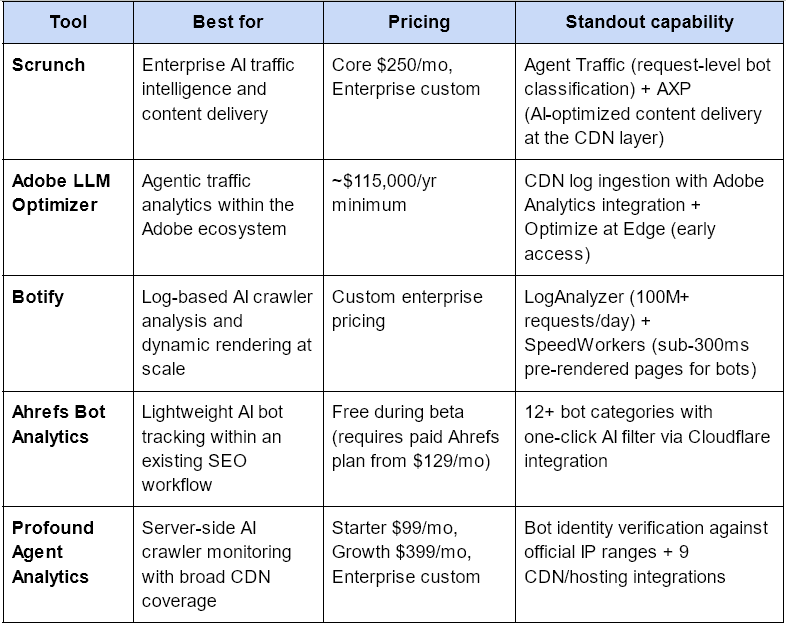
Scrunch: Best for enterprise AI traffic intelligence and content delivery
Scrunch is a full-stack AI visibility platform trusted by 500+ companies, including enterprise brands like Lenovo, Akamai, and ADP. For crawler access specifically, the relevant features are Agent Traffic, Site Maps, Page Diagnostics, Deep AI Audit, and AXP.
Standout features
Agent Traffic. Tracks which AI bots crawl your site, how often, and which pages they hit. Breaks traffic down by request type: retrieval (live user prompts triggering a bot to fetch content), indexer (building a search index), and training (scraping for model improvement). Shows top agents, top pages, human vs. bot comparisons, and a chronological request log with timestamps, bot type, page path, and request status. Integrates natively with Akamai, AWS CloudFront, Cloudflare, Fastly, Vercel, and WordPress (plus HubSpot CMS, BigCommerce, Shopify, Squarespace, Uberflip, Webflow, and Wix via Cloudflare proxy).
Retrieval traffic is the one to watch most closely. It's a real-time signal that a human just prompted an AI about something related to your brand, and a bot is visiting your site to pull the answer.
Site Maps. A visual tree of your website with per-page data: Audit Score, Agent Traffic, Citations, and AI Referrals. Drill into any page to see bot access status across all major AI models, what AI agents see vs. what humans see, and which prompts should cite that page but don't. This is the entry point for the full workflow: spot underperforming pages, audit them, optimize, and deploy via AXP. Supports up to 5,000 pages depending on plan.
Agent Experience Platform (AXP). AXP auto-detects AI traffic at the CDN layer and serves AI-optimized HTML to bots while humans see the unchanged site. It strips JavaScript, restructures content, and reduces token count by multiple orders of magnitude. Search engine crawlers like Googlebot and Bingbot aren't routed to AXP, so traditional SEO indexing stays untouched.
AXP also includes behavior rules that let you block specific pages from AI access, redirect AI traffic to alternative content, augment pages with additional context, redact sensitive information, and target specific platforms or bot types. This is the closest thing on this list to granular AI access control built into an AEO platform.
Page Diagnostics. Shows which AI bots have access to a given page, recent AI agent activity (most active agent, last agent crawl, etc.), search index status, and what your page looks like for humans vs. bots. It's the quick at-a-glance check for any individual page.
Deep AI Audit. Goes deeper, diagnosing access controls (can AI bots reach the page?), content delivery (can content be delivered without JavaScript?), and content quality, then flagging JavaScript rendering failures, metadata gaps, robots.txt misconfigurations, and content structure issues with actionable fixes. Core plans include 5 audits per month. Enterprise plans unlock full site audits.
Strengths
Full workflow in one platform. Monitor (Agent Traffic), diagnose (Page Diagnostics and Deep AI Audit), optimize (Optimizer), deliver (AXP). Most tools on this list handle one or two of these stages. Scrunch covers all four without requiring separate vendors or engineering handoffs.
CDN-layer operation, no engineering changes to the existing site. AXP and Agent Traffic plug into your existing CDN. There's no code to deploy on the origin server and no changes to the live site.
Documented results. Akamai saw 85% more citations and a 364% increase in brand presence for associated non-branded prompts after deploying AXP, representing nearly 5x growth in brand presence. In ChatGPT alone, Akamai's brand presence vs. competitors increased by 133%.
Enterprise-grade infrastructure. SOC 2 Type II certified, SAML/OAuth SSO, RBAC, and audit logs.
Limitations
AXP is on Enterprise plans only (custom pricing). Core plan users get Agent Traffic and Page Diagnostics but can't deploy the content delivery layer.
Requires CDN integration for Agent Traffic and AXP. If your site isn't behind a supported CDN, you can't access these features.
No network-level access enforcement. Scrunch controls what AI bots see (via AXP behavior rules), but it doesn't enforce allow/block/rate-limit rules at the network level. Teams needing hard enforcement still need their CDN's native WAF or bot management tools.
Pricing
Core starts at $250/mo (4 LLMs, 125 prompts, 5 audits/mo). Agency Core at $500/mo. Enterprise is custom (9 LLMs, full site audits, AXP, SSO). 7-day free trial available (credit card required, not charged until after trial).
Adobe LLM Optimizer: Best for agentic traffic analytics within the Adobe ecosystem
Adobe LLM Optimizer is an enterprise AEO application within Adobe Experience Cloud. It pairs brand presence monitoring with agentic traffic analytics via CDN log ingestion.
Standout features
Agentic traffic dashboard. Ingests CDN logs and tracks AI bot visits to your site. Distinguishes crawler vs. chatbot agent types, surfaces URL-level performance, success rates, and error patterns. Shows traffic distribution across markets, categories, and page types. Filters let you slice by time period, user agent, market, and URL category.
Error monitoring and weekly audits. Monitors HTTP error responses (403 Forbidden, 5xx) returned to AI agent user agents, including crawlers from ChatGPT, Claude, Perplexity, and Gemini. A weekly automated audit surfaces URLs returning errors to AI agents, so you can catch crawl access issues before they compound.
Referral traffic tracking. Connects AI visibility to downstream engagement and conversion metrics via CDN-side tracking and Adobe Analytics integration. This is where being inside the Adobe ecosystem pays off: agentic traffic data flows directly into Adobe Analytics for unified reporting alongside traditional web metrics.
Optimize at Edge (Early Access). Serves optimized HTML to AI agents at the CDN layer without modifying the origin CMS. Conceptually similar to Scrunch's AXP: human visitors and SEO bots see the unchanged site, while AI agents receive AI-friendly content. One-click deployment is available for AEM Sites customers. For non-AEM setups, configuration requires CDN routing rules (Fastly VCL snippets, Cloudflare Workers, etc.).
URL Inspector. Identifies blocked or inaccessible pages and provides prescriptive recommendations for robots.txt and CDN configuration changes.
Strengths
Unified analytics pipeline. Agentic traffic, referral traffic, and brand presence data all feed into Adobe Analytics. If your team already lives in the Adobe stack, this eliminates the dashboard-switching problem.
Optimize at Edge addresses the same content delivery gap as AXP. It's one of only two tools on this list (alongside Scrunch) that can serve different content to AI agents at the CDN layer.
Weekly automated error audits catch crawl access issues proactively. Most tools on this list require you to check manually.
Limitations
Requires Adobe ecosystem investment for full value. One-click deployment requires AEM Sites. CDN log ingestion and referral traffic tracking require Adobe Analytics or Customer Journey Analytics. Without the broader Adobe stack, you're paying enterprise prices for a fraction of the functionality.
Entry price of approximately $115,000/year (minimum 1,000 prompts, annual contract). No monthly or self-serve option. For context, Scrunch's Core plan starts at $250/mo and Profound's Starter at $99/mo.
Optimize at Edge is still in Early Access, not generally available. Feature scope and stability may change.
Tracks 6 AI platforms (ChatGPT, Google AI Overviews, Google AI Mode, Copilot, Gemini, Perplexity). Does not appear to track Claude, Meta AI, or Grok.
Pricing
Prompt-based annual licensing. Minimum 1,000 prompts/year. Estimated starting price of approximately $115,000/year. Free trial available for existing AEM Cloud and Adobe Analytics customers (limited to 100 prompts, one domain, and 10 URLs for optimization).
Botify: Best for log-based AI crawler analysis and dynamic rendering at scale
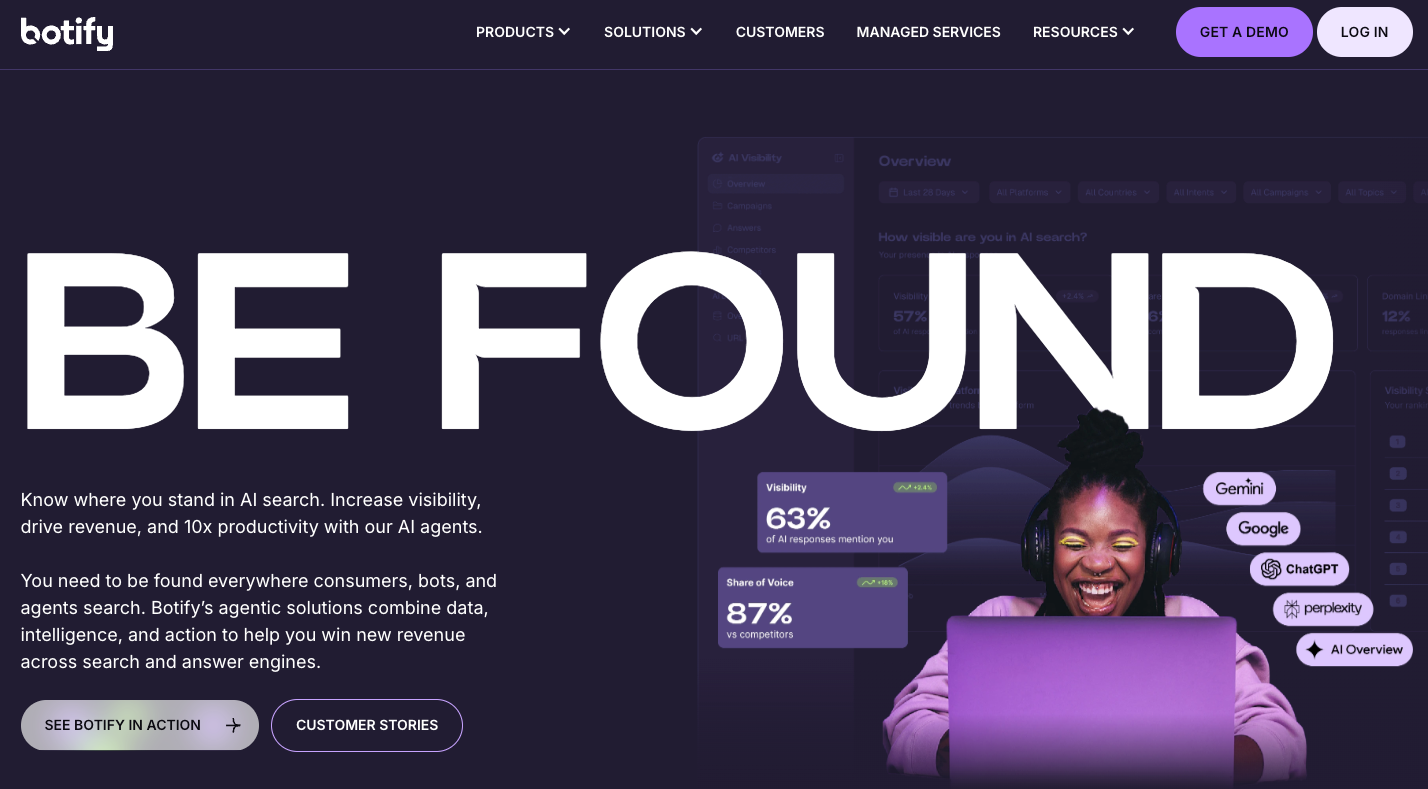
Botify is an enterprise AI search optimization platform with deep roots in technical SEO. For AI crawler monitoring and content delivery, the relevant features are LogAnalyzer and SpeedWorkers.
Standout features
LogAnalyzer. Ingests raw server log files from your CDN and analyzes every bot request hitting your site. Tracks a comprehensive directory of AI bots: GPTBot, ChatGPT-User, OAI-SearchBot, PerplexityBot, ClaudeBot, Claude-User, Claude-SearchBot, Google-Agent, Meta-ExternalAgent, AmazonBot, Bytespider, CCBot, and traditional search crawlers. Categorizes bots by purpose: Training (GPTBot, ClaudeBot, Bytespider, CCBot), AI Assistant (ChatGPT-User, PerplexityBot), and Indexation (OAI-SearchBot, AmazonBot). Handles up to 100M requests per day with up to 18 months of log data retention. Daily refresh.
Because LogAnalyzer works from first-party server logs, it captures every request and response, including status codes, timestamps, and URL-level crawl patterns. You can filter by bot type, drill into URLs crawled by specific agents, and visualize trends over time.
SpeedWorkers. Pre-renders and caches fully rendered pages, then serves them to bots at under 300ms. This solves the JavaScript rendering problem: AI crawlers that can't execute JavaScript see the fully rendered page instead of an empty shell. SpeedWorkers handles bot requests separately from user traffic, so increased crawling doesn't overload your servers. One important caveat: serving to AI bots through SpeedWorkers requires a Bing contract. SpeedWorkers serves to Google by default, but AI bot support is bundled with the Bing add-on.
AI Visibility dashboard. Tracks brand appearance across AI platforms (Google AI Overviews, Gemini, with expanding coverage through 2026). The AI Discovery report compares AI bot crawl behavior with Google Search Console impressions to surface pages that aren't showing up in AI search despite getting traditional search visibility.
Agentic Feeds (tech preview, March 2026). Automates AI-optimized product data feeds for retailers. Currently available to a select group of retailers, with GA planned for the second half of 2026. One major retailer is already using it to deliver AI-optimized feeds for more than one million products.
Strengths
The deepest log file analysis on this list. Up to 100M requests per day, comprehensive AI bot directory, and 18 months of historical data. If you need to understand exactly what every AI crawler is doing on your site at the URL level, LogAnalyzer is purpose-built for it.
SpeedWorkers solves JavaScript rendering with measurable results. Pre-rendered pages served in under 300ms. One customer reported a 170% traffic increase year-over-year after deployment.
Established enterprise platform. 500+ brands. Named a Strong Performer in The Forrester Wave for SEO Solutions (Q3 2025), with top scores in 11 criteria including AI-integrated SEO and workflow automation.
MCP-compatible agent integration via Botify Assist, which lets teams interact with their data through natural language.
Limitations
Primarily a technical SEO platform. AI visibility monitoring (brand presence, share of voice, citations) is limited compared to dedicated AEO tools. If you need full AI visibility analytics alongside crawler monitoring, you'll need a separate tool.
SpeedWorkers pre-renders existing pages, it doesn't restructure them. It ensures bots see your page as-is, fully rendered. Scrunch's AXP transforms what bots see, stripping JavaScript, restructuring content, and reducing token count. These are different approaches to the same problem, and the right choice depends on whether your content just needs rendering or optimization.
Bot categorization is fixed per bot name, not per request. LogAnalyzer classifies GPTBot as "Training" and ChatGPT-User as "AI Assistant" based on the bot identity. Scrunch classifies traffic by request type (retrieval, indexer, training), which is more granular when a single bot serves multiple purposes.
No dedicated robots.txt audit for AI bots. LogAnalyzer surfaces bot behavior data to inform decisions, but identifying specific misconfigurations requires manual review.
Pricing
Custom enterprise pricing. Annual contracts. No published rates. Industry estimates put mid-market deployments at $75,000 to $150,000 per year, with large enterprise deals exceeding $400,000 per year. No free trial.
Ahrefs Bot Analytics: Best for lightweight AI bot tracking within an existing SEO workflow
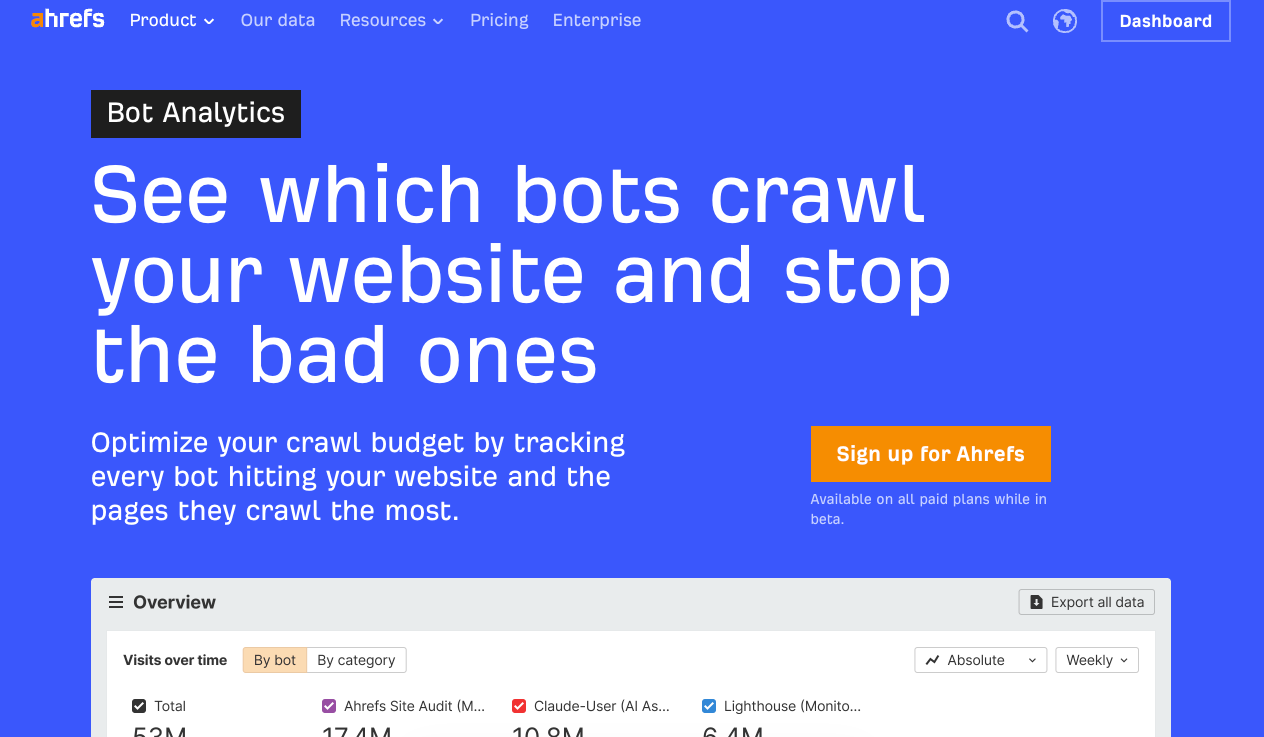
Ahrefs Bot Analytics is a new feature (launched February/March 2026, currently in beta) that shows which bots crawl your site, how often, and which pages they hit. It requires a Cloudflare integration.
Standout features
Bot tracking across 12+ categories. Tracks bots across AI assistants, AI crawlers, search engines, SEO tools, social platforms, security bots, advertising bots, monitoring tools, service agents, feed fetchers, and more. A one-click "AI bots" toggle isolates AI crawler traffic across all reports, so you can instantly filter out everything except AI-related activity.
Four reports. Overview (top-level summary of all bot activity), Bots (traffic broken down by individual bot, e.g., Googlebot, GPTBot, ClaudeBot), Categories (traffic grouped by bot type), and Crawled Pages (which URLs bots are hitting most). Configurable time granularity: hourly, daily, weekly, or monthly. Export as CSV or Google Sheets.
Page Inspect. Hover over any URL in the Crawled Pages report to view page content and historical changes, so you can check what bots actually see when they crawl it. Page Inspect data comes from AhrefsBot.
Server-side tracking via Cloudflare. No JavaScript required. Works independently from Ahrefs Web Analytics without affecting your existing setup. Connect via Cloudflare Logpush (for high-traffic sites, requires Cloudflare Enterprise) or a Cloudflare Worker (works with any Cloudflare plan).
Strengths
Zero additional cost during beta for existing Ahrefs subscribers on any paid plan. If you're already paying for Ahrefs, this is free to turn on.
Simple and focused. Setup takes seconds via Cloudflare integration. No log file uploads, no CDN configuration beyond the initial connection. You get bot data immediately.
Natural complement to Ahrefs' SEO tools. Bot Analytics sits alongside Site Explorer, Web Analytics (which now includes AI traffic segmentation), and Brand Radar (AI visibility monitoring). If your team already runs its SEO workflow in Ahrefs, bot tracking fits right in.
12+ bot categories with one-click AI filter. The AI bots toggle is a small feature that saves real time. Instead of manually filtering through dozens of bot types, one click shows you exactly what AI crawlers are doing on your site.
Limitations
Monitoring only. No diagnostics, no robots.txt auditing, no content delivery or optimization. Bot Analytics tells you what's crawling your site. It doesn't tell you why a page is failing to render for AI bots, and it doesn't help you fix it.
Cloudflare-only. Sites not on Cloudflare can't use it. Ahrefs says more data sources are coming, but for now this is a hard dependency.
Categorizes bots by platform type (AI Crawler, AI Assistant), not by request intent. Less granular than Scrunch, which classifies at the request level (retrieval, indexer, training), or Botify, which categorizes by purpose (Training, AI Assistant, Indexation).
Separate from Brand Radar. Bot Analytics and Brand Radar (Ahrefs' AI visibility monitoring) are complementary but not connected into a unified crawler-to-citation workflow. You can see what's crawling your site in one tool and how you appear in AI answers in another, but there's no automated link between the two.
Beta. Feature set may change. No guarantee on long-term pricing or availability.
Pricing
Free during beta. Requires a paid Ahrefs plan (Lite starts at $129/mo). Setup via Cloudflare Logpush requires a Cloudflare Enterprise plan; the Cloudflare Worker method works on any Cloudflare plan.
Profound Agent Analytics: Best for server-side AI crawler monitoring with broad CDN coverage
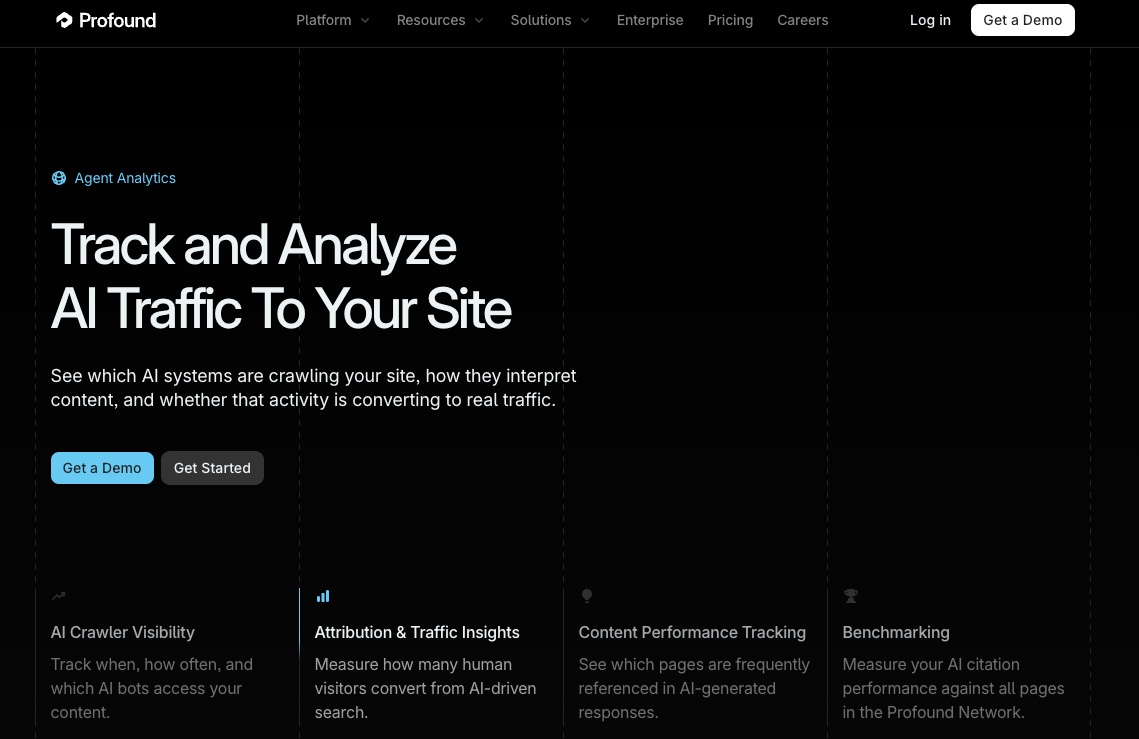
Profound is a dedicated AEO platform that includes Agent Analytics, a server-side AI crawler monitoring feature available on all plans. It ingests server-side logs through native CDN and hosting integrations.
Standout features
Broad CDN and hosting integration. Integrates with Akamai, AWS CloudFront, Cloudflare (Workers or Logpush), Fastly, Google Cloud Platform (Cloud CDN), Netlify, Vercel, and WordPress. Unlimited domains on all plans. This is the widest integration list on this comparison for server-side AI crawler tracking. Setup is straightforward: most integrations take minutes, and Profound is officially listed in the Vercel Marketplace for one-click installation.
Bot identity verification. Profound doesn't just read user agent strings. Bot classification uses multi-step verification: user agent matching, IP range checks against official ranges published by OpenAI, Anthropic, Google, and others, reverse and forward DNS lookups, ASN lookups, and behavioral pattern matching. This filters out spoofed traffic, so the data you're acting on reflects real AI crawler activity.
Bot visit classification. Classifies every verified bot visit into one of three intent types: Citation (the bot is pulling content to answer a live user prompt), Indexing (discovering and cataloging content for future use), and Training (reading content to improve the model). Live log view surfaces every AI visit within seconds. Tracks URLs visited by AI platform, crawl frequency, and paths crawled vs. not crawled. Daily refresh.
Attribution and traffic insights. Connects crawler activity to human referral traffic and conversions, so you can see whether AI bot visits are translating into actual site traffic.
Content submission. Pushes new content directly to AI crawlers for faster discovery, rather than waiting for bots to find it on their own crawl schedule.
Citation Network. Benchmarks your citation performance against 100,000+ pages in the Profound network, giving you a relative sense of how your site stacks up.
Technical Analysis. Flags slow load times, rendering issues, and blocking scripts (similar in scope to Lighthouse). This is a diagnostic report only; implementation is on your engineering team.
Strengths
Available on all plans, including Starter ($99/mo). Agent Analytics isn't gated behind an enterprise tier. Even the entry-level plan includes crawler monitoring, which makes Profound the lowest-cost option on this list for getting server-side AI bot visibility.
Most CDN/hosting integrations on this list. Eight named partners plus WordPress. Teams running multi-cloud or hybrid infrastructure can consolidate AI crawler data into a single view.
Bot identity verification adds a layer of trust. Spoofed AI user agents are a real problem. Profound's multi-step verification (IP ranges, DNS lookups, ASN checks, behavioral patterns) means you can trust that the data reflects actual AI crawler behavior, not bots pretending to be GPTBot.
HIPAA compliant alongside SOC 2 Type II. The only tool on this list with HIPAA compliance, which matters for healthcare and regulated industries.
Limitations
No content delivery layer. Technical Analysis is diagnostic only. There's no equivalent to Scrunch's AXP or Botify's SpeedWorkers. Profound can tell you what's broken, but fixing it and controlling what AI bots see requires separate tooling or your engineering team.
Starter ($99/mo) is limited. ChatGPT only, 50 prompts, 1 seat, 1 region, 1 language. Multi-platform monitoring requires Growth ($399/mo) or Enterprise.
No robots.txt auditing or access rule management. Like most tools on this list, Profound monitors what bots are doing but doesn't help you configure or enforce access rules.
Pricing
Starter at $99/mo (ChatGPT only, 50 prompts, 1 seat). Growth at $399/mo (3 AI platforms, expanded prompt limits). Enterprise is custom (10+ AI platforms, unlimited seats, SSO/SAML, dedicated support, Prompt Volumes). Agent Analytics is included on all plans. No free trial.
.jpg)