5 Post-Quantum Security Providers for Institutional Crypto Trading Platforms

Quantum computing has moved from science fiction to a boardroom deadline. Google’s security team now pegs “Q-Day” as early as 2029—just three years from today—forcing financial CISOs to revisit every key and certificate. The alarm grew louder when Caltech researchers showed that about 10 000 stable qubits could topple the elliptic-curve signatures that protect Bitcoin and Ethereum wallets. In short, attackers can harvest encrypted ledgers now and read them later.
Regulators have noticed. Agencies on both sides of the Atlantic already ask large institutions to present post-quantum migration plans during routine audits; ignoring that mandate risks a costly blend of technical and compliance fallout.
Fortunately, a new cohort of vendors now ships production-ready defenses. In this guide, we rank the five partners best positioned to shield exchange wallets, low-latency APIs, and MPC custody flows—using criteria built for traders, not academics.
You’ll leave with a clear pecking order, a feature matrix ready for the board, and a phased roadmap to harden your crypto stack before the clock runs out.
How we ranked the field
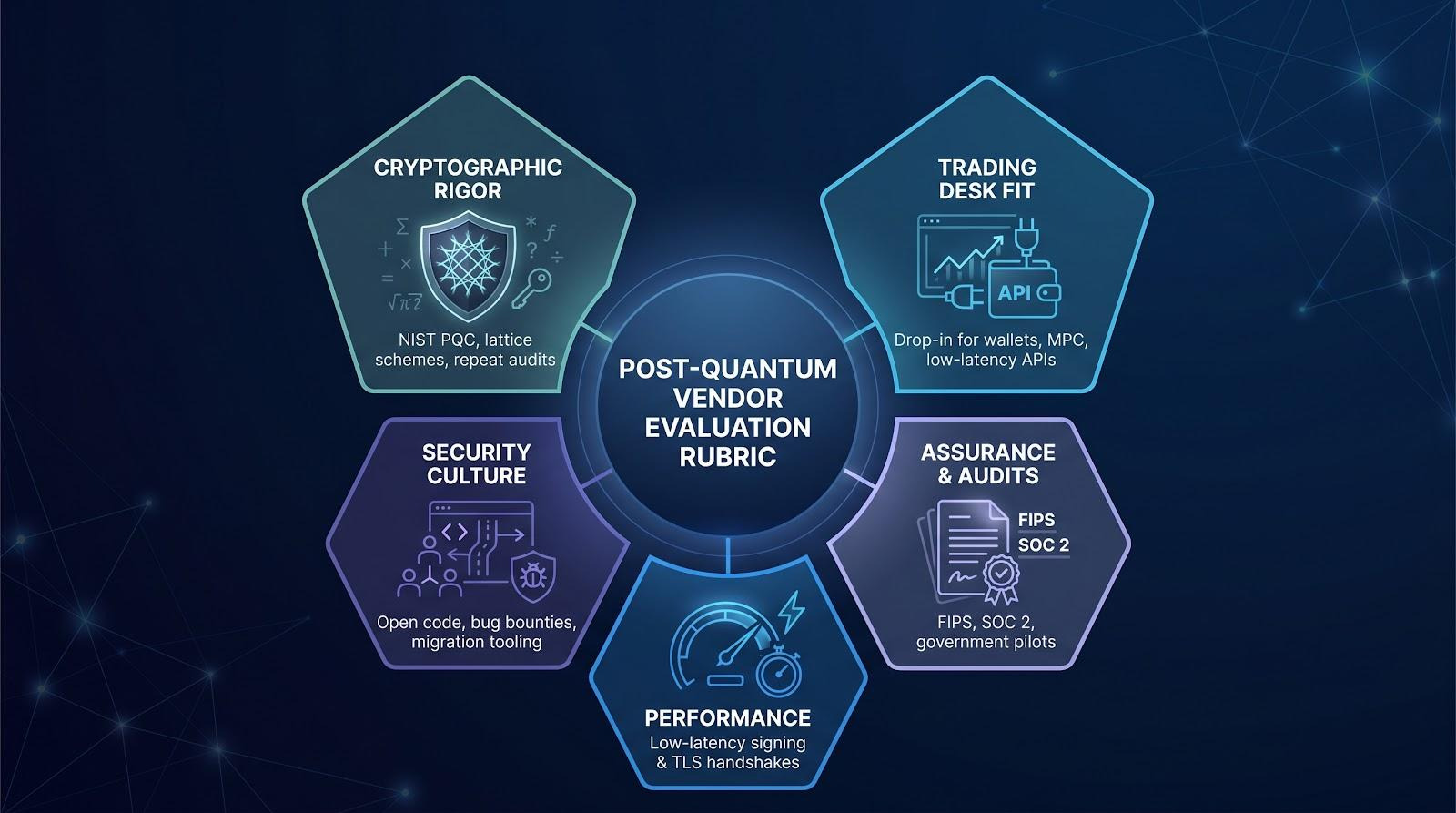
Before we score any vendor, you need to understand the rubric. We reviewed white papers, audit reports, and production pilot data to separate marketing polish from engineering substance.
Cryptographic rigor came first. Every provider had to ship at least one NIST-endorsed lattice scheme (Dilithium for signatures, Kyber for key exchange) and back that claim with repeat audits.
Project 11’s Yellowpages registry cleared that hurdle early.
According to its publicly posted Cure53 report from June 2025, the audit surfaced only four findings—one high-severity design caveat and three informational notes—with no critical bugs across twelve pages of testing and code review.
For readers assembling a vendor-due-diligence kit, that level of transparency (full PDF plus GitHub commit hashes) sets a simple litmus test: if a provider cannot match Project 11’s disclosure depth, treat the claim as unproven.
Next, we focused on fit for trading desks. Does the product drop into exchange wallets, MPC custody flows, or latency-sensitive APIs without custom hardware? If integration takes longer than a sprint, grades fall.
The third pillar was assurance. FIPS validations, SOC 2 reports, and government pilots show a vendor can pass a Big Four review.
Fourth, we measured performance. Candidates needed to keep signing operations and TLS handshakes within normal SLA envelopes (milliseconds, not seconds).
Finally, we scored security culture: open-source code, live bug bounties, transparent roadmaps, and practical migration tooling. Weighting these five factors produced a rank order you can present to your CISO with confidence.
1. Project Eleven: turning quantum fear into practical insurance
Project Eleven is the newcomer traders mention most, and for good reason. Founded in 2024 by Bitcoin Core contributors and lattice-math PhDs, the team treats quantum risk as a live incident, not a conference topic. Its Enterprise group conducts Protocol & Cryptography Reviews for layer-1 chains, delivering post quantum security solutions for protocols that audit validator logic, model systemic threats, and chart Dilithium-ready upgrades without disrupting live order flow.
Its flagship tool, Yellowpages, lets an exchange bind a post-quantum key to every customer address, without touching the main chain. If ECDSA fails tomorrow, clients still prove ownership and recover funds with a dormant Dilithium signature.
Yellowpages ships with an open audit. Cure53 reviewed the code line by line and signed off on its security posture in 2025, a level of transparency most rivals only promise. The product also carries a standing one-bitcoin bounty for anyone who can break its demo wallet.
Performance stays intact. Because the quantum-safe key remains inactive during normal trading, live flows keep their current latency profile while the escape hatch waits in reserve.
Finally, Project Eleven’s public “Q-Day Clock” tracks every new qubit milestone, reinforcing the firm’s culture of constant scrutiny and open challenge. For desks that want tangible coverage without rewriting their stack, Project Eleven offers the cleanest first step.
2. SandboxAQ: crypto agility for enterprises with no margin for error
If Project Eleven is the nimble specialist, SandboxAQ is the firm you call when one misstep can trigger a board review.

Born inside Alphabet and backed by almost one billion dollars, the company treats quantum risk as an end-to-end transformation. Its AQtiveGuard platform scans every corner of your stack, flags legacy RSA or ECDSA, and swaps in hybrid Kyber-TLS or Dilithium signatures through automated pipelines. No spreadsheets, no guessing; the inventory updates with each code push and certificate renewal.
Discovery is only half the draw. SandboxAQ pairs the scan with drop-in libraries your DevOps team can wire into trading engines or custody services during a normal sprint. The approach earned trust at the highest levels of government: in late 2025 the U.S. Department of War CIO signed a five-year agreement to deploy AQtiveGuard across its environment.
The résumé continues. SandboxAQ secures classified U.S. traffic, holds SOC 2, and chairs the Quantum-Safe 360 Alliance that shapes migration playbooks. That lineage shortens vendor-risk reviews, an often hidden cost.
Performance also delivers. A recent integration with CrowdStrike Falcon lets AQtiveGuard pull data from endpoints and provide value within the first hour, all without adding latency to order routing.
If you manage thousands of microservices across global data centers, you don’t need another point product; you need orchestration. SandboxAQ keeps every cryptographic system in tune.
3. PQShield: baking post-quantum math straight into your hardware wallet
Software patches are fine until a key leaks from the silicon. PQShield tackles the root cause by shipping lattice-crypto engines that live inside the secure element of a chip.
The company’s edge is academic depth. Its researchers co-authored Dilithium, the NIST-approved signature scheme, then wired that math into reusable IP blocks. Chip makers Arm and NXP have already shown Cortex-M4 prototypes that sign transactions with Dilithium in just a few milliseconds, matching today’s ECDSA speeds.
Integration stays simple. A hardware-wallet vendor licenses the core, drops it into the next silicon run, and exposes the same API your firmware team already uses. From the user’s view nothing changes, except that a future quantum computer now faces a lattice problem instead of a 256-bit curve.
PQShield also ships a cross-platform SDK for back-end HSMs, letting exchanges run dual signatures: classic ECDSA, Dilithium, and a toggle when the chain is ready.
For custody teams who believe real security starts below the firmware layer, PQShield serves as an insurance policy cast in silicon.
4. QuSecure: wrapping every packet in quantum-safe armor
Trading infrastructure depends on fast, private links. A breached VPN or API tunnel can expose strategies long before a quantum attacker cracks a wallet. QuSecure focuses on that gap: data in transit.
Its QuProtect platform installs like a virtual appliance. Traffic hits the gateway, negotiates a hybrid Kyber-TLS session, and crosses the wire wrapped in post-quantum encryption, all without rewriting a single micro-service. The approach is battle tested; the U.S. Air Force, Space Force, and NORAD report 100 percent uptime while using QuSecure’s algorithms on legacy systems, keeping performance well inside the jitter budget of most matching engines.
Proof outpaces promises. In 2023 the company encrypted a live U.S. Space Force satellite feed, showing the stack works even when packets bounce off the ionosphere. Banco Sabadell later used QuProtect to validate post-quantum TLS across its customer-facing infrastructure during a four-month pilot, demonstrating enterprise banking strength, not just government reach.
Day-to-day operations stay simple. A unified dashboard flags any server that falls back to classical ciphers, so teams catch misconfigurations before auditors do. Because the service is cloud delivered, QuSecure pushes new NIST algorithms the moment they are standardized, avoiding midnight patch drills.
For desks that want quantum-safe pipes without hiring cryptography specialists, QuSecure moves the network from risky to resilient in one afternoon.
5. Silence Laboratories: quantum-safe MPC without the migration migraine
Institutional custody relies on multi-party computation, where shards of a private key sit on separate servers so no single box can betray you. Silence Laboratories adds a new twist: each shard now runs a lattice-based signature, so even a future quantum computer faces a combinatorial wall.
The upgrade path stays pleasantly simple. If you already use an MPC wallet, drop in Silence’s library, restart the nodes, and you are done. Policy engines, approval flows, and user devices stay exactly the same. Under the hood, the firm’s ML-DSA algorithm signs a transaction in under one second, proof that post-quantum math no longer slows operations.
Security culture also runs deep. Every release arrives with formal proofs, and the company offers a standing reward for anyone who finds a flaw in its threshold design. That openness builds developer trust and shortens procurement cycles.
Most important, Silence Labs relieves a governance headache. Boards worry about a sudden switch to quantum-safe keys. With this platform you can blend signatures—classical for on-chain compatibility, quantum-safe for cold-storage resilience—and adjust the mix over time. No cliff edge, no panic.
For custodians managing billions, Silence Laboratories delivers quantum protection that feels like a routine patch Tuesday, not a heart transplant.
Side-by-side snapshot: who excels where
You have met the contenders. Now we will stack them against each other, and let the numbers speak for themselves.
Beyond the top five: vendors worth watching
The quantum-security field stretches well past our scorecard. Several specialists deserve a nod because they solve narrow problems with precision or bring hard-won standards experience to the table.
Post-Quantum in the United Kingdom has spent more than a decade refining quantum-safe VPNs and PKI replacements for NATO projects. Their tooling can slip into a private blockchain consortium where certificate sprawl causes real pain.
CryptoNext Security, spun out of French academic labs, offers a ready-to-use library that junior developers can drop into Python or Go services within minutes. If you run a proof-of-concept and need working code fast, their SDK makes the difference.
Qrypt takes a different path. Instead of new math, the firm injects true quantum entropy into key generation, pairing cleanly with any PQC scheme listed above. The result is a stronger root seed with nothing predictable for an adversary to target.
ISARA and Keyfactor push crypto-agility into the forgotten corners of enterprise PKI. If your exchange still relies on X.509 certificates for machine authentication, their dual-signature certs buy valuable breathing room.
These vendors did not reach the top tier on breadth or trading focus, yet each covers a specific blind spot. Depending on your stack, one could be the missing puzzle piece.
The road ahead: ticking milestones between now and Q-Day
We remain in the pre-quantum era, yet the timeline keeps shrinking.
NIST set the pace in 2024 by releasing the first official post-quantum standards, moving Dilithium and Kyber from lab projects to baseline requirements. The publication opened budgets and kicked off every vendor story in this guide.
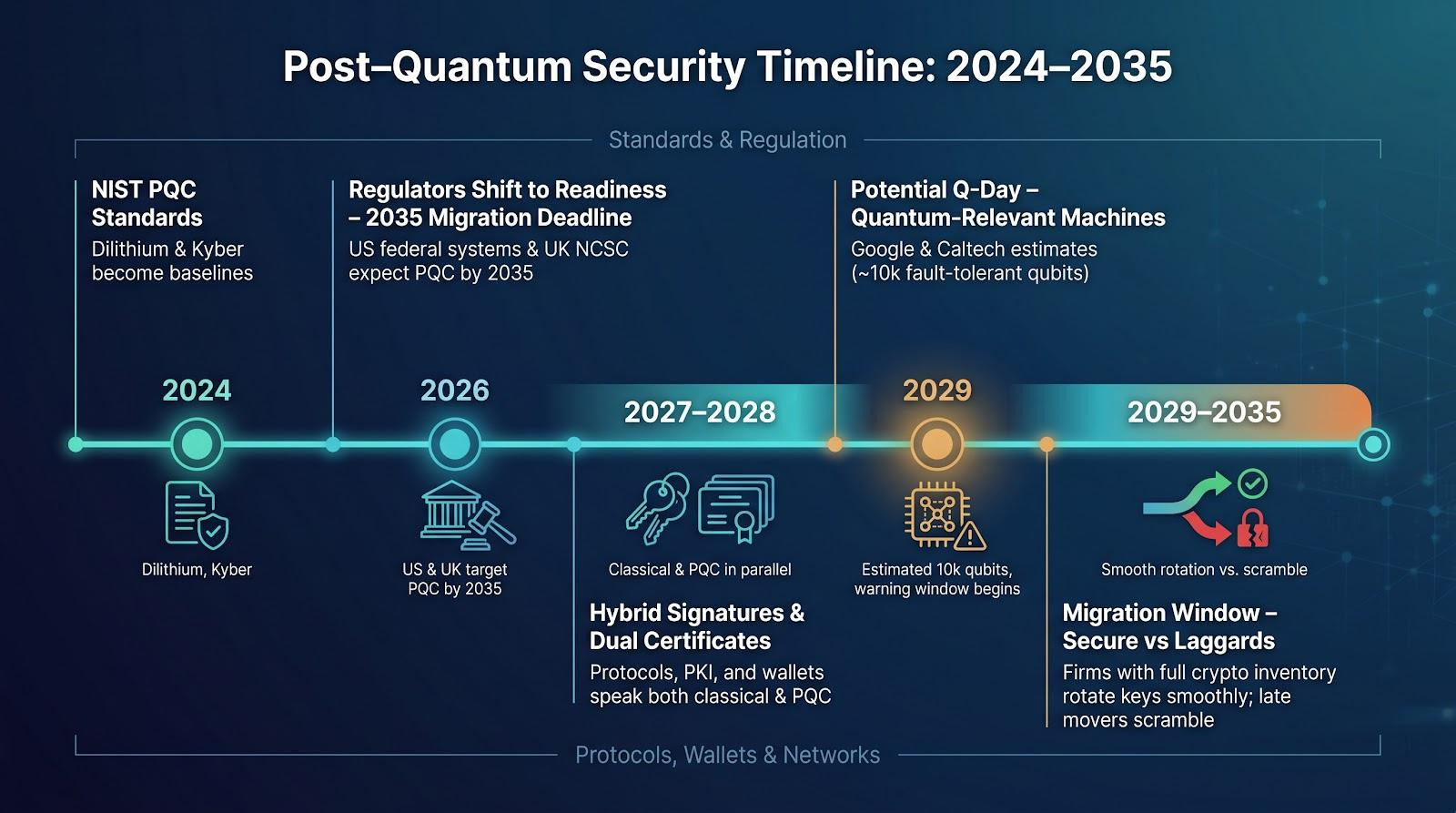
By 2026, regulators shifted from research to readiness. The United States expects federal systems to migrate by 2035, a deadline mirrored by the United Kingdom’s NCSC. Custodians often ride on the same certifications, so missing the date risks being treated like a legacy bank running outdated software.
Researchers then tightened the window. Google’s security team warned that a cryptographically relevant quantum computer could appear as early as 2029, and Caltech calculated that roughly ten thousand fault-tolerant qubits could break common blockchain signatures. The gap between standards and potential attacks has fallen to a few years.
From 2027 through 2028, expect hybrid signatures at the protocol level, dual certificates in enterprise PKI, and a mix of wallet formats across the market. Trading platforms will need to speak both classical and quantum-safe dialects, much like the older shift from IPv4 to IPv6.
The span from 2029 to 2035 will decide who stays secure. If a working quantum rig arrives early, chains such as Bitcoin and Ethereum must already have soft-fork paths in place, or custody layers will act as the last refuge. Firms that finish their crypto inventory by then will rotate keys with minimal fuss, while laggards face a scramble.
Your next moves: a CIO’s quantum-readiness checklist
Start with visibility. Run a crypto-inventory tool and map every RSA, ECDSA, or SHA-2 instance in your trading stack—wallets, gateways, and cron jobs that sign logs. You cannot fix what you cannot see.
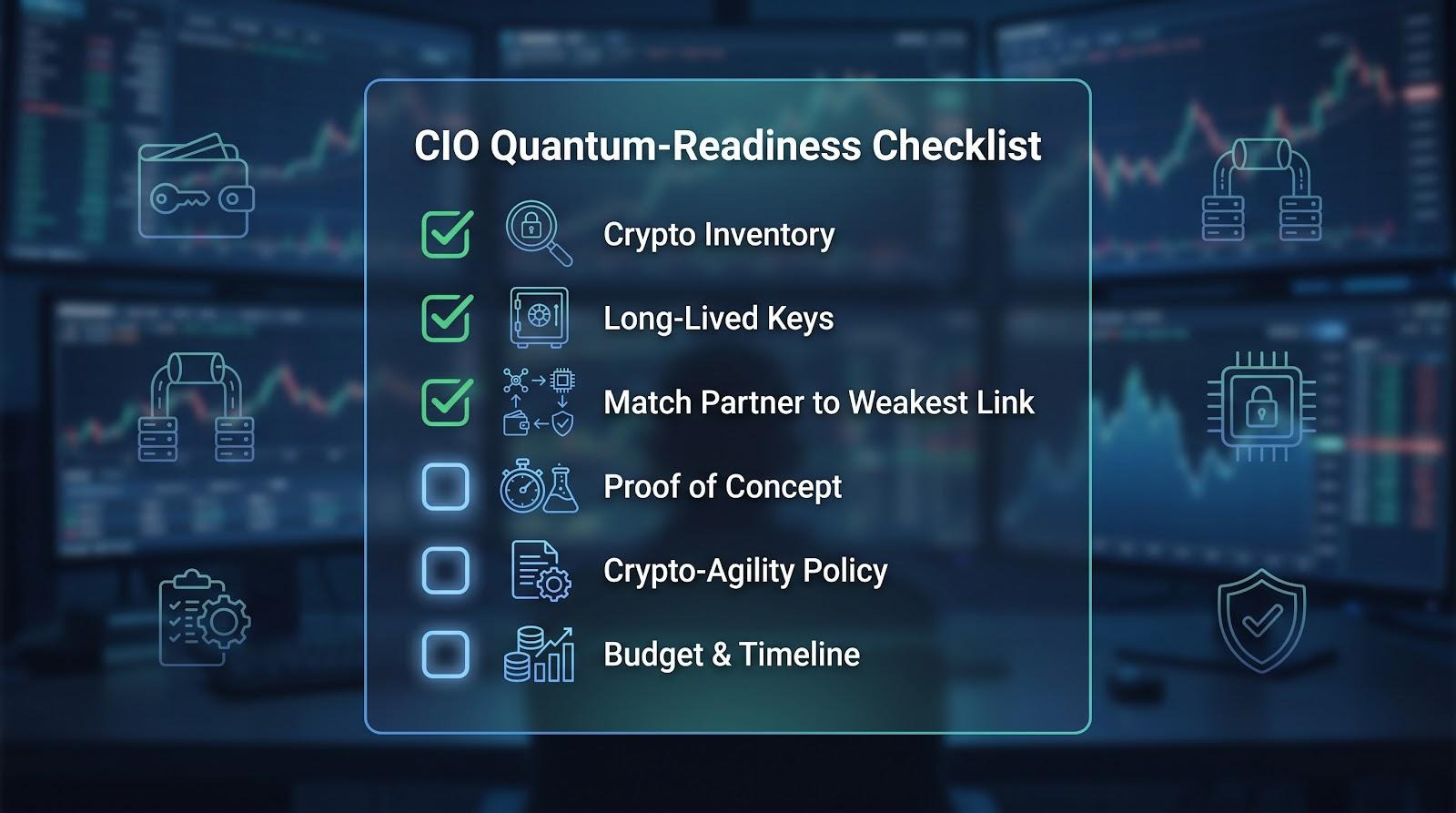
Prioritize long-lived keys. Cold-storage addresses, root certificates, and inter-data-center tunnels stay active for years, so they carry the highest “harvest now, decrypt later” risk.
Match the partner to the weakest link. If network links pose the gap, select QuSecure. If hardware wallets trail, speak with PQShield. Skip generic, all-purpose claims.
Demand a proof of concept. Measure latency, signing speed, and fail-over behavior in your own environment, then share those numbers with the board.
Document a crypto-agility policy. Assign ownership for algorithm updates, define key-rotation cadence, and name the trigger for emergency switchover. Print it, share it, and rehearse it.
Allocate budget today. Migration costs rise each quarter as quantum advances; waiting until Q-Day risks lost assets, not just new line items.
FAQ: straight answers on post-quantum crypto
Is quantum hacking hype or a real threat?
It is real, and the timer is running. Google security engineers place Q-Day as early as 2029, and researchers estimate that about ten thousand fault-tolerant qubits can break common blockchain signatures. Those figures move quantum risk from fiction to a board-level priority.
Can blockchains switch algorithms overnight?
Not realistically. Bitcoin needed four years to adopt SegWit, a far simpler tweak. Moving to lattice-based signatures will require a soft fork, new address formats, and broad wallet support. Custodial layers will provide coverage long before on-chain code changes.
What is the single best first step for an exchange?
Inventory long-lived keys. Cold wallets, HSM roots, and inter-site tunnels hold secrets that attackers can steal today and read later. Map them, insert quantum-safe controls layer by layer, and shrink the blast radius before the first viable quantum computer appears.
Final word on future proofing or falling behind
Quantum risk has left theory. Standards are live, regulators have set the clock, and credible machines continue to advance.
That pressure comes with opportunity. A mature group of vendors now runs post-quantum defenses in production finance, satellite links, and chip fabs. Whether you need off-chain key recovery, network hardening, or silicon-level signatures, practical options exist.
The question is not if you act, but when and how thoroughly. Map your cryptography, choose the partner that closes your biggest gap, and start the migration while you still control the schedule.
Take those steps, and Q-Day will feel like a routine cutover instead of a headline crisis.