The Metal Stamping Process: From Coil to Finished Part
Metal stamping turns flat sheet metal into finished components by feeding it through tooling inside a press. It produces the brackets, clips, contacts, enclosures and housings that sit inside almost everything a factory ships, usually at a unit cost no other process can match once volumes climb.
For manufacturers weighing how to produce a metal part, the process is worth understanding in sequence, because nearly every cost in a stamping project is fixed early, long before the first production run.
It starts with a coil
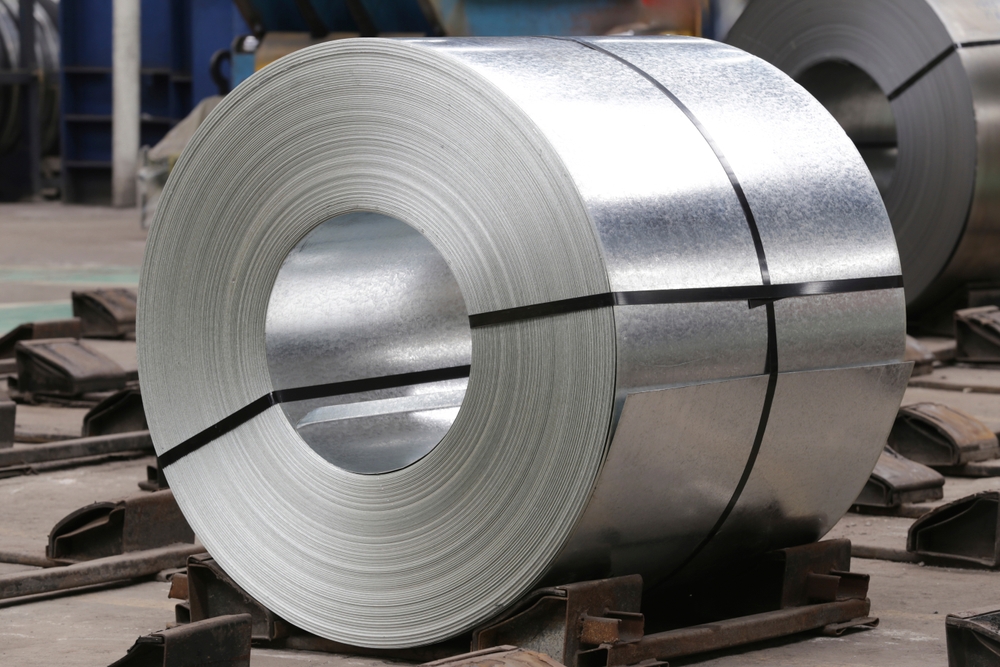
Stamped parts begin as a coil of sheet metal: steel, stainless, aluminium, copper or brass, wound into a roll and fed into the press by an automatic feeder.
Two decisions made at this stage follow the part all the way through. The first is material and thickness, which governs how tightly the metal can be bent before it cracks and how much spring-back to expect once pressure is released. The second is grain direction, the orientation of the metal's internal structure created during rolling. A bend made across the grain holds up; a bend made along it is far more likely to split. On parts with bends in two directions, grain direction decides how the blank is laid out on the strip, and that layout decides how much material ends up as scrap.
What happens inside the press
The press supplies force. The die decides what that force does to the metal.
Every stamping die has two halves. The punch moves, the die stays fixed, and the sheet passes between them. From there the tools diverge, and the types of stamping dies in production use cover blanking dies that cut a flat shape, compound dies that cut and punch in one stroke, forming and bending dies that shape metal without cutting, coining dies for fine detail, and progressive dies that carry a part through a dozen stations in a single pass.
The operations themselves are more limited than the variety of finished parts suggests.
Most real parts combine four or five of these. An electrical enclosure panel might be blanked, punched, embossed for stiffness and flanged on two edges, all inside one die.
Single-hit tooling against progressive dies
The decision that moves a stamping quote more than any other is how many operations happen per press stroke.
Single-hit dies perform one operation at a time, with the part moved between tools by hand or by a robot. The die is cheaper to build, the piece price is higher, and changeovers eat time. It suits low volumes, early production and parts whose design is still moving.
A progressive die feeds the strip through a series of stations, adding a feature at each one, and ejects a finished part at the end of every stroke. The die costs considerably more and takes longer to build, so it only pays back across a long run. For an annual volume in the hundreds of thousands, it usually pays back comfortably.
The mistake worth avoiding is ordering the die for the volume you hope to reach rather than the volume you have committed to. A progressive die built for a forecast that never arrives is expensive idle steel.
Where the cost is actually decided
By the time a quote comes back, most of the cost is already locked into the drawing.
Holes placed too close to a bend distort when the metal moves. Holes too close to the edge tear the material, and features closer together than the die can carry steel between them cannot be punched in one station. Bend radii tighter than the sheet thickness risk cracking, especially in harder tempers and across the grain. Tolerances tighter than the process holds naturally push the part into secondary machining, which removes the reason for stamping it in the first place.
Nesting matters just as much and gets less attention. How blanks are arranged on the strip determines the scrap rate, and on a long run material is often the largest line in the cost. A small change to part geometry that allows tighter nesting can cut material use measurably, and it costs nothing if it is made at the design stage.
After the press
Few stamped parts ship straight off the die. Edges usually need deburring. Threads are tapped as a secondary operation. Parts may need plating, passivation, powder coating or anodising, depending on the material and where the part will live.
Each of these adds handling, time and another chance to damage the part, so they belong in the plan from the start rather than in a scramble after the first sample arrives.
When stamping is the wrong answer
Stamping earns its place through repetition. For prototypes, one-off panels and volumes in the tens or low hundreds, laser cutting and press-brake fabrication almost always cost less overall, because they need no dedicated tooling and a design change means editing a file rather than recutting steel.
Parts with deep three-dimensional form, heavy wall thickness or machined features may suit casting or machining better. And for volumes that sit awkwardly in the middle, it is worth pricing both routes rather than assuming tooling is the cheaper path.
Where the volume genuinely is there, stamping is hard to beat: fast cycles, repeatable dimensions and a piece price that keeps falling as the run gets longer. Getting there depends on the same unglamorous work every time, which is choosing the right material, designing features the press can actually form, and matching the tooling to the volume you have rather than the one on the forecast.