The Most Profitable Crypto Miners in 2026: 7 ASICs Ranked by Real Numbers
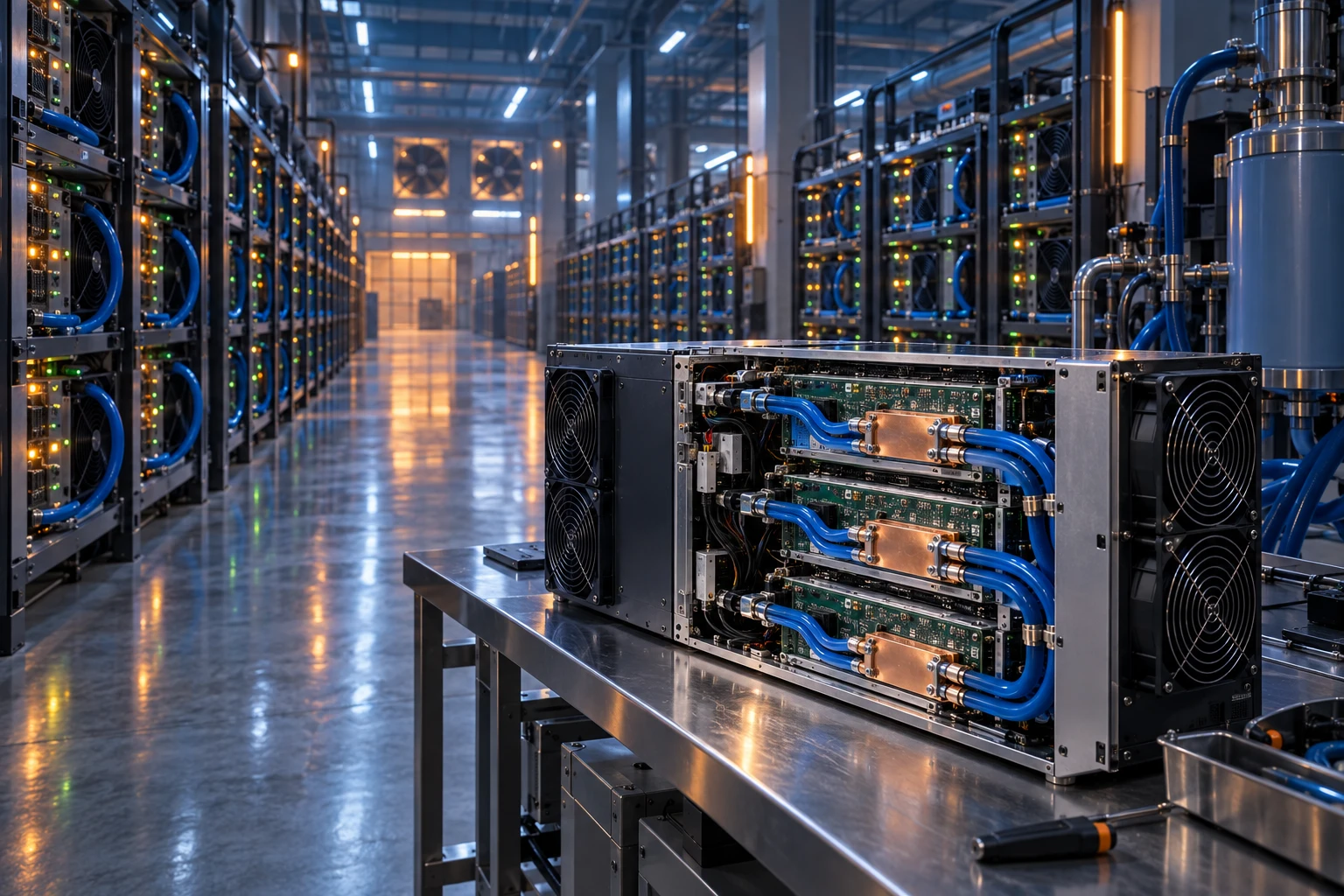
Bitcoin mining had a rough summer. In July the hashprice, the dollar revenue a petahash of computing power earns per day, slid to around $28, low enough to push older machines across the world to switch off. Then the price recovered. By 30 September Bitcoin was trading near $83,200, up roughly 38 percent since June, while network difficulty had risen only about 6 percent. The gap went straight into miners' revenue, and the hashprice climbed back to $39.71.
That rebound makes this a good moment to ask which machines actually make money in 2026. The answer is narrower than the marketing suggests, and it depends far more on electricity than on any brand.
The one number that matters
A miner's profitability comes down to two figures: how much hashrate it produces and how much power it burns to do it. Divide one by the other and you get efficiency, measured in joules per terahash (J/TH). Lower is better.
The arithmetic is simple. A machine's daily revenue is its hashrate in petahashes multiplied by the hashprice. Its daily cost is its power draw in kilowatts, multiplied by 24, multiplied by your electricity price. And the electricity price at which it breaks even is the hashprice divided by 24 times its J/TH rating.
At today's hashprice, that last formula sorts the market brutally:
• Below 10 J/TH: profitable up to around $0.17–$0.19 per kWh.
• Around 12 J/TH: profitable up to about $0.14.
• Around 15 J/TH: profitable up to about $0.11.
• Around 23 J/TH (the S19-generation machines still common in 2024): profitable only below about $0.07.
Residential electricity in Europe and much of the US costs $0.15 to $0.30. In other words, almost nothing on this list is profitable plugged into a wall at home. Mining in 2026 is an industrial-power business, and the machines below are ranked on that basis.
All figures use the 30 September 2026 hashprice of $39.71 per PH per day and exclude pool fees, which typically take 1 to 2 percent. For a ranking that updates with the live price and difficulty, see the Bull Miners profitability table.
The rankings at a glance
1. Antminer S23 Hyd 3U — the best machine for scale
Bitmain's rack-mounted flagship produces 1,160 TH/s at 9.5 J/TH, the highest absolute profit of any Bitcoin miner in this list at realistic hosting rates: about $33 a day at $0.05 per kWh and still almost $25 at $0.08. It is, in effect, two S23 Hyd units in a single 3U chassis designed for data-centre racks.
The catch is everything around it. At roughly $28,000 to $30,000 for the unit itself in September 2026, it also needs a liquid-cooling loop, coolant distribution unit and dry cooler, which can cost as much again. That is a problem for an individual and a non-issue for a hosting facility that already has the plumbing. The Bull Miners S23 review breaks down the full S23 family, real-world wall draw and the hydro-loop costs most spec sheets leave out.
2. WhatsMiner M79S — the biggest single machine
MicroBT's M79S is enormous: 1.35 PH/s from one unit, drawing 20 kW. That gives it the highest gross revenue on the list, over $53 a day. But at 14.8 J/TH it is noticeably less efficient than Bitmain's S23 generation, so its advantage evaporates as power gets more expensive. At $0.05 it earns nearly as much as the S23 Hyd 3U; at $0.08 it earns barely more than half; and its break-even sits at about $0.11 per kWh. It is the right choice only where power is genuinely cheap and plentiful.
3. Antminer S23e Hyd 2U — the dense middle ground
At 865 TH/s and 10.0 J/TH, the S23e trades a little efficiency for a more compact 2U form factor. It earns about $24 a day at $0.05 per kWh and breaks even around $0.165. For operators building out racks of hydro miners, it is the sensible balance between the 3U flagship and single-unit machines.
4. Antminer S23 XP Hyd — the efficiency record, arriving in November
The most efficient Bitcoin miner announced so far: 600 TH/s at 8.9 J/TH, with a break-even near $0.186 per kWh, the highest on this list. It ships in November 2026, priced at about $15,300. In absolute profit it sits below the larger rack machines, but its efficiency gives it the longest runway, which matters a great deal given what is coming in 2028 (see below).
5. Antminer S23 Hyd — the best single hydro unit
The standalone version of the S23 Hyd does 580 TH/s at 9.5 J/TH and earns about $16 a day at $0.05. For a buyer who wants one or two machines hosted rather than a full rack, it offers the same efficiency as the 3U flagship at half the size and a far lower entry price.
6. Antminer S21 XP Hyd — the value pick
Last generation's hydro flagship still earns about $12 a day at $0.05 per kWh and breaks even at $0.138. As S23 machines arrive, S21 XP units are becoming cheaper, which shortens their payback. A sensible choice for buyers who want proven hardware at a lower price and have access to power under about $0.08.
7. Antminer S23 (air-cooled) — the best machine without plumbing
Not every facility runs liquid cooling, and not every buyer wants it. The air-cooled S23 delivers 318 TH/s at 11.0 J/TH, the best efficiency available in a conventional fan-cooled box, with a break-even near $0.15 per kWh. Its daily profit is modest at $8.43 at $0.05, but it can be hosted almost anywhere and sold easily later, and at around $4,900 it is the most accessible machine on this list.
Beyond Bitcoin: the altcoin rigs
Bitcoin is not the only coin worth mining, though altcoin profitability swings much harder with coin prices. Three categories are worth knowing:
• Litecoin and Dogecoin (Scrypt). Machines such as the Antminer L9 at 16 GH/s mine both coins at once through merged mining, which has kept Scrypt among the steadier altcoin markets.
• Kaspa (kHeavyHash). The Antminer KS7 at 40 TH/s for about 3.1 kW is the current leader. With KAS trading near $0.04, returns are thin and highly sensitive to price.
• Zcash (Equihash). The Antminer Z15 Pro has had a strong year as interest in privacy coins revived.
A new generation of RandomX hardware has also appeared for Monero. Treat it with care: Monero's algorithm is designed to keep ordinary CPUs competitive, and the network has a history of changing its rules to discourage specialised machines.
The 2028 problem
The next Bitcoin halving is expected around April 2028, roughly 19 months away. On that day the block reward falls from 3.125 BTC to 1.5625, cutting every miner's revenue roughly in half unless the price rises to compensate. A machine that breaks even at $0.17 per kWh today will break even at about $0.085 afterwards; one that breaks even at $0.11 today will need power below about $0.055.
That is why efficiency, not raw hashrate, should drive a 2026 purchase. The machines at the top of this list will keep running profitably at industrial power prices after the halving. The ones at the bottom may not.
Where you run it matters more than what you buy
The single largest variable in mining profit is not the machine but the electricity price. The difference between $0.04 and $0.12 per kWh is worth tens of thousands of dollars over a miner's life, more than the gap between any two models on this list.
That is why most buyers in 2026 host rather than run machines at home. Bull Miners sells more than 170 ASIC models from Bitmain, MicroBT, IceRiver and others, payable in Bitcoin, USDT and more than 25 other coins, and can either ship a machine to you or host it in one of 21 facilities, with listed power prices from under $0.01 to $0.02 per kWh. You own a specific, serial-numbered machine, it mines to your own pool and wallet, and there is no lock-in contract. Avoid anything sold as "cloud mining" with promised returns: owning the hardware is the honest version of the same idea.
The bottom line
In 2026 the most profitable miners are Bitmain's S23 family and MicroBT's M79S, with the S23 Hyd 3U earning the most at typical hosting rates and the S23 XP Hyd offering the best efficiency and the longest life after the 2028 halving. But no machine on this list is profitable on home electricity, and every one of them earns half as much once the halving arrives. Buy on efficiency, run on cheap power, and check the live numbers before you commit, because the hashprice that made this list possible moved 43 percent in a single quarter.