What Is on Your Car's Surfaces and What Professional Detailing Removes
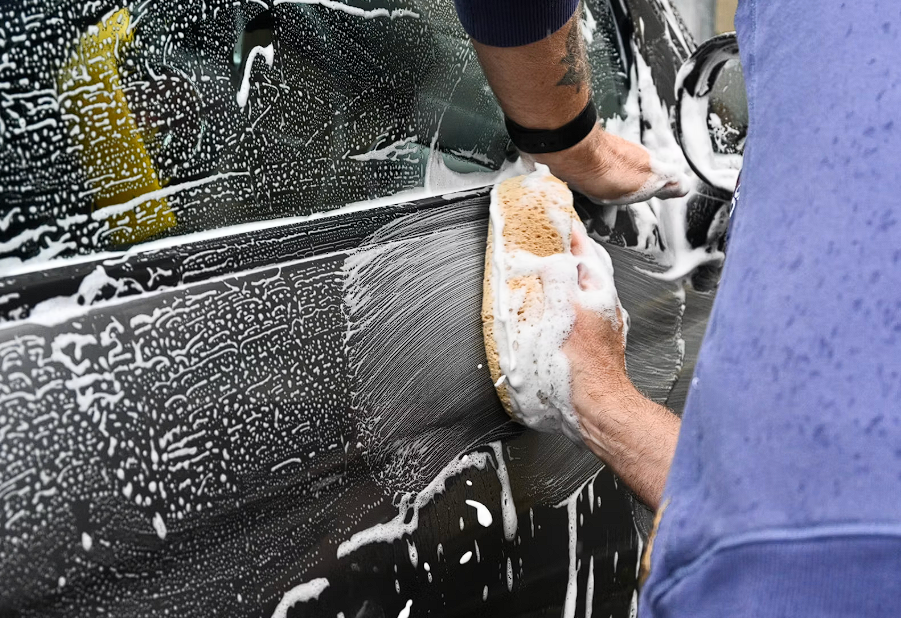
Most car owners clean their vehicles on a basic cycle. A wash, a vacuum, a wipe of the dashboard. This routine removes what is visible.
It does not remove what is embedded.
Professional detailing removes a category of contamination that does not look like dirt, does not respond to car wash soap, and does not disappear with a microfiber wipe. Understanding what that contamination is and what it does to painted surfaces changes how you evaluate the difference between a car wash and a professional detail.
What Is Embedded in the Paint Right Now
Car paint has a layered structure. The base coat provides color. The clear coat protects it. The clear coat is not hard glass. It is a polymeric material with pores.
Over time, several categories of contamination bond chemically or mechanically into the clear coat surface.
Industrial Fallout
Every time a vehicle drives near railroad lines, manufacturing facilities, or even under bridges with corroding steel, fine metallic particles land on the paint surface. These particles include iron compounds from brake dust, industrial exhaust, and rail operations.
When these particles contact the moist paint surface, they begin oxidizing. The oxidation process creates a bond between the particle and the clear coat. Standard car washing removes particles sitting on the surface. It does not remove particles that have oxidized into the clear coat.
The visual evidence: small orange or red dots visible on white or light-colored paint when inspected closely. On dark paint, they are harder to see but still present.
Tar and Road Film
Bituminous road tar, petroleum residue from road surfaces, and the oily film that tires spray onto lower body panels do not respond to standard car wash detergent. They require specific petroleum solvents to dissolve without damaging the clear coat.
Tree Sap and Bird Droppings
Both of these sources contain organic acids. Bird droppings contain uric acid, which etches clear coat at the cellular level within days. Tree sap contains resins that cure on the paint surface and bond tightly when exposed to heat.
Standard washing applied within 24 hours removes both. After that, they begin chemically interacting with the clear coat. After 72 hours, they require compound or clay bar treatment to remove without damaging the paint.
What the Clay Bar Actually Does
A clay bar is a polymer clay compound that mechanically shears embedded contaminants from the clear coat surface without removing the clear coat itself.
The clay is worked across the paint surface in a lubricated gliding motion. The contamination particles that project above the surface plane are caught by the clay as it passes and pulled out of the surface rather than pressed deeper into it.
The test for contamination presence is simple: run a bare hand across the paint surface and feel for roughness, grit, or texture that should not be there on a smooth finish. Then repeat the test with the surface covered by a clean plastic sandwich bag. The bag amplifies the texture, making contamination easier to detect.
After clay bar treatment, the same test produces a distinctly glassy smoothness. That change shows what the clay has removed from the paint and why decontamination comes before polishing or paint correction.
Moxxi’s Auto Detail includes this step when performing Full Car Interior & Exterior Detailing Services in Fort Collins CO, where the exterior surface needs to be clean and free of bonded contaminants before further correction work.
What Paint Correction Removes That Clay Bar Cannot
Clay bar removes surface contamination. It does not remove the defects within the clear coat itself.
The clear coat on most vehicles is between 40 and 100 microns thick. Within this layer, years of car washing with dirty media, automatic car wash brush contact, and parking lot door dings create microscopic scratches called swirl marks.
Swirl marks are visible in direct sunlight as circular patterns across the paint surface. Each mark is a scratch in the clear coat that deflects light differently from the surrounding surface, creating the circular interference pattern.
Paint correction removes these scratches through controlled abrasion. A machine polisher equipped with a cutting pad and polishing compound removes a measured amount of clear coat to bring the surface below the scratch depth.
This requires precision. Each pass removes a clear coat. Remove too much and the base coat is exposed. Remove too little and the scratch remains.
Professional paint correction produces a depth measurement before beginning. The clear coat thickness is measured at multiple points across each panel. The measurements determine how much correction is safe for that specific vehicle.
What Is on the Interior That Most People Do Not Know About
A study and content posted at SFgate states that the average car steering wheel carries approximately 629 colony-forming units of bacteria per square centimeter. The average toilet seat carries approximately 172. The steering wheel is nearly four times more contaminated.
This is not a reflection of poor cleaning habits. It is a reflection of what hands carry and how frequently they contact a warm, textured surface that is rarely disinfected.
Where contamination concentrates:
Seams between steering wheel leather and the structural frame. Gaps between seat cushion panels. Texture grooves in plastic trim pieces. The fabric loops of seat belt webbing. Cargo area carpet backing.
Standard interior cleaning removes surface contamination from accessible flat areas. Professional interior detailing uses steam extraction, enzyme-based biological cleaners, and UV sterilization equipment to address contamination within texture grooves and fabric structures where surface wiping cannot reach.
What Hard Water Does to Glass
Fort Collins receives water from the Poudre River system with moderate mineral content. When this water contacts vehicle glass and evaporates, the minerals remain as deposits.
A single water droplet that dries on glass leaves a ring of calcium and magnesium carbonate at its perimeter. Hundreds of these deposits from rain, irrigation overspray, and car wash rinse water create a haze on glass surfaces over months.
The haze is most visible in low-angle light: during sunrise driving, sunset driving, and when headlights from oncoming vehicles shine through the windshield at night. It reduces visibility and cannot be removed by standard glass cleaners or wiper fluid.
Hard water deposits on glass require acidic treatment to dissolve the mineral bond. The pH of standard glass cleaner is neutral to slightly alkaline. At neutral pH, calcium carbonate deposits do not dissolve. They smear.
Professional glass polishing with the appropriate acidic chemical treatment removes years of mineral accumulation and restores clarity that most vehicle owners had forgotten the glass once had.
What Leather Conditioning Does and When It Is Needed
Leather is a biological material. It contains natural oils that keep the fiber structure flexible. Without those oils, leather dries, stiffens, cracks, and eventually fails.
In a vehicle, leather experiences UV exposure through the glass, extreme heat during summer with the vehicle closed, and the mechanical stress of repeated flexing from normal seating use. These factors deplete the oils faster than normal use alone.
In Fort Collins and northern Colorado's dry climate, the conditioning schedule that most leather care products specify for average humidity levels is too infrequent. Average humidity in the continental US runs higher than Fort Collins's typical range.
The recommendation for leather conditioning in northern Colorado's low-humidity, high-UV environment is every four to six months rather than annually. Leather that has developed visible surface cracking has already passed the point where conditioning maintains it. Cracking is not reversible. The maintenance that prevents cracking costs a fraction of what repair or replacement costs.
Key Takeaways
- Industrial fallout particles oxidize into the clear coat surface and require clay bar treatment to remove. Standard car washing does not address them
- Bird droppings contain uric acid that etches a clear coat within 24 to 72 hours of contact. Washing within 24 hours removes them without damage
- The average car steering wheel carries approximately 629 CFU of bacteria per square centimeter, nearly four times the contamination of the average toilet seat
- Hard water deposits on glass require acidic treatment to dissolve. Neutral pH glass cleaners do not remove them
- Leather conditioning in Colorado's dry, high-UV climate is needed every 4 to 6 months rather than annually to prevent irreversible cracking