What Payroll Challenges Appear When a Retail Business Starts Expanding? Key Risks and Solutions
.jpg)
Growth changes payroll fast. When you add stores, staff, and schedules, you face payroll challenges that center on accuracy, compliance across locations, and reliable tracking of varied hours and pay rules. Small errors scale quickly and affect trust, costs, and operations.
Retail expansion also brings mixed contracts, irregular shifts, and location-based tax and labor rules. You juggle time tracking, overtime, benefits, and reporting while keeping pay consistent and on time. The pressure rises as manual processes strain under higher volume.
Key Takeaways
- Expansion increases payroll complexity and error risk.
- Multiple locations introduce compliance and tax challenges.
- Scalable systems help maintain accuracy and control.
Core Payroll Challenges During Retail Expansion
As your retail business expands, payroll grows more complex across systems, locations, and regulations. You must control payroll costs while keeping calculations accurate, classifications correct, and compliance consistent across jurisdictions.
Scaling Payroll Systems for Increased Workforce
Growth adds employees quickly, often across roles with different pay structures. Legacy payroll systems struggle to handle higher volumes, variable schedules, and frequent payroll calculations tied to overtime, commissions, and bonuses.
You face payroll challenges when manual processes persist. Errors increase, payroll processing slows, and rework raises payroll costs. Automation becomes essential for time tracking, earnings rules, and payroll taxes.
Scalable payroll software for retail also supports operational shifts such as seasonal hiring or consumer packaged goods fulfillment tied to distribution growth. Systems must integrate with scheduling, HR, and accounting tools to maintain accurate payroll processes as headcount rises.
Key system requirements
- Automated earnings and deductions
- Real-time time and attendance data
- Scalable payroll tax handling
Managing Multi-Location Payroll and Jurisdictions
Expansion across cities or states introduces multi-location payroll complexity. Each location brings unique tax regulations, pay rules, and reporting timelines that directly affect payroll compliance.
You must calculate payroll taxes accurately for each jurisdiction. Mistakes trigger penalties and audits, especially when employees work across locations or split time between stores.
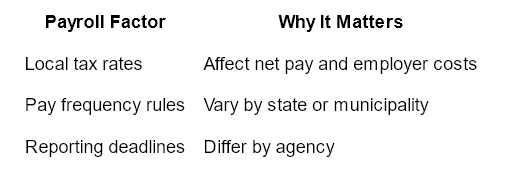
Centralized payroll systems help you standardize payroll processes while applying local labor laws correctly. This structure supports growth without losing control over payroll management.
Ensuring Payroll Compliance With Complex Labor Laws
Retail expansion increases exposure to changing labor laws. Minimum wage rates, overtime thresholds, and paid leave mandates often vary by state and sometimes by city.
You must track updates continuously to maintain payroll and compliance. Outdated rules cause underpayment or overpayment, both of which create legal and financial risk.
Payroll compliance also affects payroll cost control. Incorrect overtime calculations inflate payroll costs, while missed benefits reduce employee trust. Automated compliance alerts and rule-based calculations reduce manual oversight and help you stay aligned with current labor laws.
Accurate Employee Classification and Pay Calculations
Growth often blurs role definitions, which complicates employee classification. Misclassifying exempt and non-exempt employees leads to incorrect overtime and payroll taxes.
You also manage diverse pay models. Retail payroll includes hourly wages, shift differentials, commissions, and bonuses, all requiring precise payroll calculations.
Consistent data inputs protect payroll compliance and ensure employees receive correct pay on time.
Strategic Solutions for Streamlining Retail Payroll
As your retail business expands, payroll complexity rises across systems, people, and locations. You need technology, controls, and operating models that scale without increasing errors, delays, or compliance risk.
Implementing Payroll Software and Automation
A modern payroll system reduces manual work and keeps payroll processing consistent across locations. You benefit most from a payroll platform that supports multiple pay rates, roles, and pay schedules within one interface.
Payroll automation handles repetitive tasks such as gross-to-net calculations and automated tax filings. Many platforms generate W-2 and Form 941 reports automatically, which lowers filing errors and late penalties.
Look for features that support rapid onboarding and seasonal hiring. Built-in workflows help you add employees quickly while keeping records complete.
Key capabilities to prioritize include:
- Real-time payroll calculations
- Integrated payroll analytics
- Support for multi-state tax rules
Optimizing Time Tracking and Scheduling
Accurate time data directly affects payroll accuracy. You reduce errors when time tracking feeds directly into your payroll software without manual edits.
Use scheduling software that accounts for labor laws, overtime thresholds, and role-based pay rates. This approach helps you control labor costs while keeping payroll processing predictable.
Digital time clocks and mobile punch-in tools work well for distributed retail teams. They also create clear audit trails for payroll audits.
To improve reliability, ensure your system supports:
- Automated overtime calculations
- Location-based rules
- Manager approvals before payroll runs
Enhancing Data Security and Payroll Accuracy
Payroll systems store sensitive personal and financial data. Strong data protection measures reduce your exposure to fraud and compliance violations.
Choose platforms that enforce multi-factor authentication and role-based access controls. These tools limit who can view or change payroll data.
Regular payroll audits catch discrepancies early. Automated validation checks flag unusual pay amounts, duplicate entries, or missing time records before final processing.
Accuracy also improves when payroll connects to one data source. A centralized employee record prevents mismatches between onboarding, time tracking, and pay calculations.
Outsourcing Payroll Services and Centralizing Operations
As you scale, managing payroll in-house may strain internal teams. Outsourcing payroll services shifts tax filings, compliance updates, and reporting to specialized payroll service providers.
A reliable payroll service provider manages automated tax filing across jurisdictions and tracks regulatory changes. This reduces risk as you enter new markets.
You gain the most value when outsourcing pairs with a centralized payroll system. Centralization standardizes payroll rules while still supporting local pay requirements.
This model works best when you retain visibility through dashboards, reports, and direct access to payroll analytics.
Conclusion
As your retail business expands, you face payroll challenges tied to variable schedules, multiple pay types, and rising compliance demands across locations. Growth increases the risk of errors, delays, and employee dissatisfaction if payroll processes do not scale with your workforce.
You reduce these risks by standardizing data, strengthening time tracking, and aligning payroll systems with tax and labor rules in each jurisdiction. Clear processes and the right tools help you protect margins, support your team, and sustain growth without adding unnecessary payroll strain.