Why a Pop Up Banner Still Earns Its Place at Business Events in 2026
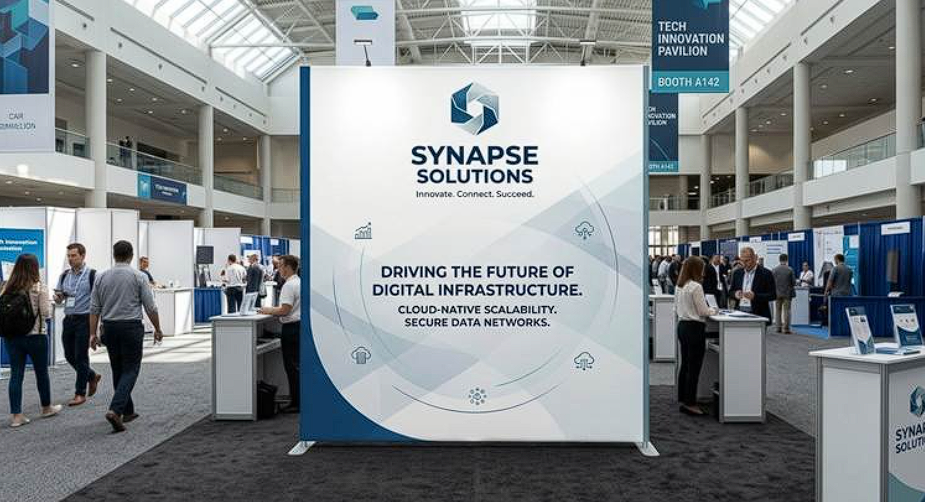
Every founder who has stood behind a folding table at a trade show knows the feeling: dozens of booths, hundreds of badges drifting past, and roughly three seconds to explain what your company does. In 2026, with so much marketing living on a screen, the physical tools that do that explaining deserve a second look. Among them, the banner stand is the one most often chosen in a hurry and regretted later.
What is a pop up banner, and how does it work?
A pop up banner is a freestanding display that holds a large printed graphic upright without a wall, a table or an installer. In most buyers' usage the phrase covers two families of product. Retractable stands keep the graphic rolled inside a base cassette and pull it up to a telescoping pole. Collapsible frame stands stretch the graphic over a folding frame. Both are designed to pack into a carry case, which is why they are the default choice for exhibitors who travel light.
The appeal is simple. The graphics are printed once, the hardware is reusable, and the unit is built for one person to carry and assemble. That puts it in a different category from a custom built booth wall or a tension fabric backdrop, which are larger, heavier and usually come with their own shipping and installation questions.
Why in person events still reward a visual anchor
The case for showing up in person is better documented than most marketers assume. A study from the Center for Exhibition Industry Research (CEIR) that surveyed 9,000 attendees and 800 exhibitors found that both groups rated exhibitions as the most valuable face to face setting, with 48% of attendees ranking exhibitions first and in person sales calls second at 26%. CEIR's more recent reporting on intimate B2B exhibitions adds that small events can produce profit margins competitive with larger shows for the organizers who run them, a sign that compact events remain a healthy place to exhibit.
For a startup working with a modest budget, that is good news. You do not need a 20 foot island to be taken seriously. You do need something that keeps telling your story while you are busy talking to someone else.
Where a banner stand earns its keep
That is the practical case for using a pop up banner at business events. One person can usually set it up without tools, it travels in a carry case, and the same graphic can serve a conference sponsor table on Tuesday, an investor demo day on Thursday and an office lobby the following week. Because it is reusable, its cost per appearance falls every time it leaves the closet. That is a different economic profile from printed flyers or a one off event sign.
Consider the situations where it tends to pay off. A conference sponsor table where the organizer supplies only a draped table. A demo day where ten startups share one room and one clock. A retail pop up with no permanent signage. A career fair or community expo where your table sits in a long row of identical ones. A reception area at your own office, where visitors form a first impression before anyone says hello. In each case the banner does the same job: it answers, "who are you?" before the conversation starts.
Printers that specialize in banners and displays can make the buying side easier. Custom Banner Lab, for example, publishes guides on trade show booth design and tabletop banner displays alongside its product pages, which gives first time buyers a way to compare formats before committing to artwork.
How does a pop up banner compare with other event displays?
Founders often ask whether a banner stand is enough, or whether they should jump straight to a backdrop or a booth kit. A useful rule is to match the display to the space you control. A banner stand suits a table or a narrow footprint, and it adds height to a table throw that already carries your logo. A wider backdrop or a booth kit makes sense when you have a full 10 by 10 space and a team to manage it. Feather flags and hanging signs help outdoors but add little in a crowded convention hall. Many small teams start with one banner stand, learn what visitors respond to, and then add pieces.
The sequence matters because graphics age. Messaging that felt right at launch can feel stale within a year as products and positioning shift. Starting small keeps the cost of changing your mind low.

How do you judge the cost?
Rather than comparing sticker prices alone, work out the cost per appearance. Divide the purchase price by the number of events you realistically expect to attend in the next twelve months, then add the cost of replacing graphics when your message changes. A lower priced stand that wears out early can cost more per use than a sturdier one that travels for years. Ask suppliers for the specifications behind a price, not just the price itself.
Five quality checks before you order
These checks apply whether you are asking Custom Banner Lab for a quote or comparing several suppliers.
Proof the artwork at full size. A logo that looks sharp on a laptop can turn soft at six feet tall. Supply vector logos and high resolution images and ask for a proof before production.
Check the material and finish. The banner material should be opaque enough that stand hardware does not show through, and the finish should hold up under harsh venue lighting without heavy glare.
Ask about the hardware. The base and the retraction mechanism tend to wear first. Ask how the stand is built, how graphics are replaced when your messaging changes, and what replacement parts are available.
Plan for transport. Weigh the carry case and confirm it fits in a checked bag or a rental car. A banner that is awkward to carry tends to stay home.
Confirm the finished size. Stands come in different widths and heights. Measure against your table or booth space and read the exhibitor manual for height or placement rules before you commit.
Questions to ask a supplier before you commit
Quality standards are easier to judge when you ask specific questions. Where is the graphic printed, and by whom? How long does production take, and what happens if your event date is fixed? Will you receive a proof, and who approves it? Can replacement graphics be ordered without buying a new stand? What does the warranty or return policy cover, in writing?
Treat vague answers as information. A supplier confident in its process will usually answer in detail, and published guidance can help you frame the questions before you call. The trade show booth design and tabletop banner display guides on Custom Banner Lab's blog are one example of the kind of reading worth doing first.
Design rules founders tend to skip
Keep one message per banner. Visitors read a banner in passing, so a company name, a single line about what you do and one clear next step are plenty. Put the most important content in the upper two thirds of the graphic, because tables, chairs and crowds tend to hide at the bottom of a banner stand. Use strong contrast between text and background and add a QR code only if it leads to something specific, such as a demo booking page rather than a generic home page.
It also helps to design for the second glance. Someone who walks past once and sees your logo should be able to recall it a few booths later. Consistency with your website colors and type does more for that than any clever slogan.
Finally, make the banner measurable. Point any QR code or short link at a landing page created for that event, with a campaign tag so your analytics show how many visitors came from it. Without that, the banner stays a brand expense; with it, you can compare one event against the next.
Care, storage and setup habits that extend its life
A banner stand lasts longest when it is treated like equipment. Retract or fold it according to the supplier's instructions, keep it in its case between events, and store it dry. Before each show, set it up once in the office to check that the graphic sits straight, the pole sections lock and no edges are curling. Clean the graphic gently with a soft cloth and follow the supplier's care guidance, since harsh cleaners can mark a print.
Build a short packing list at the same time: the stand, its case, any spare parts, a cloth, tape and a printed copy of the exhibitor rules. The few minutes spent on this tend to prevent the most common setup day problems.
From one event to the next
With those checks in hand, the sensible next step is to treat your banner as a small, reusable asset instead of a one time expense. Keep the source files organized, note which version appeared at which event, and review what worked after each show before you reorder or redesign.
In the same spirit, it pays to read buying guidance from specialists before you place an order. Custom Banner Lab's resources on banners, backdrops and trade show displays are a reasonable place to start, and the questions raised above give you a way to test any supplier's answers in 2026. Over time, the banner that was chosen with care will usually outlast the event that prompted the purchase.