Why an LPG forklift runs rough on a cold morning and smooths out once the engine warms
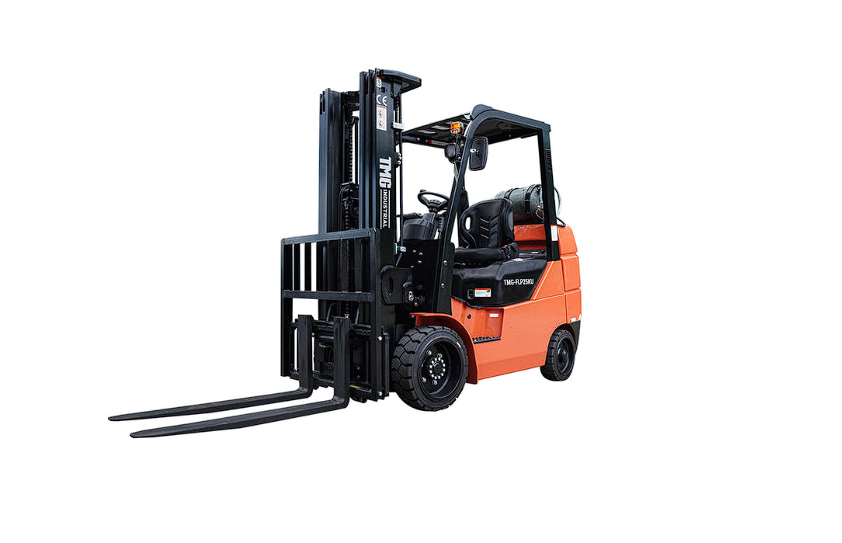
The season the loading dock door stops being a formality
By early September the temperature gap across a Canadian loading dock starts to matter. Inside it is twenty degrees; outside, at six in the morning, close to freezing. A machine crossing that line all shift has to work in both climates, and this is the point in the year when an LPG forklift that ran perfectly all summer begins to stumble for the first ten minutes of the day.
Operators read that stumble as a fault. It almost never is. It is the fuel system doing what the physics of propane says it must, and knowing why is the difference between a service call and a cup of coffee.
The tank sends out liquid, not gas
Start by correcting the mental picture. A barbecue cylinder stands upright, drawing vapor off the top of the liquid. A forklift cylinder lies horizontally, held by a locating pin, and draws liquid off the bottom through a dip tube.
That difference is not a detail. Drawing vapor means the tank boils the propane itself, and boiling absorbs heat, so a vapor-draw tank gets cold and loses pressure as you use it. Drawing liquid moves that job elsewhere, which is why forklifts are built this way.
So the cylinder is a liquid container under its own vapor pressure, and what leaves it is still liquid. Something downstream has to turn it into gas.
The vaporizer borrows heat from the engine coolant
That something is the vaporizer, the component that explains the cold morning. Liquid propane arrives, and the vaporizer boils it into gas using heat drawn from the engine's coolant loop.
The consequence follows. On a cold start the coolant is at ambient temperature, so the vaporizer has little heat to work with and delivers gas unevenly. The engine runs rough, hunts at idle, and may stall if it is loaded too early. Three or four minutes later the coolant is warm and the machine is smooth.
This is why an experienced operator lets the machine idle briefly instead of driving straight to the first pallet. They are not warming the oil. They are waiting for the fuel system to start working.
Cold weather changes what the tank can deliver
The tank has its own temperature problem, separate from the vaporizer. Propane's vapor pressure falls as it gets colder, so a cylinder that sat outside overnight pushes fuel toward the engine with less force than a warm one.
Indoors this rarely matters. For an LPG forklift in cold weather that lives half its life in an unheated yard, it shows up as hard starting and poor performance under load, and it worsens as the cylinder empties, because less liquid means less thermal mass holding the temperature up.
The fix is unglamorous and effective: store spare cylinders where they will not sit overnight at outdoor temperature. A cylinder that starts the shift warm behaves like one in July.
Where an LPG forklift sits between electric and diesel indoors
Fuel choice inside a building is really a choice about exhaust. Diesel produces particulate matter that no reasonable amount of ventilation makes acceptable in an enclosed space, which is why diesel machines stay outdoors.
Propane burns far cleaner, which is why it survives indoors at all. But cleaner is not clean. It still produces carbon monoxide, and carbon monoxide is odorless, so the warning that works for most hazards does not exist here. Indoor operation depends on ventilation that is designed rather than assumed, and on engines kept in tune.
Electric machines replace the exhaust question with a charging question. In a single-shift warehouse that trade is often worth making. Across two or three shifts it usually is not.
Changing a cylinder is the most routine dangerous job on the site
Cylinder changes happen so often they stop feeling like a procedure, which makes forklift propane tank safety worth stating plainly. The cylinder holds liquid under pressure, and the fitting being disconnected is on the liquid side.
The order of operations exists for a reason. The service valve closes first, then the engine runs until it stalls, burning off the fuel left in the line. Only then is the coupling disconnected, because a line emptied that way cannot spray liquid propane onto a hand.
Two details get missed. The locating pin sets the cylinder's rotation so the pressure relief valve points into the vapor space rather than the liquid; a quarter turn off, and a relief event discharges liquid instead of gas. And the cylinder gets inspected as it goes on, because a damaged collar is easiest to catch while it is already in your hands.
What the LPG forklift fuel system is actually made of
The chain from cylinder to cylinder head is short, and each part fails differently from the outside:
- Cylinder: liquid under vapor pressure, changed by hand
- Service valve: the manual shutoff, closed before disconnecting
- Vaporizer: boils liquid to gas using engine coolant
- Regulator: drops pressure to what the engine accepts
- Mixer or injector: meters gas into the intake air
Reading the chain in order makes diagnosis faster. Rough running that clears as the engine warms points at the vaporizer and its coolant supply. Rough running that persists once warm points downstream, at the regulator or mixer. A machine that starts and dies has a supply problem upstream.
One yard learned this expensively, replacing two regulators on a machine that ran badly only in the first minutes of a shift. The regulators were fine. Coolant was low enough that the vaporizer never got a reliable flow of hot coolant.
What propane gives up in exchange
The honest comparison has costs on both sides, showing up in different places:
- Refueling: two minutes, no charging infrastructure
- Cold starting: worse than electric, better than diesel
- Indoor use: acceptable with ventilation, not without
- Maintenance: an engine to service, not a battery to manage
The last point surprises buyers. This is an internal combustion machine, with oil changes, filters, spark plugs, and a cooling system that now has a second job. That system is part of the fuel path, which is why coolant belongs on the daily check rather than the monthly one.
Where forklift fleets are heading
Two shifts are visible. Electric machines keep taking single-shift indoor work, where charging overnight is free time and zero exhaust removes a category of ventilation planning. The LPG forklift is holding the multi-shift and mixed indoor-outdoor work, because a two-minute cylinder change is hard to beat when the building runs around the clock.
The selection question has not changed, and the equipment guidance from TMG Industrial puts it the same way. Decide how many shifts the machine runs, decide how much of its day is spent outside, and let those two answers choose the fuel before capacity or price enters the conversation.