Why Businesses Can't Afford to Treat Video as an Afterthought Anymore

There was a time when video sat in a separate lane from the rest of a business. Marketing made the occasional ad. Everyone else stuck to slides and email. That lane has closed. Product teams need demo videos. HR needs onboarding videos. Sales needs walkthroughs. Social needs a constant stream of short clips. Video has quietly become baseline business output, not a specialist function.
What has not changed at the same pace is how most teams actually produce it.
The output has scaled. The workflow has not.
Ask a mid-sized company how many videos it needs this quarter and the number keeps climbing. Ask how it plans to make them, and the answer is usually the same setup from three years ago, one editor, a folder of raw footage, and a queue that only gets longer. The workflow was designed for occasional production, not constant output, and it shows.
This is not a talent problem. The people doing the editing are perfectly capable. The problem is that video production still runs on the assumption that every request needs a specialist to sit down and manually build the timeline from scratch, take by take, trim by trim. That assumption made sense when a company made four videos a year. It does not hold when video is expected weekly, sometimes daily, from teams that were never meant to become production houses.
Treating video as optional creates a hidden queue
The cost of this mismatch rarely shows up as a single visible failure. It shows up as a delay. A product update ships without a demo because the video is still in the queue. A sales team reuses an outdated clip because a new one was never finished. Social fell quiet for a week because nobody had time to cut anything. None of this looks dramatic from the outside, but it adds up to a business that treats video as a nice to have precisely because its own process makes video expensive to produce.
The irony is that the demand side has already moved on. Customers expect video explanations. Candidates expect video culture content. Buyers expect product walkthroughs before they will book a call. The expectation is that video is standard. The internal reality, in most companies, is that it is still handled like a special project.
Where the actual friction lives
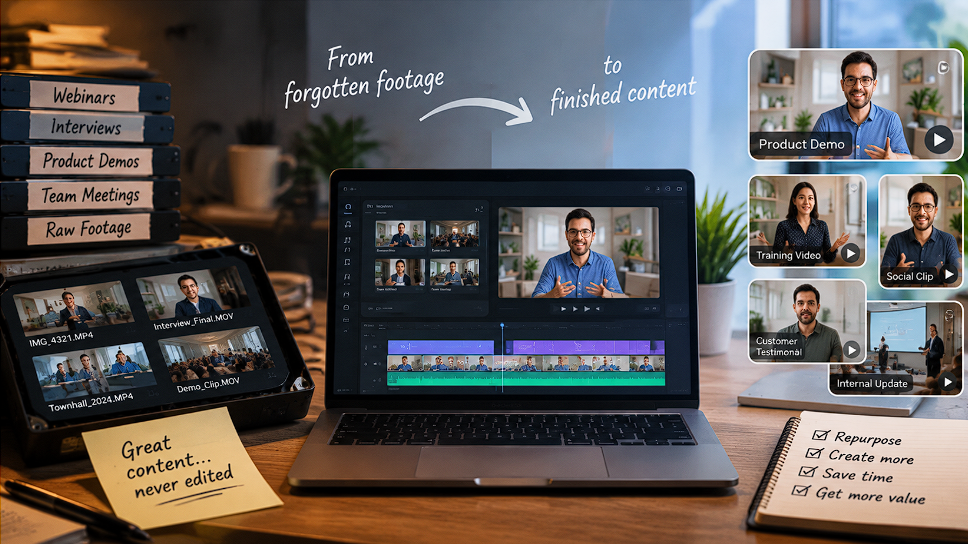
The friction is almost never the creative decision. Most people know roughly what they want a video to say. The friction is in getting from raw footage to a usable cut, reviewing long recordings, picking the right take, trimming dead air, arranging clips in a sensible order, fixing audio, then doing it all again for a slightly different version. That is mechanical work, not creative work, and it is exactly the part that eats the hours a small or mid-sized team does not have.
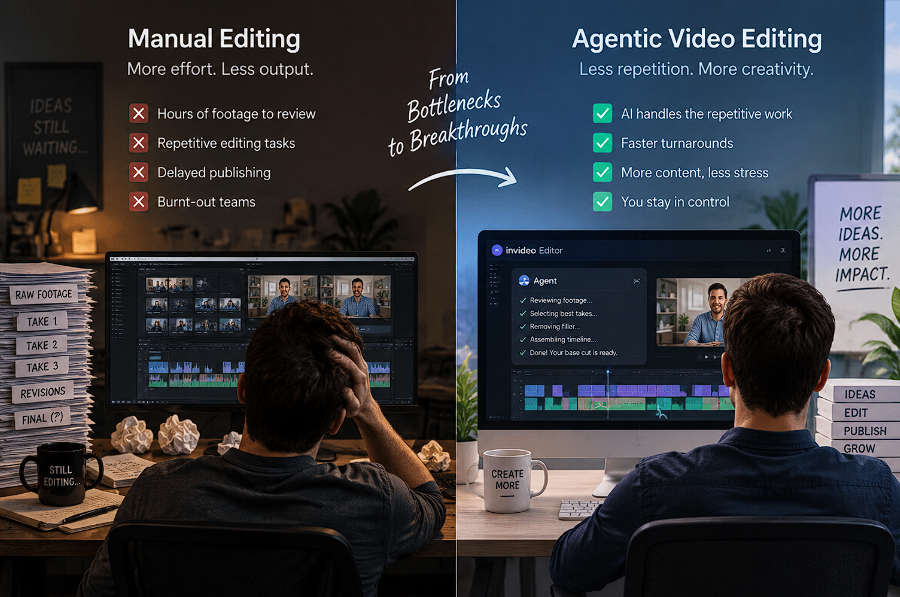
This is the layer that AI-assisted editing is built to absorb. Instead of a person manually assembling a rough cut from scratch, you describe what you want and let an agent handle the repetitive part first, then step onto the timeline yourself for the decisions that actually need a human. Invideo Editor was built around exactly this idea, treating the review and assembly work as something to hand off rather than something every editor repeats by hand. It changes the shape of the work rather than removing the person from it.
Invideo Editor is built specifically to solve this. It runs free in the browser, with no installs and no setup, and it lets you describe the edit you need while an AI agent handles the repetitive assembly work, reviewing footage, picking usable takes, and building a base cut you can then refine. For a team trying to edit videos with AI without giving up the ability to fine-tune the result, that combination matters more than any single flashy feature. The agent takes the first pass, the editor decides what happens next, and the video does not sit in a queue waiting for someone to find three uninterrupted hours.
For teams producing talking head videos, product walkthroughs, or recurring social content, this shift is the difference between video staying a bottleneck and video becoming something the business can actually keep up with. Invideo Editor's base cut approach in particular means the first pass is never a blank timeline; it is already a working starting point.
Producing video like it matters
Businesses do not need to become production studios to meet the demand they are already facing. They need a workflow that matches how often video is actually required now, not how often it used to be required. That means treating the repetitive part of editing as something to offload, not something every request has to survive from scratch.
The companies that figure this out first will not necessarily make better videos. They will simply make enough of them, on time, without burning out the one person who used to carry the whole workload alone. That is what treating video as a requirement actually looks like in practice, not a bigger creative ambition, just a workflow built for how much video a business is genuinely expected to produce.