Why Your Digital Marketing Strategy Needs a Reputation Layer Before Paid Media Does Anything
Pouring thousands into paid ads while your reviews are sitting at 2.3 stars is not a traffic problem. It's a sequencing problem. A well-built digital marketing strategy accounts for what happens after someone clicks your ad, and most of the time, they check your reviews before doing anything else.
According to BrightLocal's 2023 Local Consumer Review Survey, 78% of consumers check online reviews before making a purchase decision. Paid traffic accelerates that behavior. It doesn't bypass it.
How Reputation Fits Into the Marketing Funnel
The funnel breaks down into three stages where reputation plays a direct role.
At the awareness stage, paid ads through Google Ads or Facebook Ads drive traffic. That's what most marketers focus on. But awareness is just the first stage. At the consideration stage, visitors scan Google reviews, Yelp ratings, and Trustpilot scores before deciding whether to trust you. At the conversion stage, social proof, including star ratings, testimonials, and review volume, closes the gap between interest and purchase.
A weak reputation causes high drop-off at the consideration stage. Paid media can't fix that; it can only deliver more people to the same problem faster. This is why businesses increasingly invest in platforms like Brandjet to strengthen brand perception, improve credibility, and create more meaningful engagement with potential customers before they reach the decision stage.
The Sequence That Actually Works
The correct order is: build your reputation baseline, then launch paid campaigns, then scale using social proof signals. Most businesses do the reverse, or skip the first step entirely.
A practical two-week setup before any paid launch:
- Week 1: Run a full reputation audit, identify negative reviews across platforms, and set up sentiment monitoring
- Week 2: Begin review generation, respond to outstanding negative feedback, and verify your Google Business Profile
Launch paid efforts in week three, once the foundation is set. Google's own E-E-A-T guidelines reward reputation signals with better ad relevance scores, which directly affects how much you pay per click.
What Happens When You Skip the Reputation Layer
The clearest illustration comes from a straightforward scenario. A business invests $50,000 in Facebook Ads, drives thousands of clicks, and watches 67% of visitors leave immediately. The reason: a 2.3-star Google rating that visitors found before they read a single word of the landing page copy.
This isn't theoretical. It's a documented pattern. Negative first impressions from poor reviews raise bounce rates and lower conversion rates, and those metrics feed directly back into platform algorithms. Google interprets high bounce rates as a poor landing page experience, which drops your Quality Score and raises your cost per click.
The FTC guidelines also create risk here. Campaigns that drive traffic to pages loaded with authentic negative reviews, while ads promise quality or satisfaction, invite both consumer backlash and regulatory scrutiny if the gap between promise and reality is wide enough.
How Poor Reviews Inflate Paid Media Costs
Google's Quality Score is rated on a scale of 1 to 10 and is calculated from three factors: expected click-through rate, ad relevance, and landing page experience. A poor reputation damages all three.
The numbers make the case directly. A business with a 2-star rating might see 4.2% conversion rates from paid traffic. A competitor with 4-plus stars from the same traffic volume sees 12.1%. According to WordStream data, improving Quality Score from 6 to 8 can cut cost per click by 41%.

The same ad budget produces dramatically different results depending on how the landing page environment appears to a skeptical visitor.
How a Reputation Layer Improves Paid Campaign Performance
A reputation layer is a set of trust signals, including verified reviews, star ratings, testimonials, and social proof, that reduces purchase friction before a visitor makes a decision. It is not a single tactic. It is a structural component of the conversion environment.
When reputation is strong, Google Ads review extensions can display star ratings directly in the ad unit, lifting click-through rates by around 15% according to Google's own documentation. That improvement happens before the visitor even reaches your landing page.
NetReputation has outlined how businesses in high-consideration categories, including legal, medical, and financial services, see compounding paid media improvements once their review profiles cross the 4-star threshold. The credibility gap closes, and ad spend starts returning what the projections promised.
Three Amplification Risks When Reputation Is Weak
Running paid traffic to an unmonitored, negatively reviewed presence creates amplification in the wrong direction. The three main ways this plays out:
- Review platforms outrank your landing pages in ad-triggered SERPs, so the first organic result a visitor sees is a complaint thread
- Social proof mismatch between polished ad creative and actual customer feedback signals inauthenticity
- User-generated content, including public replies and forum threads, contradicts ad claims and surfaces during consideration-stage research
Each of these is manageable before launch. Each one becomes expensive to fix after a campaign has already run.
Building the Reputation Layer Before You Spend
Five components form the core of a pre-campaign reputation layer: a verified Google Business Profile, active review generation, a review response protocol, on-page social proof, and reputation monitoring.
The right tool depends on your business size and complexity. Here's a direct comparison:
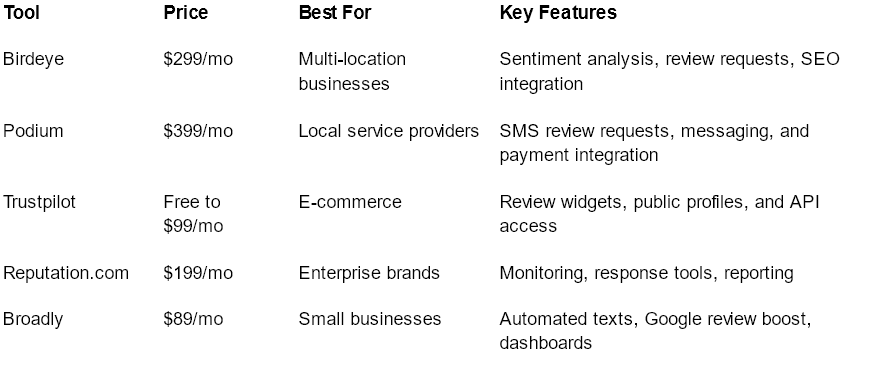
None of these tools does the work on their own. The tool manages the process. Someone still has to respond to reviews, request feedback at the right time, and keep the content on landing pages up to date.
Implementation Order for the First Two Weeks
Week one covers the foundations:
- Claim and fully optimize your Google Business Profile with photos, posts, and consistent NAP data
- Set up automated SMS review requests through a tool like Podium for post-service follow-ups
- Add review widgets from Trustpilot or Google to all key landing pages
Week two focuses on response infrastructure and social proof content:
- Create a written review response protocol with a 24-hour response SLA for negative reviews
- Collect video testimonials from satisfied clients and embed them on landing pages
- Add trust badges, security seals, and review score displays to reinforce first impressions
Complete this before the first paid campaign goes live. The sequence matters more than the speed.
Measuring the ROI of Reputation in Paid Media
Every dollar invested in review management can generate $6.20 in revenue, representing a 520% ROI, according to industry research. The formula is straightforward: subtract the reputation tool cost from revenue generated by review-influenced conversions, then divide by the tool cost.
A concrete example: a $500 monthly tool subscription produces 28 additional conversions at an average order value of $89. That's $2,492 in revenue and $1,992 in net gain, for roughly 398% ROI in a single month. That figure scales as review volume and average ratings improve.
Tracking Reputation's Impact in GA4
Set up GA4 custom events to measure how visitors interact with review content. Track events like review_star_click and testimonial_scroll to see which social proof elements influence engagement.
Tag all paid campaigns with UTM parameters that segment traffic landing on review-rich pages. A tag structure like utm_source=google&utm_campaign=reviews-boost isolates the specific conversion impact of pages with strong review profiles versus those without.
Build a custom report in GA4 comparing conversion rates, bounce rates, and time on site between high-review pages and standard landing pages. Run the comparison monthly. The data will consistently show the same pattern: reputation-strong pages outperform neutral pages across every engagement metric, and the gap widens as review volume grows.
Attribution Across the Full Funnel
Multi-touch attribution matters here because reputation influences decisions at multiple stages, not just the final click. A visitor might see your ad, check your Yelp rating, read two Google reviews, and return three days later to convert. Last-click attribution credits the final visit. Multi-touch attribution shows you that the review check was part of the path.
Layer net promoter score data and customer satisfaction metrics into your attribution model. Track how positive mentions on Yelp or Trustpilot contribute to organic search traffic alongside paid media performance. Over time, this builds a documented business case for treating reputation management as a core line item in the paid media budget, not an optional add-on.