Where Is My Order? The Question Small Shops Answer Most

It is Monday morning. The owner of a small candle shop opens her inbox to 31 new messages. Nineteen of them are some version of the same question: where is my order?
She calls it Monday admin. The ecommerce trade has a less charming name for it: WISMO, short for "where is my order." Whatever you call it, it is often one of the biggest categories of messages a small online shop receives, and the one that feels most pointless to answer by hand.
The parcels are mostly fine. The tracking links exist. The customer just could not find them, or did not trust them, or wanted a human to say it out loud.
Here is how to cut WISMO down without hiring anyone, and without automating your way into new problems.
Why WISMO Eats a Small Shop's Week
For a big retailer, order status questions are a line item in a support dashboard. For a shop run by two people, they are the reason the product photos never got reshot.
One question, four different problems
"Where is my order" sounds like one question. It is actually at least four.
Has it shipped yet? Why is it late? It says delivered, so why is it not on my doorstep? Can I change the address before it goes out?
The first two are information problems. The answer exists, the customer just cannot see it. The last two are real problems that need a person. Treating all four the same way is where most shops go wrong, in both directions.
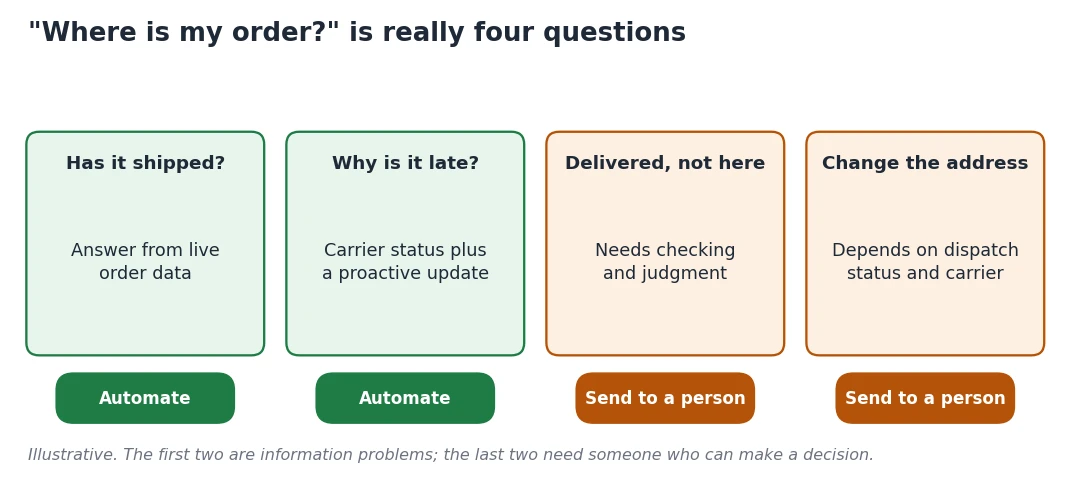
One question, four different problems. Only the first two should be automated.
Why customers ask even when tracking exists
Most shops send a tracking link. Customers ask anyway. Partly because the link is buried, partly because carrier tracking pages can be vague, and partly because "in transit" for four days in a row does not feel reassuring to anyone.
Good ecommerce customer support is not just about having the information. It is about putting it in front of the customer in a form they trust, before the worry starts. That is also what good customer service for small business looks like in general: fewer surprises, fewer reasons to write in.
What it really costs the owner
Each message only takes a minute or two. That is the trap. Nobody notices the cost until they add up a week of them and realise a good chunk of Monday went on copying tracking numbers into replies.
There is a quieter cost too. A customer who has to ask where their order is has already started to worry. Answer slowly and that worry becomes a refund request, or a one-star review, or both. For a small shop that lives on repeat customers and word of mouth, that is a real cost, even if it never shows up on a spreadsheet.
Fix the Information Before You Automate Anything
The cheapest way to reduce WISMO is to make sure customers already have the answer before they think to ask. Most of this is housekeeping, not technology.
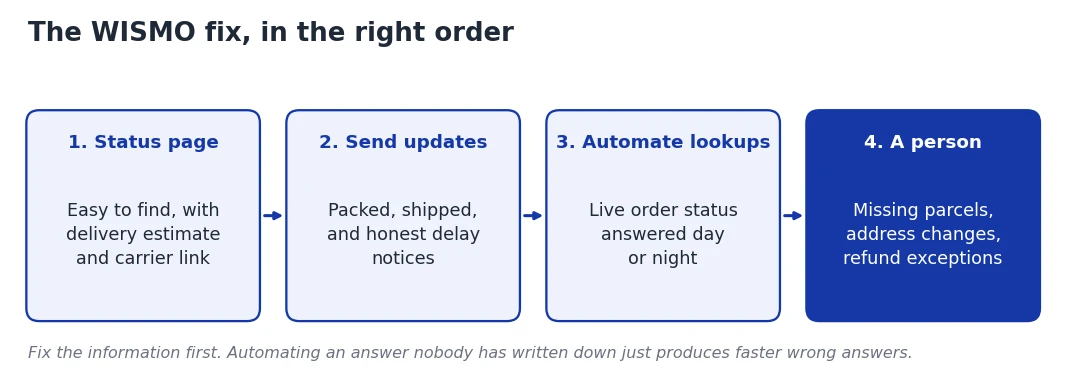
Fix the information first, then automate the lookups, and keep the exceptions for a person.
Build an order status page customers can find
Most ecommerce platforms give you a status page out of the box. The problem is that customers never see it, because the link is buried at the bottom of a confirmation email nobody reads twice.
Put the link where people look: in every shipping email, in the website footer, and in the reply to any order question. If you sell on Shopify, check what a Shopify order status actually looks like to the customer. Delivery estimates and carrier links are far more useful than an order number on its own.
Send updates before customers ask
Proactive updates are the single most effective way to cut these questions. Tell people when the order is packed, when it ships, and, most importantly, when it is running late.
For US customers, that last one is not optional. Under the US Federal Trade Commission's Mail, Internet, or Telephone Order Merchandise Rule, a seller must ship within the time it advertises, or within 30 days if it states no time. If it cannot, it has to tell the customer, give a revised shipping date, and offer the option to cancel for a prompt refund. A good delay email is both good service and a legal requirement.
Tell customers what normal looks like
A lot of WISMO starts with a mismatch in expectations. The shop dispatches in three working days. The customer assumed it would ship tomorrow.
Put your real dispatch times on the product page and at checkout, not just in the shipping policy. A customer who knows to expect three days will not email on day two.
Make Shopify order tracking obvious
If you use Shopify order tracking, test it as a customer would. Place an order, wait for the shipping email, and click through on your phone. If it takes more than two taps to find out where the parcel is, your customers will email you instead.
Small changes here, like a clearer tracking button or a delivery estimate in the subject line, often cut more order questions than any software purchase. It costs nothing but an afternoon, and it is the kind of fix that keeps working long after you have forgotten you made it.
Where Customer Service Automation Helps
Once the information is in place, automation stops being a gamble. It can answer from something real instead of guessing.
Answering "has it shipped" from live order data
The useful kind of automated customer service does not paste a generic tracking link. It looks up the actual order. An ecommerce chatbot that checks live orders can tell a customer at 11 p.m. that their order shipped yesterday, which carrier has it, and when it is expected, without anyone opening the inbox.
That is where customer service automation earns its keep for a small shop. Not by replacing the owner, but by taking the copy-and-paste questions off the owner's plate.
Answering after hours
Order questions do not arrive during office hours. They arrive at 11 p.m., on Sundays, and on the evening a parcel was supposed to turn up.
For a small shop, after-hours coverage is where automation makes the biggest difference to ecommerce customer service. The customer gets an answer that night, and the owner starts Monday with the real problems, not nineteen copies of the same question.
What should always reach a person
"Delivered but not here" should never be answered by a bot. Neither should address changes after dispatch, damaged items, or anything involving a refund exception. These need judgment, and often a little empathy.
The best setup answers the information questions automatically and passes the real problems straight to a person, with the order details attached so nobody has to ask twice.
How to Cut WISMO in a Week
This does not need a project plan. It needs about five working days and a bit of honesty about your inbox.
Step 1: Count last month's order questions
Go through your inbox, contact form, and social messages and tag every order status question. Then sort them into the four types: not shipped, late, delivered but missing, and address change. The split tells you where to start.
Step 2: Write the answers down once
Write a short, plain answer for each type. Your dispatch times, your carriers, what to do if a parcel says delivered but has not arrived. Most shops discover these answers only exist in the owner's head. Writing them down is the step everything else depends on, so do it properly, in plain language a tired customer can read on a phone.
Step 3: Fix the order status page and shipping emails
Add the tracking link and delivery estimate to every shipping email. Make the status page easy to find. Add a delay template you can send the moment something slips.
Step 4: Automate the lookup, not the exceptions
Now automate the simple part: checking the order and replying with the status. Anything that is not a straightforward lookup goes to a person. This is the safest way to automate customer support without upsetting anyone. If a reply would need you to make a decision, it is not a lookup, and it should not be automated.
Step 5: Read what still gets through
After a week, look at the order questions that still reached you. Each one points to a gap: a carrier that does not update tracking, a confusing email, a missing answer. Fix the gap and the message usually stops arriving.
Choosing Customer Service Software for Small Business
You do not need an enterprise platform to solve this. Most small business help desk software is built for teams of twenty, and you will pay for features you never open.
What to test first
Whether you are looking at an ecommerce help desk or a simpler chatbot, test three things before you commit. Can it look up a real order? Does it answer from your own shipping and returns rules rather than generic text? Does it hand over to you cleanly when it should?
Customer support automation that fails any of those will create more ecommerce customer service work, not less. And automated customer support that guesses about a refund is worse than no automation at all.
It is also worth asking what it costs to run when volume jumps. A sale or a busy December should not turn your support tool into a surprise bill. And ask how long setup takes. If the answer involves a developer and a six-week project, it was built for someone else.
How Agentency Handles WISMO
We build one of these, so here is how ours deals with the four types of order question.
It looks up the live order
Agentency answers tracking, dispatch-window, and carrier questions from your published shipping rules, and it can call your order API through a Call Action to check the live order. The customer gets the real status, not a link to a help page.
It answers from your own rules, with the source shown
Delivery and returns questions are answered from the policies you already wrote, and every answer shows its source. The returns policy is quoted the same way to every customer, and changing the document changes every future answer.
It hands the real problems to a person
When a request is a refund exception, the agent escalates it with the transcript, the order reference, and the customer's details already attached. You start the conversation knowing exactly what happened.
It turns out-of-stock questions into customers
When a shopper asks about something that is sold out, a pre-chat form can collect their email or phone number for a restock alert, and the contact lands in your Customers list. A question that used to end the conversation becomes a sale you can follow up on.
It works where customers ask
The same agent answers on your storefront, WhatsApp, Instagram, and Messenger from one knowledge base, and replies in the customer's language. It installs with a script tag or the WordPress or Shopify plugin, and the conversations view shows which questions went unanswered, so you can fix the page behind them.
Frequently Asked Questions
What is WISMO?
WISMO stands for "where is my order." It is the ecommerce term for order status questions from customers, which are often one of the largest categories of messages an online shop receives.
What is customer service automation?
It is the use of software to handle repetitive customer questions without a person, such as order status, delivery times, and returns. Good automation answers from your own data and passes anything complicated to a person.
How to reduce WISMO
Make tracking easy to find, send proactive shipping and delay updates, and answer order status questions automatically from live order data. Tools like Agentency can handle the lookup, while exceptions like missing parcels still go to you.
How to track a Shopify order
Customers can usually follow the tracking link in their shipping confirmation email or use the status page linked from it. As the merchant, you can see tracking details on the order in your Shopify admin.
What This Comes Down To
The candle shop owner did not have a customer service problem. She had an information problem that arrived as nineteen emails every Monday.
Fix the information first: a findable status page, clear shipping emails, and honest delay notices. Then automate the lookups and keep the real problems for a person. WISMO will not disappear, but it will stop eating the week.
And the product photos might finally get reshot. Start with last month's inbox. Count the order questions, write the answers down once, and fix the pages behind them. Everything else follows from that.
Agentency is an AI chatbot builder for customer service and sales. Businesses train the Agentency AI agent on their own website, documents, and product catalogue, and it answers customer questions with the source shown. When the answer is not there, it declines and hands off to a person with the full transcript. One agent covers the website, WhatsApp, Instagram, Messenger, Telegram, Slack, and 10+ channels, in the customer's language, for ecommerce, real estate, restaurants, and support teams.
About the Author
Omar El Bahr is a Senior Digital Growth Specialist at Agentency, where he leads SEO, content strategy, and organic growth across international markets. He is a Forbes Communications Council contributor and has written for Entrepreneur on business communication and digital strategy.
Disclaimer: This article is for general information only and is not legal advice. The scenario is illustrative. Agentency features are described as of November 2026.