3 Ways Humanoid Robots Could Transform Industry
Humanoid robots could transform industry by taking on repetitive factory work, moving materials through dynamic facilities, and handling inspection tasks in places that challenge human workers. Their human-like form matters because factories, warehouses, and plants were built around human movement, tools, and access points. That makes deployment more practical than rebuilding entire environments for fixed automation. Advances in perception, mobility, and control also allow these robots to respond to changing conditions instead of repeating only one programmed motion. For industrial teams, that means greater flexibility, improved uptime, and safer operations across multiple functions. Rather than serving as novelty machines, humanoid robots are becoming useful platforms for production support, logistics assistance, and field inspection where adaptability matters most in daily operations.
1. Smarter Manufacturing and Production Automation
Automating Repetitive Tasks and Improving Production Efficiency
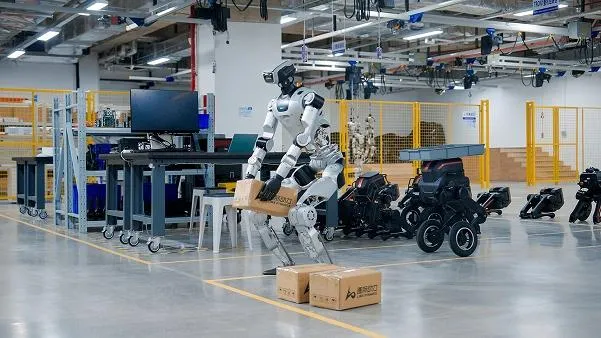
Humanoid robots can raise production efficiency by handling repetitive tasks that slow human teams and create inconsistency over long shifts. In assembly, machine tending, packaging, part transfer, and basic quality checks, they can repeat precise movements with stable timing and fewer interruptions. Their value grows in processes that require standing workstations, human-scale tools, and movement through standard aisles. A full-size platform such as LimX Oli, at 165 cm tall with up to 31 DoF, is designed for more human-like posture and motion, helping it operate in work areas created for people. With independent compute for motion control and perception, plus depth cameras and a self-developed 6-axis IMU, it supports responsive, controlled operation in complex production settings.
Supporting Flexible Production Lines and Human-Robot Collaboration
Industrial production rarely stays fixed for long. Product changes, shorter runs, and mixed-model manufacturing all require automation that can adapt without major line redesign. Humanoid robots support this need by moving between stations, using human-oriented interfaces, and assisting operators with material presentation, tool handoff, or subassembly steps. That flexibility makes them well suited for collaborative environments where people still manage judgment-heavy tasks. Built-in perception also helps them work safely around shifting obstacles and nearby workers. In practice, this can reduce bottlenecks during peak demand or changeovers. Instead of replacing every manual process with dedicated machinery, manufacturers can add adaptable robotic support that fits existing workflows and extends automation into tasks that were previously difficult to standardize.
2. More Flexible Logistics and Material Handling
Streamlining Warehouse Operations and Internal Transportation
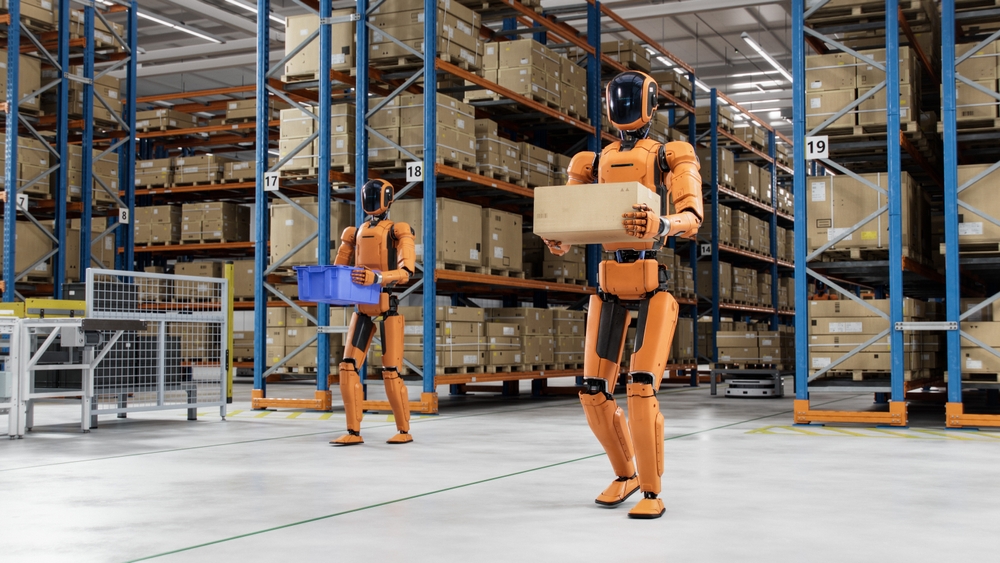
Humanoid robots can improve internal logistics by moving materials between storage, staging, production, and packing areas without requiring major infrastructure changes. In warehouses and industrial campuses, they can support picking assistance, bin transport, line-side replenishment, and movement of small loads across shared spaces. Their human-like mobility helps them navigate corridors, doors, and work zones designed for people rather than for specialized automated vehicles alone. This is especially useful in facilities where layouts change often or where mixed traffic is common. With stronger perception and autonomous navigation, humanoid systems can respond to obstacles, route changes, and temporary congestion. The result is steadier material flow, fewer manual transport interruptions, and better support for time-sensitive production and fulfillment operations.
Adapting to Existing Industrial Workspaces and Workflows
One of the biggest advantages of humanoid robot in logistics is the ability to fit into industrial spaces that already exist. Many facilities cannot justify rebuilding aisles, platforms, storage zones, or access points just to support new automation. A humanoid form reduces that barrier by working within human-centered layouts and following familiar operational paths. Transport and deployment also matter in real operations. LimX Oli is designed for single-person operation and uses a foldable seated storage design for compact packing and easier transport between sites or departments. With USB 3.0 and 3.2 support and broad electrical interfaces, it also allows practical integration with external sensors such as LiDAR or additional cameras for more capable navigation in varied logistics environments.
3. Safer Industrial Operations and Equipment Inspection
Performing Inspections in Hazardous and Hard-to-Reach Environments
Humanoid robots can improve industrial safety by taking on inspections in environments that expose workers to heat, dust, unstable footing, confined access, or repetitive climbing. In plants, utilities, and heavy industrial sites, they can check equipment status, read instrument panels, capture visual data, and approach areas that are uncomfortable or risky for routine human inspection. Their form allows them to move through ladders, walkways, doors, and equipment clearances designed around human technicians. Combined with depth sensing and stable motion control, they can gather information while maintaining safe navigation around obstacles. This reduces unnecessary human exposure to hazards and allows inspection programs to run more frequently, supporting earlier detection of wear, leakage, misalignment, or abnormal operating conditions.
Enhancing Operational Flexibility with Advanced Humanoid Robotics
Advanced humanoid robotics adds flexibility beyond simple inspection rounds. Systems can combine mobility, sensing, and interaction to support guided checks, remote teleoperation, and on-site information access for maintenance teams. Voice capability can also make operation easier in dynamic environments. LimX Oli includes a self-developed voice interaction system that supports natural bilingual conversation in Chinese and English, plus voice-based control. Custom knowledge bases can be uploaded to support different application scenarios, which can help standardize inspection routines or maintenance guidance. Its head-mounted and chest-mounted Intel® RealSense™ D435i depth cameras support wide-range perception, close-range manipulation, human-robot interaction, and safer obstacle avoidance. These features make humanoid robots more practical for complex industrial workflows that require both mobility and responsive task support.
Conclusion
Humanoid robots could have their biggest industrial impact in three areas: manufacturing, logistics, and safety-focused field operations. Their core advantage is not just automation, but adaptable automation that works within spaces already built for people. That makes them useful for repetitive production tasks, changing warehouse flows, and inspection work in hazardous locations. As sensing, control, and interaction improve, these robots can support more practical deployment across real industrial environments instead of limited demonstrations. Platforms such as LimX Oli show how human-scale design, rich perception, flexible interfaces, and voice interaction can expand what industrial robotics can do. For companies looking to improve efficiency, resilience, and worker safety, humanoid robots are becoming a serious operational tool rather than a distant concept.