A Parent's Guide to Choosing the Right Child Support Services

When your child is struggling at school or you have concerns about their development, the number of education and developmental support options can feel overwhelming. Tutoring centres, online test-prep coaches, speech pathologists, occupational therapists, and play-based early intervention providers may all promise progress, yet comparing child education service businesses side by side is rarely simple.
A quick clarification: in this article, "child support services" means educational and developmental supports such as tutoring, study-skills coaching, test preparation, and early childhood intervention. It does not cover legal child-support payments or family law matters.
The goal is to help you match your child's needs to the right type of provider, check credentials, and set up a short trial with measurable milestones. Think of it as applying a few practical vetting habits to your child's education, wellbeing, and safety.
Key Takeaways
- Clarify the goal first. Talk with your child's classroom teacher and, where relevant, your GP or paediatrician to identify whether the need is academic skill-building, test-taking confidence, or developmental support.
- Shortlist by credentials and method. Check teacher registration, AHPRA or SPA membership, and Working With Children Checks before comparing approaches.
- Ask targeted questions. A useful discovery call covers baseline assessment, session structure, home practice, safeguarding, and how progress will be reported.
- Trial with measurable milestones. Commit to four to six weeks with clear goals and review points before signing a longer package.
- Review and adjust. If progress stalls, revisit the goals, change the approach, or involve school and clinical teams. No single provider suits every child forever.
Start with Your Child's Goals and Observable Signs
Before browsing provider websites, write down what you are actually seeing. Is your child avoiding reading at home? Losing confidence before tests? Finding it hard to take turns, follow multi-step instructions, or manage sensory input?
A quick triage can narrow the field:
- Academic skill gaps in reading, writing, or maths usually point towards tutoring aligned with the Australian Curriculum.
- Test-taking anxiety or strategy gaps may call for coaching or test-prep support, particularly around NAPLAN or selective-school entry.
- Developmental concerns involving speech, motor skills, social communication, or sensory processing usually call for allied health professionals working within early childhood intervention models.
Your child's classroom teacher is often the best first contact. They can share assessment data you may not have seen and may suggest school-based supports before you look externally. If developmental concerns are involved, a GP or paediatrician can guide you towards appropriate clinical pathways.
Tutoring and Test-Prep Explained
Tutoring and test-prep coaching overlap, but they serve different purposes. Tutoring usually targets curriculum-aligned skills, building literacy, numeracy, or subject knowledge over time. Test-prep coaching focuses on strategy, timing, question familiarity, and confidence for a specific assessment.
Be cautious with hard guarantees. Claims about guaranteed score jumps or fixed academic outcomes can be misleading, especially when they ignore a child's starting point, learning needs, and school context. Instead, look for transparent progress feedback, practice tasks matched to your child's level, and regular communication with you as the parent.
NAPLAN Context for Parents
NAPLAN is the National Assessment Program for Literacy and Numeracy. It assesses reading, writing, conventions of language, and numeracy for students in Years 3, 5, 7, and 9 across Australia. Most students complete it online, though schools may have specific arrangements for accessibility and support.
Healthy preparation usually looks like steady skills practice with constructive feedback, not last-minute cramming. If your child needs structured help with literacy and numeracy before national testing, some NSW families compare providers described as best NAPLAN tutoring in sydney. Look beyond the label and ask how each provider personalises work, reviews progress, and communicates with parents.
Keep expectations grounded. NAPLAN gives teachers and parents a point-in-time snapshot. It is not a complete measure of a child's ability or potential.
Research child education service businesses Like a Pro: Your Provider Due-Diligence Steps
Once you have a shortlist, work through these checks before booking a trial.
1. Read the methodology page. A credible provider explains how sessions are structured, what curriculum or therapeutic framework they use, and how they adapt for different learners.
This gives you broader context on how an educational tool for children is being used: as practice support, feedback, or assessment, rather than as a substitute for qualified teaching.
2. Verify credentials.
- Teachers and tutors advertising as registered teachers should hold current state or territory registration. In NSW, check through NESA; in Victoria, check through VIT.
- Psychologists and occupational therapists must be registered with AHPRA. Parents can confirm registration and any conditions on the AHPRA public register.
- Speech pathologists are not AHPRA-registered. Speech Pathology Australia Certified Practising Speech Pathologist membership indicates that a clinician meets ongoing professional standards set by the association.
3. Confirm Working With Children Checks. Staff who work directly with children generally need a valid WWCC, though the name and rules vary by state or territory. Ask to sight a current clearance number and check it with the relevant authority where possible.
4. Ask about safeguarding and escalation policies. Who is the safeguarding lead? What happens if a concern arises during a session? A provider should be able to answer these questions clearly.
5. Check data privacy practices. Ask how your child's information is collected, stored, shared, and accessed. You should also know what happens to records if you leave the service.
Early Childhood Intervention 101
Early childhood intervention is different from tutoring. It usually involves a team of allied health professionals, such as speech pathologists, occupational therapists, psychologists, or developmental educators, working with younger children who have developmental delays or disabilities.
Sessions are often play-based, and parent coaching is a central part of the process.
One widely referenced model is the Early Start Denver Model, or ESDM. It is a play-based developmental approach often discussed in early autism intervention and places strong emphasis on parent involvement and learning in everyday routines.
This does not mean ESDM is right for every child. Families should speak with qualified professionals about which approach, if any, suits their child.
The NDIS Early Childhood approach may support eligible young children with early intervention funding.
Eligibility and access steps are set by the National Disability Insurance Agency and can change, so check current rules directly with the NDIA or a qualified access partner.
For Melbourne families exploring childhood early intervention services, look for providers that clearly explain their assessment process, therapy options, parent coaching model, safeguards, and goal-tracking process. Always confirm clinician qualifications independently before proceeding.
Compare Shortlists with a One-Page Grid
A simple comparison table helps you weigh providers objectively. Create columns for each shortlisted provider and score rows on a 1-to-5 scale across these criteria:
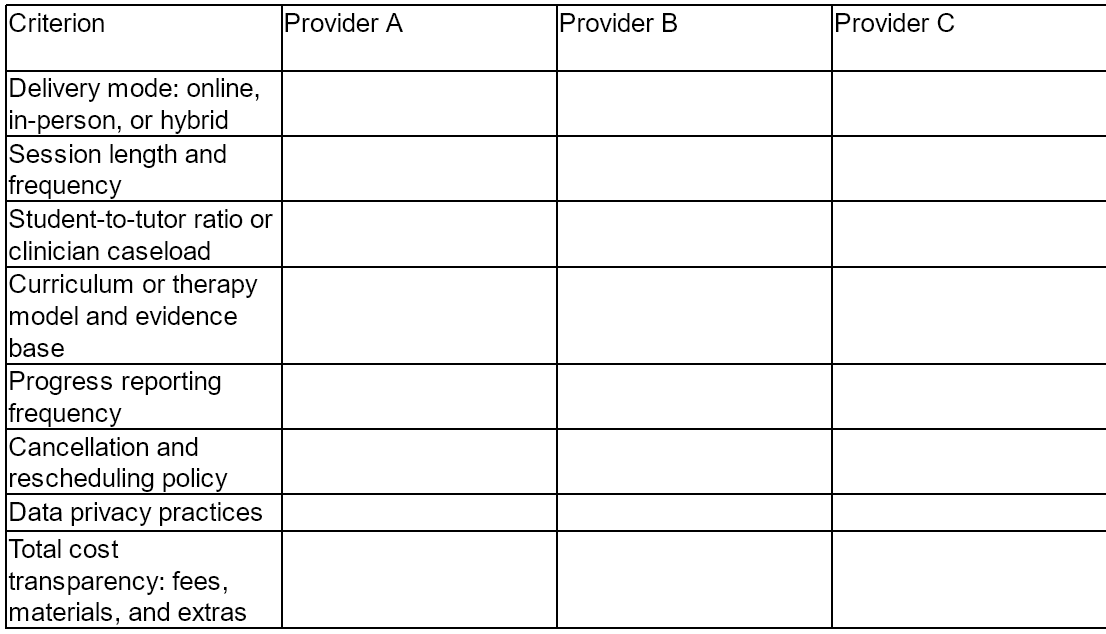
You do not need to find a perfect score across every row. Focus on the criteria that matter most for your child's situation. A provider with a lower ratio and strong progress reporting may suit a child who needs close attention, even if scheduling flexibility is limited.
Ten Smart Questions to Ask on the Discovery Call
A brief discovery call or intake meeting should cover practical ground. These ten questions are worth asking:
- How do you assess my child's baseline skills or needs?
- What curriculum, framework, or therapy model do you follow?
- Who delivers the sessions, and what are their qualifications?
- What weekly practice or homework is expected at home?
- How do you adapt sessions for different attention spans or sensory needs?
- How often will I receive progress updates, and in what format?
- What does a typical session look like from start to finish?
- How will we know if the approach is working at the four-to-six-week mark?
- Who is your safeguarding lead, and what is your escalation process?
- What is your cancellation, pause, or exit policy?
Pay attention to how the provider responds. Clear, specific answers signal confidence in their process. Vague answers, pressure to sign up immediately, or reluctance to discuss safety are reasons to keep looking.
Trial, Measure, and Decide
Avoid locking into a long package before you know whether the approach suits your child. A four-to-six-week trial with agreed goals is usually enough to see early signals.
Set SMART goals at the outset. For example: By week six, my child will independently attempt all reading comprehension questions in their homework without avoidance behaviours. Collect a baseline work sample or observation notes before the trial starts, then compare progress at each fortnightly check-in.
If progress stalls, that does not automatically mean the provider is poor. It may mean the goals need adjusting, the session format needs changing, or a different type of support, such as allied health rather than tutoring, would be more appropriate. Discuss next steps with the provider and, where relevant, involve school staff or your child's clinical team.
Budget and Access Pathways
Costs vary widely among child education and therapy providers, and this guide deliberately avoids quoting specific prices. What matters is transparency. A trustworthy provider lists or openly discusses fees, materials, cancellation rules, and any extras before you commit.
It also helps to think about access to quality education more broadly, because transport, scheduling, language, technology, and eligibility rules can shape which supports are realistic for a family.
Several funding and rebate pathways may be available in Australia, but the details change. The NDIS Early Childhood approach may cover eligible children's early intervention services. Medicare rebates may apply to some sessions delivered by registered psychologists or other allied health professionals under specific referral plans. Private health insurance extras cover may also contribute, depending on your policy. In every case, confirm current rules through the relevant official channel rather than relying on a provider's summary alone.
Bringing It All Together
Choosing the right educational or developmental support for your child does not require specialist knowledge. It requires the same habits you would use for any important decision: clarify what you need, check credentials, compare options fairly, start small, and measure what happens.
No single provider is right for every child, and needs change over time. Schedule periodic reviews, stay in regular contact with your child's school, and involve health professionals whenever developmental concerns arise. With a clear process and realistic expectations, you can make a confident choice that puts your child's safety, wellbeing, and progress at the centre.

.jpg)
.webp)