AI Chatbot Solutions for Small Businesses: A Practical Guide

Small businesses across the UK and Europe are adopting chatbots for simple reasons: to answer repeated customer questions, capture leads outside office hours, and reduce repetitive admin. The benefits can be real, but so can the risks.
A poorly configured bot can give inaccurate answers, mishandle personal data, or create costs that outweigh the time it saves.
This guide gives founders and startup leaders a practical way to choose a chatbot, run a time-boxed pilot, and scale with more confidence in about 90 days. It is written for teams of roughly 2 to 200 employees that want measurable outcomes rather than long feature lists.
Start by understanding the three broad categories you are likely to see.
Rules-based bots follow scripted decision trees and give the same answer to the same question.
LLM-powered bots with retrieval, often called RAG, pull from your own documents to generate more flexible responses.
Hybrid bots combine both, using fixed flows for structured tasks and language-model responses for wider customer questions. When researching chatbot options, compare vendor-published material with independent reviews, demos, and your own test queries before building a shortlist.
Key Takeaways
- Start with one measurable use case. Pick a problem you can track, such as FAQ deflection, first-response time, or qualified leads.
- Check your content before launch. Out-of-date policies, conflicting pages, and missing steps will weaken any chatbot.
- Use the simplest approach that meets your goal. A rules-based bot may be enough for order status or opening hours. Save RAG or hybrid tools for knowledge-heavy cases.
- Plan human handoff from day one. Customers should always have a clear route to a person when the bot cannot help.
- Run a pilot before scaling. A 30/60/90-day plan helps you learn cheaply, fix mistakes early, and build internal confidence.
Choose Your First High-Impact Use Case and KPI
The most common mistake is trying to automate too much at once. Choose one use case where volume is high, the answers are fairly predictable, and success can be measured.
For vendor-published background on common categories, use cases, and deployment considerations, read this guide to AI chatbot solutions, then compare it with demos, independent reviews, and your own test queries.
Support FAQ deflection. Primary KPI: deflection rate, meaning the percentage of enquiries resolved without a human. A first target of 15 to 25 per cent is realistic for many teams.
Order or booking status. Primary KPI: first-response time. This works best when the bot can pull live data from your eCommerce, ticketing, or booking system.
Lead qualification. Primary KPI: qualified leads per month. The bot asks a short set of questions and routes warm prospects to the right person.
Internal IT or HR help. Primary KPI: resolution rate for common requests, such as password resets, holiday balances, or policy lookups.
Before choosing a vendor, gather 50 to 200 recent support transcripts or emails. They will help you test accuracy and identify gaps in your knowledge base.
Pick an Approach That Fits Your Data and Risk Tolerance
Rules-based. Best when the answer set is small and must be exact, such as returns policy, opening hours, or delivery zones. It is predictable and lower risk, but less flexible.
LLM with retrieval (RAG). Best for knowledge-rich FAQs where customers ask the same question in many ways. The bot searches your documents and creates a response based on that content. It needs guardrails and regular reviews.
Hybrid. Best when you need fixed flows for structured tasks, such as booking or order tracking, plus natural-language answers for less predictable questions. It takes more setup, but can suit growing businesses.
Choose the lightest option that meets your KPI. You can add complexity later if the pilot proves there is value.

Data Readiness and Content Governance
A chatbot is only as useful as the content behind it. Before launch, review your FAQ pages, policy documents, product catalogues, and past support tickets.
Common problems to fix first include:
- Out-of-date refund or shipping policies
- Conflicting answers across different pages
- Missing steps in common processes, such as how to return an item
Appoint a content owner, even if it is one team member who reviews the knowledge base each month. Set an update cadence after every policy change, and keep simple version notes so you know what the bot was using at any point in time.
Chat transcripts often include names, email addresses, order IDs, or device identifiers. Under GDPR Article 4(1) and ICO guidance, this can be personal data. Plan retention periods and redaction processes before the bot goes live.
Channels, Integrations, and Handoff
Decide where the bot should live first. A website widget is the most common starting point, but WhatsApp, Instagram, email autoresponders, Slack, or Teams may be better if that is where customers or staff already communicate.
Map only the integrations you need for the first use case, such as CRM, helpdesk, eCommerce platform, or booking system. Each connector adds cost and maintenance, so start lean and prioritise links that simplify routine processes rather than duplicate manual work.
A good handoff process includes:
- A confidence threshold that routes uncertain answers to a human
- A visible "talk to a person" option
- The full transcript passed to the agent so the customer does not repeat themselves
- Clear operating-hours messaging when live support is unavailable
Safety, Privacy, and Compliance for UK/EU SMBs
This section highlights practical considerations, not legal advice. Consult the ICO's official guidance and, where needed, a data-protection professional.
Guardrails. Block topics the bot should not answer, such as medical, legal, or financial advice. Require answers to come from approved documents where possible. Add a fallback message when the bot is unsure. Do not request or store full payment card details in chat; route payments through PCI DSS-compliant processors.
Lawful basis. Confirm your lawful basis, such as legitimate interests or consent, before processing or training on chat transcripts that contain personal data.
Data minimisation and retention. Keep only the chat data you need for your stated purpose, and retain it only for as long as needed. This supports GDPR principles such as data minimisation and storage limitation.
Cookies and tracking. If the web chat widget sets non-essential cookies or similar technologies, obtain consent in line with UK PECR and ICO cookie guidance. Teams can use CookieRisk to check which cookies and tracking requests are observed before and after visitors make a consent choice.
Automated decisions. Avoid use cases where the chatbot makes decisions with legal or similarly significant effects unless you have reviewed GDPR Article 22 requirements and user rights.
Vendor contracts. Put a Data Processing Agreement in place with any chatbot provider that processes personal data on your behalf. It should cover processing instructions, security measures, and sub-processors.
Security evidence. Ask vendors for relevant certifications or reports, such as ISO/IEC 27001 or SOC 2, in line with your risk profile.
Budgeting and Pricing: What Actually Drives Cost
Chatbot pricing varies. Common cost drivers include per-seat fees, per-conversation charges, token usage, add-on connectors, implementation fees, support tiers, and overage rates.
Build a simple total-cost worksheet that covers:
- Monthly subscription or usage fees
- Implementation and onboarding costs
- Integration and connector fees
- Ongoing content curation and re-training time
- Human quality checks and error review
Then estimate payback: deflected tickets per month x average handling time x hourly staff cost, minus total monthly chatbot cost. If the result is positive and the margin is comfortable, the investment may be worthwhile.
Watch for hidden costs, including long-tail content curation, updates after policy changes, and the staff time needed for weekly error triage.
Build vs. Buy for Small Businesses
For most small businesses, a managed platform is the safer starting point. It usually gives you built-in guardrails, vendor support, more predictable pricing, and a faster launch.
A light custom build may make sense if you need deep process automation with niche internal systems, strict data-residency requirements, or specialised workflows that off-the-shelf tools cannot handle.
Either way, start with a pilot, keep humans responsible for decisions, and treat AI as a tool that still needs people, process, and oversight. Prove the concept before committing to a long contract or a full engineering build.
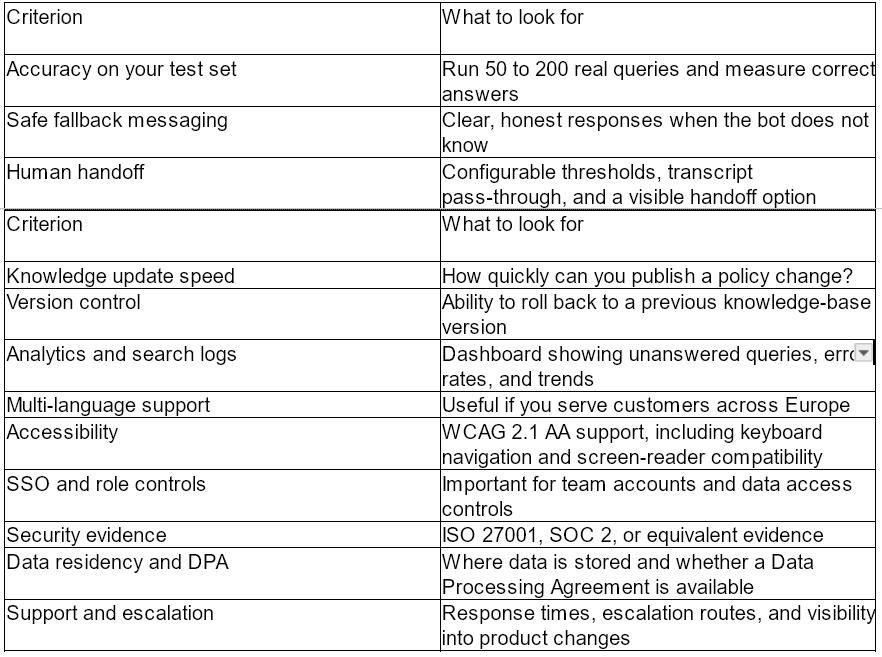
Vendor Evaluation Checklist
Score each criterion from 0, not met, to 3, fully met. This gives you a simple way to compare shortlisted vendors using your own priorities.
Measure ROI and What Good Looks Like
A simple formula for monthly savings is:
Monthly savings = (deflected tickets x average handling time in hours x hourly staff cost) minus monthly chatbot fees
Qualitative wins matter too. Track faster first-response times, useful out-of-hours coverage, fewer repetitive tasks for the team, and whether support agents have more time for complex issues.
Set realistic early targets. A 15 to 25 per cent deflection rate in the first quarter is a reasonable starting point for many small businesses. Improve from there.
Common Pitfalls to Avoid
- Launching without a single, defined use case
- Going live before cleaning up the knowledge base
- Operating without a human handoff path
- Training on chat transcripts that contain personal data without confirming a lawful basis
- Ignoring accessibility requirements
- Chasing features instead of measurable outcomes
- Skipping the pilot and committing to a long-term contract too early
Use-Case Snapshots
Retail returns policy. A rules-based bot walks customers through eligibility checks and creates a returns-label request. KPI: percentage of returns handled without agent involvement.
Professional services lead qualification. A hybrid bot asks prospects about budget, timeline, and project scope, then routes qualified leads to the sales team. KPI: qualified leads per week.
Hospitality booking triage. An FAQ bot answers questions about availability, parking, and dietary options, then points guests to the booking system. KPI: reduction in pre-booking phone calls.
SaaS onboarding FAQs. A RAG-powered bot answers new-user questions by searching the help centre. KPI: support-ticket volume in the first 14 days after sign-up.

Final Thoughts
Start small. Pick one use case, clean up the content behind it, choose the simplest architecture that works, and run a disciplined pilot. Measure what matters, fix what breaks, and scale only when the results support it.
The businesses that get this right will not necessarily have the most advanced technology. They will be the ones that treat their chatbot like any other operational decision: scoped carefully, tested honestly, and improved week by week.
FAQ
These short answers cover common questions that come up when small businesses compare chatbot options.
What is the difference between a rules-based chatbot and an LLM-powered one?
A rules-based chatbot follows scripted decision trees and gives the same answer when a condition is met. An LLM-powered chatbot uses a language model to generate responses, often using retrieval to pull from your documents. Rules-based bots are predictable but less flexible. LLM-powered bots handle varied wording better, but need stronger guardrails.
How do I reduce chatbot hallucinations?
Limit the bot to approved content, use retrieval so answers are grounded in your documents, and add fallback messages for low-confidence queries. Block sensitive topics and review unanswered or low-scoring queries each week.
How does RAG use my documents?
RAG stands for retrieval-augmented generation. When a user asks a question, the system searches your knowledge base for relevant passages, then uses those passages to create a response. This helps keep answers closer to your approved content.
Can a chatbot support multiple languages?
Many platforms offer multilingual support, but quality varies. Test each language with real queries before committing. Also check whether your knowledge base is available and up to date in each target language.
When should I involve a legal or data-protection professional?
Involve one before launch if the chatbot processes personal data, affects individuals through automated decisions, or operates across multiple jurisdictions. They can help review lawful basis, vendor contracts, retention, and redaction policies.