Cash Drawer Count Sheet: A 15-Minute End-of-Day Routine for Small Retailers

It's 10:15pm. The café is closed, the chairs are up, and the drawer is $20 short.
Again.
Somebody counts it twice. Somebody else swears they didn't take anything. Everyone goes home a little annoyed and nobody knows where the money went.
Most small shops close the till like this. A quick count, a number scribbled on a receipt roll, and a vague feeling that it's "about right." In the UK they'd call it cashing up, and the question owners keep asking is how to cash up a till without it turning into a nightly argument.
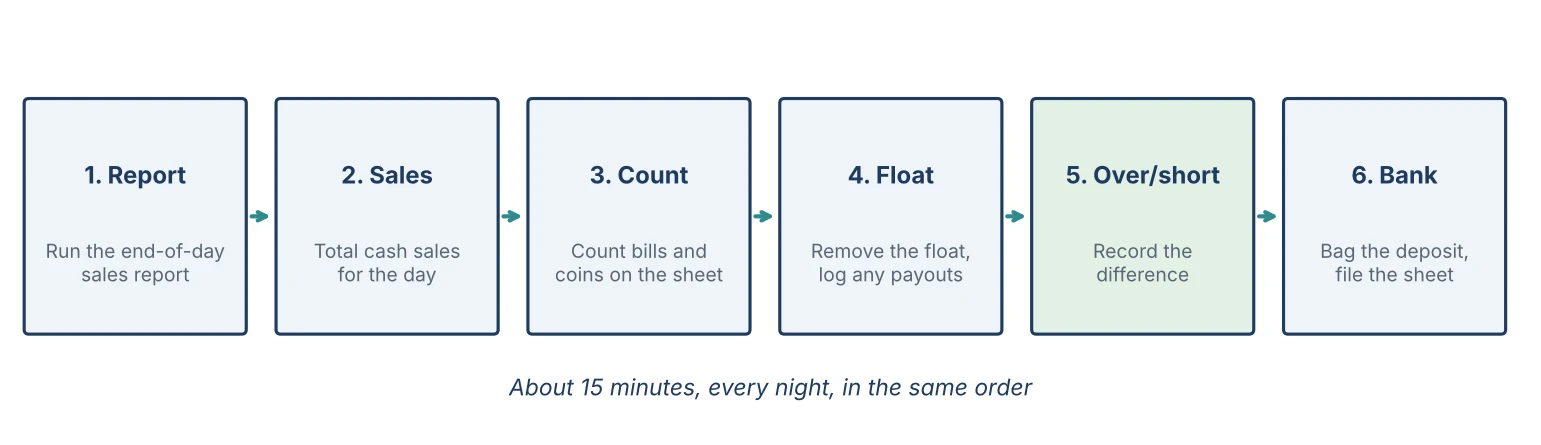
The answer is boring, which is why it works: a cash drawer count sheet, the same six steps every night, and about 15 minutes.
What Is a Cash Drawer Count Sheet?
A cash drawer count sheet is a one-page form for counting the money in a register at the end of a shift. It lists every bill and coin, totals them, removes the starting float, and compares what's left with the day's cash sales. The difference is your over or short.
A cash count sheet does the same job for any pile of cash, and its cousin covers the money kept in the back office safe. Same idea, different drawer.
It also matters for your records. The IRS lists cash register tapes and deposit information among the documents that support a business's gross receipts. A signed count sheet next to the day's report is exactly that kind of paper trail.
At a Glance
What it is: A one-page count of the drawer at close.
How long it takes: About 15 minutes once it's routine.
What it catches: Missing payouts, miscounts and patterns by shift.
What you need: The sales report, the sheet and a calculator.
What you keep: The sheet, the report and every payout slip.
Petty Cash and Cash Float: Not the Same Money
Here's the part almost every till dispute comes down to. There are three piles of money in one drawer, and people mix them up.
Think of it like a shared kitchen fridge. The float is the milk that has to be there in the morning. The sales are what you're taking home. The payouts are what someone borrowed. If nobody writes anything down, it all looks like theft.
A separate petty cash fund for small expenses is cleaner still, because then nobody needs to dip into the register at all.
Worked Examples
All three examples follow Corner Grind, a fictional café and deli with a $200 cash float. The numbers are sample data.
Example 1: A Clean Close
Tuesday's report shows $1,146.50 in cash sales. The drawer counts to $1,346.50.
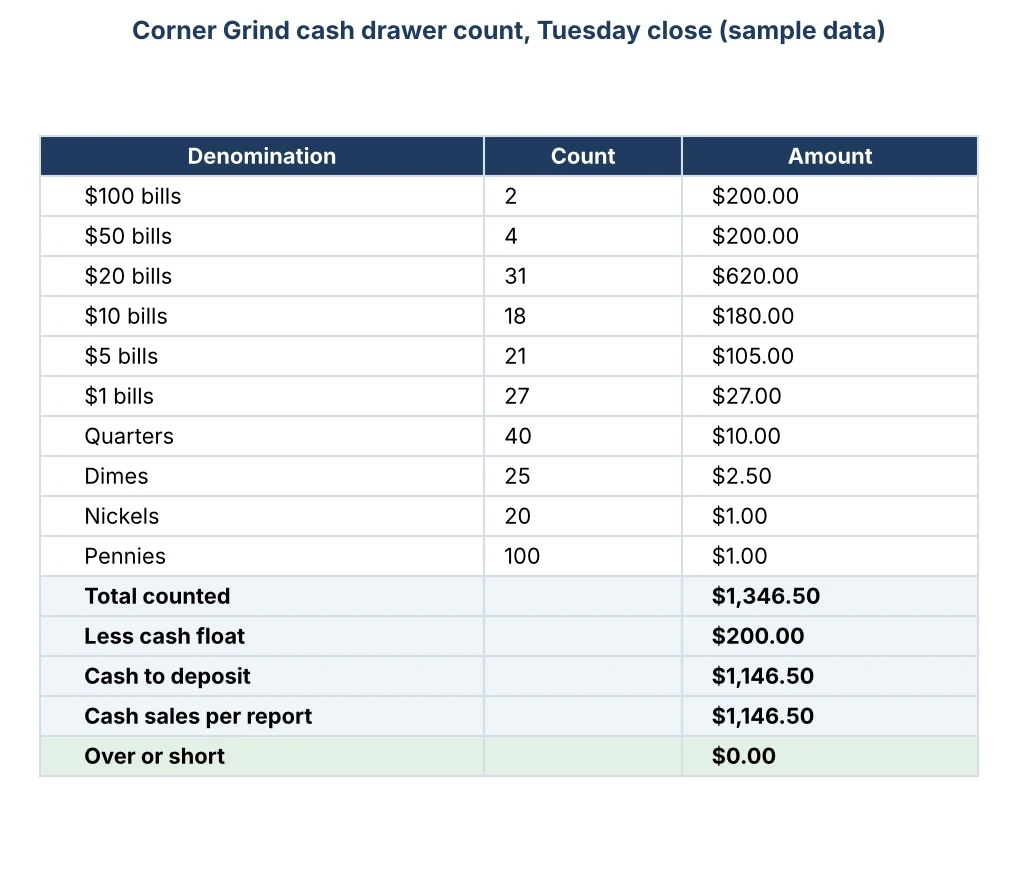
$1,346.50 counted, less the $200 float, leaves $1,146.50. That matches the report exactly: over or short of $0.00.
That's what a good night looks like. Nothing exciting. That's the goal.
Example 2: The Shortage That Wasn't
Wednesday's report shows $982.00 in cash sales, so the drawer should hold $1,182.00 including the float. It holds $1,162.00. Twenty dollars short.
Then someone remembers. The milk ran out at 3pm and a barista paid the delivery driver $20 from the till.
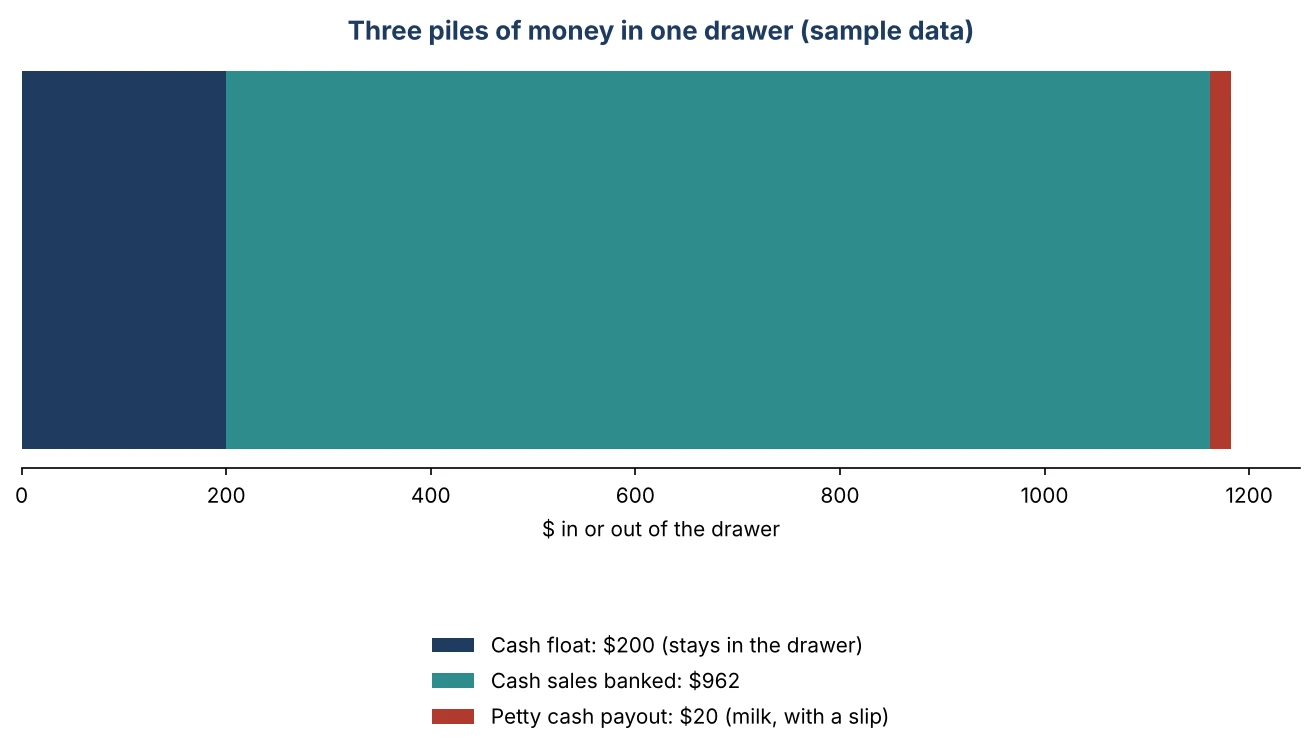
One slip fixes it. Record the $20 as a payout, attach the receipt, and the drawer balances. Nobody stole anything. The paperwork just went missing.
Example 3: The Pattern a Single Count Never Shows
Corner Grind tracks the over and short figure on every sheet. After one week, the picture is clear.
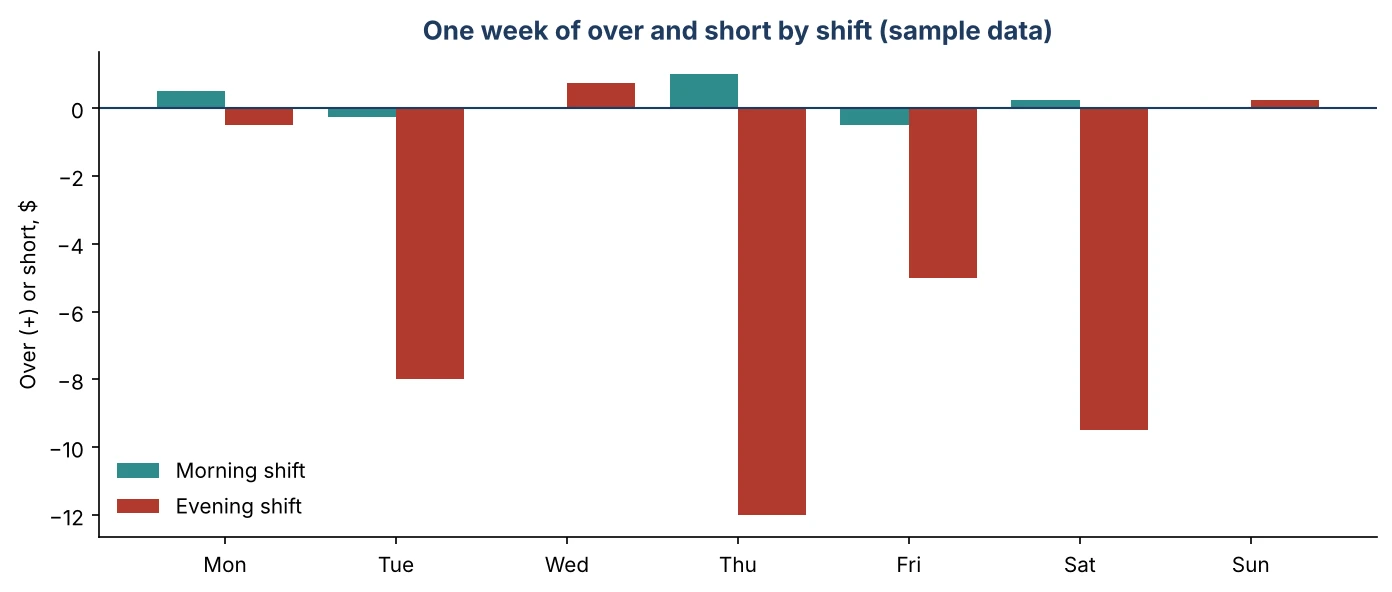
Morning shifts land within a dollar either way all week. The evening shift is short by $5 to $12 on four nights, $34.00 across the week.
That isn't proof of anything. It's a question worth asking, and it usually has a boring answer: refunds handed out without a receipt, or change given from memory during a rush. Either way, you only see it because the number was written down every night.
How to Close the Till in 15 Minutes
Six steps, in the same order every night.
1- Run the End-of-Day Report
Why: the report is the number you're checking against. Print or save it before anyone starts counting, so nobody counts toward a target.
Tip: close the register session first, so no late sale slips in between the report and the count.
2- Total the Day's Sales
Why: you need cash sales on their own, separate from card payments. Most POS reports split them.
Tip: if your system doesn't, keep a simple POS sales sheet that totals cash and card separately each day.
3- Count the Drawer
Why: counting by denomination on a cash count sheet is slower than a quick riffle, and far more accurate. Count bills, then coins, then total.
Tip: good cash handling means two people for the count, one counting and one checking. That removes most arguments before they start.
4- Remove the Float and Log Payouts
Why: the float isn't income, and payouts aren't missing money. Good cash float management means taking out the same fixed amount every night and writing down every payout separately.
Tip: keep petty cash slips with the receipt stapled on, and record each one in a petty cash log for the till float, so payouts never look like shortages again.
5- Record Over or Short
Why: one number on the sheet, every night. On its own it means little. Over a week or a month, it tells you which shift or which habit needs attention.
Tip: set a tolerance, such as a dollar either way, and only investigate beyond it.
6- Bank It and File the Sheet
Why: the deposit leaves, the sheet stays. Signed sheets, reports and slips together are your evidence if a number is ever questioned.
Tip: if cash sits in a safe overnight, count it on its own sheet too. Writing down your cash handling procedures once means every new hire closes the same way.
Daily Count vs Weekly Count
A drawer you count every night is a drawer you can explain.
Common Mistakes
✗ Counting toward a number
Why it matters: People unconsciously make the count fit the report.
The fix: Count first, compare second, ideally with two people.
✗ Taking payouts from the till with no slip
Why it matters: Honest spending looks exactly like a shortage.
The fix: Use a separate fund, or log every payout with a receipt.
✗ Changing the float amount
Why it matters: Every night's math becomes a guess.
The fix: Keep the float fixed and reset it to the same amount at close.
✗ Throwing the sheets away
Why it matters: You lose the trail that explains any gap later.
The fix: File each sheet with that day's report and slips.
How Enerpize Handles End-of-Day Cash
What if the sheet filled half of itself in?
Enerpize is a cloud-based, all-in-one ERP platform for small and medium-sized businesses, combining accounting, inventory, HR, sales, and CRM in a single system. On the shop floor, its POS is where the routine above lives.
POS Sessions With a Counted Close
Each sales session is closed and validated with the amount of cash you counted by hand, so the counted figure sits next to the recorded one for every shift and every salesperson.
Cash In and Cash Out
Cash added to or taken from the register is recorded as it happens, with the employee in charge, so a payout is logged rather than discovered at 10:15pm.
Treasuries and Expense Funds
Branches and teams can have their own treasuries and cash accounts for small expenses, with spend limits, and receipts can be scanned from a phone, with OCR pulling out the amount, date and vendor.
Sales That Keep Going Offline
If the internet drops mid-shift, the POS keeps recording sales and syncs them when the connection returns, so the end-of-day report still matches the day.
Key Takeaways
- A cash drawer count sheet turns closing the till into a 15-minute routine with one clear result: over or short.
- Corner Grind's clean close: $1,346.50 counted, less a $200 float, matched $1,146.50 in cash sales exactly.
- A $20 "shortage" was a milk payout with no slip. One logged payout balanced the drawer.
- One week of figures showed $34.00 short, all on the evening shift, a pattern no single count would reveal.
- The IRS lists cash register tapes and deposit information as records that support gross receipts.
- Keep the float fixed, log every payout, and file each sheet with the day's report.
Frequently Asked Questions
What is cash float?
It's the fixed amount of cash left in a register at the start of a shift so staff can give change. It isn't income, so it's taken out before the day's cash is compared with sales, and it's reset to the same amount at close.
How do you decide how much float to keep in the till?
Look at how customers pay and what change they need on a busy day. Enough small bills and coins to get through the morning rush is the target. Once you pick a figure, keep it the same every day so the math stays simple.
What is a cash drawer count sheet used for?
It records the count of every bill and coin at close, removes the float, and compares the rest with the day's cash sales. It shows whether the drawer is over or short and gives you a dated record of the result.
What's the difference between petty cash and the till float?
The float stays in the drawer to make change. A separate cash fund pays for small business expenses, such as supplies, and each payment needs a slip and a receipt. Mixing them up is the most common cause of false shortages.
What is a safe count sheet?
It's the same idea as a drawer count, used for cash held in a safe, such as deposits waiting to be banked or spare change. It confirms the safe holds what your records say it should.
What does "over and short" mean?
It's the difference between the cash you counted and the cash you should have. Over means extra cash, short means less. Small amounts happen; a repeated pattern is worth a closer look.
How often should you count the cash drawer?
At the end of every shift, or at least every day. The sooner you count, the easier it is to remember what happened and fix a missing slip.
What cash sales records should a small business keep?
Keep the end-of-day reports, deposit records and count sheets together. The IRS lists cash register tapes and deposit information among the documents that support gross receipts, so they belong in your files.
Back to 10:15pm
It's 10:15pm at Corner Grind again. The chairs are up.
The report is printed, the drawer is counted on the sheet, the float is back at $200, and the milk payout has a slip with a receipt stapled to it. Over or short: zero.
Nobody argues. Everybody goes home.
That's all a cash drawer count sheet really buys you. Not perfection. Just a number you can explain, every single night.
About the Author
Omar El Bahr
Senior Digital Growth Specialist, Enerpize
Omar El Bahr is a Senior Digital Growth Specialist at Enerpize, where he leads SEO, content strategy, and organic growth across international markets. He is a Forbes Communications Council contributor and has written for Entrepreneur on business communication and digital strategy.