Is Your Scrap Stainless Steel Ending Up in the Right Place?
By a scrap metal industry contributor.
A pile of gleaming metal trim, old kitchen sinks, or industrial off-cuts represents more than just project waste. It's a commodity with real value, but that value is easily lost. Many contractors and facility managers unknowingly leave money on the table by mixing high-value grades with lower-value ones, or by failing to remove contaminants like plastic or wood. This simple mistake can downgrade an entire load, turning valuable 316-grade steel into a much lower-priced, mixed-metal payout.
Understanding the fundamentals of sorting and preparation is the first step toward a more profitable and efficient process. Proper stainless steel recycling ensures you get fair compensation and that the material re-enters the supply chain at its highest potential use. Globally, the system works remarkably well. Around 95% of end-of-life stainless steel is collected and recycled, according to the global trade body worldstainless, making it one of the world's most recovered materials. The challenge for you is ensuring your specific scrap is handled correctly to capture its full market value.
Quick answer: Yes, stainless steel is highly valuable and almost infinitely recyclable. The key to maximizing your return is separating different grades (like 304 from 316) before you arrive at the yard and ensuring your load is free of contaminants. Your choice of recycling partner matters, as their sorting technology and transparent process directly impact your payout.
What's inside
· How are different types of stainless steel identified?
· What should you look for in a recycling facility's process?
· How is scrap stainless steel actually priced?
· Frequently Asked Questions
· Turning Knowledge into a Better Payout
How are different types of stainless steel identified?
Professionals use X-ray fluorescence analyzers for precision, but you can use a simple magnet test to separate the most common and valuable grades yourself.
The value of stainless steel scrap is determined by its specific alloy composition, particularly its nickel and molybdenum content. If you are filling a metal recycling dumpster, you will encounter two main families: the 300 series (austenitic) and the 400 series (ferritic). The 300 series, like grades 304 and 316, contains a significant amount of nickel, making it non-magnetic and more valuable. The 400 series has very little or no nickel, which makes it magnetic and worth considerably less.
❝ The single most important field test you can do requires a simple pocket magnet. Press it against your scrap. If it does not stick, you likely have a 300-series grade like 304 or 316, which carries a higher price. If the magnet sticks firmly, it is almost certainly a lower-value 400-series grade. Separating your piles based on this test alone can prevent an entire load from being downgraded.
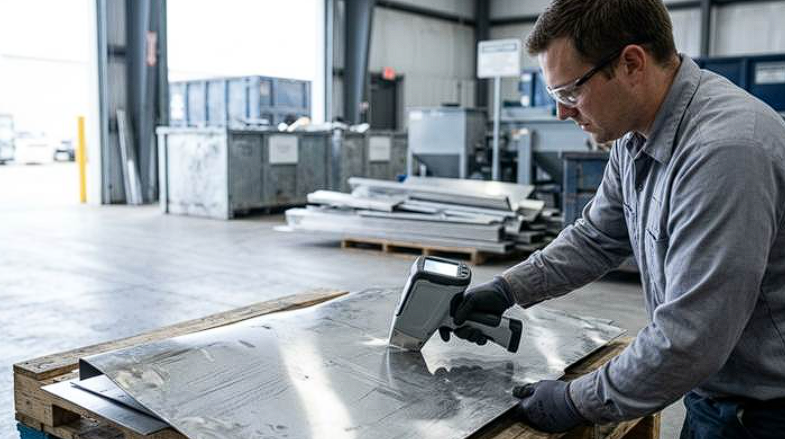
When you bring your sorted material to a recycling facility, they will verify the grade with a handheld X-Ray Fluorescence (XRF) gun. This device provides a near-instantaneous chemical breakdown of the metal, showing the exact percentages of chromium, nickel, and other elements. This is how a yard can definitively distinguish between 304 stainless and the more valuable 316 grade, which contains molybdenum for added corrosion resistance. An honest facility will use this tool to ensure you are paid accurately for each grade you bring in. Ask if they can test a few pieces in front of you.
The financial stakes of sorting are significant. Mixing a small amount of low-value 400-series steel into a bin of high-value 316 can force the buyer to price the entire container as "mixed stainless," a much lower-paying category. Proper identification ensures you capture the full value of premium alloys.
What should you look for in a recycling facility's process?
You should look for a facility with certified scales, a transparent weighing process, and clear pricing based on standardized grades.
The most critical piece of equipment at any scrap yard is the scale. An inaccurate or uncalibrated scale directly impacts your payment. All commercial scales must be certified by the state's department of weights and measures, a process governed by standards like those in the National Institute of Standards and Technology (NIST) Handbook 44. Ask to see the scale's certification sticker. It should have a recent date, showing it has been tested and found accurate by a government official. This is a non-negotiable mark of a professional operation.
Beyond the scale itself, observe the yard's workflow. A well-run facility will have a clear, organized process. You should be able to witness your material being weighed on both a truck scale (for your vehicle's gross weight) and then again after unloading (the tare weight). The difference is your net weight, which should be printed on an official scale ticket. This document is your receipt and the basis for your payment. It should clearly list the material type, weight, price per pound, and total value.
❝ A key question to ask is, "How do you handle mixed-grade loads?" A reputable yard will explain their process for sorting and grading your material. They may offer to sort it for a fee or explain how they will downgrade the price. A vague answer is a red flag that you might not be getting the full value for your higher-grade alloys.
Finally, a professional facility bases its pricing on established industry standards. They will grade your stainless steel according to specifications set by a trade body like the Institute of Scrap Recycling Industries (ISRI). Using these standard grades ensures a common language and fair market pricing. A yard that uses vague, internal names for different grades may be creating confusion that works against you.
Here is a simple checklist for evaluating a recycling partner:
How is scrap stainless steel actually priced?
The price you receive is not arbitrary. It is directly tied to global commodity markets, specifically the price of nickel, minus a "spread" that covers the recycler's operational costs.
Unlike a fixed retail price, scrap metal values fluctuate daily, sometimes hourly. The primary driver for the most common stainless grades, like 304 and 316, is the price of nickel on the London Metal Exchange (LME). This is the global benchmark for industrial metals. A recycling facility tracks this market and uses it as the foundation for its pricing. From that benchmark, the facility subtracts its spread. This is the margin required to cover the costs of sorting, processing, baling, and shipping the material to a steel mill, as well as their own profit.
The size of that spread is not fixed. It can vary based on several factors. A large, clean, well-sorted load of a single grade is more efficient to process and therefore commands a tighter spread, meaning a better price for you. In contrast, a small, mixed load that requires significant labor to sort will have a wider spread. Transportation costs also play a major role. A yard with efficient logistics and strong relationships with mills can often offer more competitive pricing.
❝ When you call a yard for a price, don't just ask for the per-pound rate. Ask a more revealing question: "How is your price calculated relative to the market?" A professional buyer should be able to explain their process. They might mention the LME nickel price or another industry benchmark. A vague answer suggests their pricing may be less transparent and potentially less competitive.
Ultimately, the price reflects the real-world cost of turning your scrap back into a usable raw material for a steel mill. A facility that has invested in efficient sorting technology, maintains low overhead, and moves high volumes of material can operate on a smaller margin. This translates directly into a higher payout for their customers. Understanding this mechanism helps you evaluate whether you are getting a fair deal based on market realities, not just an arbitrary number.
Frequently Asked Questions
Is stainless steel worth scrapping? Absolutely. Its value comes from the high cost of its primary alloy components, like nickel and chromium. Recycling stainless steel is also far more energy-efficient than producing new steel from raw ore, which creates consistent demand from mills. This makes it one of the more consistently valuable materials you can bring to a scrap yard.
How much is one pound of stainless steel worth? There is no fixed price, as it changes daily with global commodity markets. While prices are often quoted per pound for small quantities, be aware that industrial transactions are typically priced per hundredweight (CWT) or per ton. A yard's price will reflect the global benchmark minus their processing costs, so a clean, well-sorted load will always command a better per-pound rate.
What are some common sources of stainless steel scrap? You can find valuable stainless steel in many places. Common examples include old commercial kitchen equipment like sinks and prep tables, restaurant appliances, food processing machinery, and medical devices. It is also found in automotive exhaust systems, marine hardware, and certain high-end home appliances.
Why do I need to show an ID to sell scrap metal? State and local laws require scrap yards to record seller identification for every transaction. This is a measure to combat metal theft by creating a paper trail for law enforcement to follow. Requiring a valid driver's license or state-issued ID and paying by check are standard procedures for any licensed, professional recycling operation.
How can I tell if an appliance is stainless steel or just a look-alike finish? Use a magnet. True 300-series stainless steel, the most common type used in appliances, is non-magnetic. If a magnet sticks firmly to the surface, it is likely a lower-value steel with a stainless-look coating or a less valuable 400-series ferritic stainless steel.
Turning Knowledge into a Better Payout
The journey from a pile of scrap to a fair payment is not a passive one. The value of your stainless steel is determined by its specific grade, something you can initially test with a simple magnet. That grade's value is then tied directly to global commodity markets, particularly the fluctuating price of nickel. These factors set the stage, but they do not guarantee you will receive the material's full potential worth. The final, and most critical, variable is the integrity of the facility you choose.
Your most important decision is selecting a partner whose process is transparent. A high price-per-pound means little if the scales are inaccurate or your high-value 316-grade steel is vaguely categorized as "mixed scrap." A facility that welcomes questions, shows you its scale certification, and explains its pricing relative to market standards is not just being helpful. It is demonstrating a professional foundation that ensures you capture the true value of your material. This transparency is more important than any advertised price.
Ultimately, the best price for your scrap is not found, but created. It is created through your own diligence in sorting materials and through your choice of a recycling facility that operates with verifiable integrity. By understanding the "why" behind the price, you move from being a simple seller to an informed partner in the recycling stream. That shift in perspective is the key to maximizing your return.
About the author
The team at Olympus Recycling specializes in scrap metal recovery for a wide range of clients, from large-scale industrial operations to local businesses and individuals. Operating out of facilities in Atlanta and Gainesville, Georgia, the company provides roll-off container services and a structured process for weighing, grading, and purchasing both non-ferrous and ferrous metals. By managing the logistics for materials like stainless steel, copper, and aluminum, Olympus Recycling creates an efficient pathway for returning valuable raw materials back into the manufacturing supply chain.