My Big Idea: restaurant payment system Café QR
Hi Qaiser! What's your elevator pitch?
Café QR is an affordable till, QR table ordering and kitchen display system built for independent cafés, restaurants, pubs and takeaways. Customers can scan a QR code, order and pay from their phones, and send orders directly to the kitchen. Staff can manage sales, tables and orders from a tablet, while owners get access to reporting and business management tools. The idea is simple: give independent hospitality businesses the technology larger chains use, without expensive hardware contracts or complicated pricing. QR ordering starts at £9.99 a month, and the full POS costs £39 a month per venue. There are no long-term contracts, and Café QR takes no commission on orders.
Why does the market need it?
Independent hospitality businesses operate on tight margins, but many end up paying for several disconnected systems: a till, card payments, table ordering, kitchen displays, online ordering and stock management. Some traditional EPOS systems require expensive equipment or long agreements. At the other end of the market, inexpensive QR menu tools often solve only one problem. We wanted to bring those functions together in one accessible platform. A small independent café should have access to the same digital capabilities as a large restaurant chain without needing a large IT budget.
Where is the business today?
We launched Café QR in 2026 as a UK-based hospitality technology business. Our platform is live, with features including QR ordering, a browser-based till, waiter applications, kitchen display screens, table bookings, loyalty programmes, inventory tools and AI-assisted reporting. We are now concentrating on the UK market, working on customer acquisition, refining onboarding and improving the product based on real hospitality requirements. We're also developing integrations that will make it easier to connect card payment terminals and third-party delivery platforms. These are ongoing projects rather than completed partnerships.
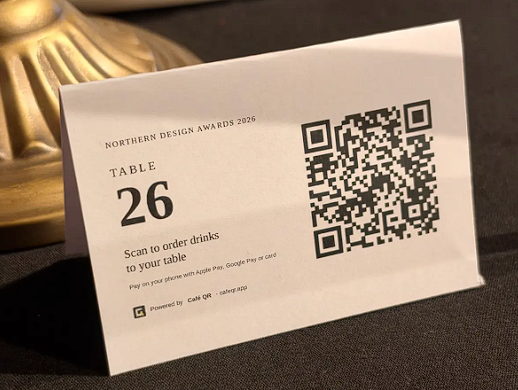
Our first customers are using it in real service. DndLounge, a lounge in London, takes its table orders through Café QR, and the Northern Design Awards used it to run drinks and table ordering at their awards night at Chester Town Hall and Chester Cathedral in November.
What made you think there was money in this?
My background is in software engineering, so I naturally look at problems from the perspective of how technology can simplify them. The opportunity I identified was the gap between expensive, fully integrated hospitality systems and cheaper applications that solve only one part of the job. A café might have one system for taking payments, another for online ordering and a third for managing its kitchen. Bringing those functions together at a transparent monthly price seemed like an opportunity to build something useful for independent operators. Instead of trying to compete with established providers on hardware or sales teams, we decided to focus on simplicity, flexibility and affordability.
What's your biggest strength?
As a small technology company, our strength is being able to respond quickly. We can listen to a customer, understand the problem and make improvements without navigating layers of management. The platform is browser-based, so venues can use equipment they already own rather than committing to an expensive hardware lease. Transparency is another strength. Our prices are published openly, and customers can start with a free month without entering card details.
What is the secret to making the business work?
Trust. A restaurant's till and ordering system are critical to daily operations. Owners understandably hesitate before replacing something their staff already know. Rather than asking customers to change everything immediately, we let them start small. For example, they can introduce QR ordering alongside an existing till for £9.99 a month, learn how the platform works and decide whether to expand to the full POS. For me, an important lesson is to make it easy for customers to try your product without taking a big financial or operational risk.
How do you market the company?
We're taking a practical, cost-conscious approach. We reach out directly to independent hospitality businesses, particularly new venues that may still be choosing their systems. We also invest in educational content covering subjects such as EPOS pricing, payment processing fees and restaurant profitability. Our website, search engine optimisation, targeted advertising and LinkedIn are important parts of our marketing. We're learning which approaches bring genuine conversations with restaurant owners rather than simply generating website traffic.
What funding do you have? Is it enough?
Café QR is self-funded. We've deliberately kept our operating costs low by building the platform with modern cloud technology and a lean development approach. Our focus is on building a sustainable business with recurring subscription revenue. At this stage, proving the value of the product, building customer relationships and growing a stable base of paying venues are more important than pursuing growth at any cost.
Tell us about the business model.
Café QR operates on a monthly subscription model. QR table ordering starts at £9.99 a month. Venues can add their own online collection and delivery ordering page for £5 more. Our full POS costs £39 a month per venue, while multi-site plans start at £59 a month, with £29 for each additional venue. Optional features include stock and recipe management and more advanced accounting insights. We don't charge commission on orders. Venues use their own payment provider and remain responsible for the provider's processing fees. The subscription model gives us predictable recurring revenue while allowing customers to expand their systems as their businesses grow. Our immediate priority is to build a sustainable customer base rather than make premature claims about profitability.
What were you doing before?
Before founding Café QR, I worked as a full-stack software engineer, building web applications and business platforms. My experience includes backend development with C# and .NET, frontend technologies such as React and Angular, database systems, cloud infrastructure and third-party integrations. I've worked on enterprise applications and operational systems where reliability, security and handling complex workflows are essential. That experience helped me approach Café QR as more than a digital menu or simple checkout application. I wanted to build a complete system that could bring several parts of hospitality operations together.
Are there any technologies you've found useful?
AI development tools have made a significant difference to how small software teams operate. We use Claude to help with development, testing and research, allowing us to move quickly while keeping the team lean. Café QR uses Next.js, Vercel and Neon as part of its application infrastructure, alongside Stripe for payments, Clerk for authentication and Ably for real-time updates. Real-time technology is particularly useful in hospitality because an order placed at a table needs to appear promptly on the kitchen display. We also use Zoho Mail and Resend for business communications.
What is the future vision?
I want Café QR to become a trusted, affordable operating platform for independent hospitality businesses. Our aim is to connect the counter, tables, kitchen, online ordering, customer loyalty and business reporting in one system. In the near term, we're focused on growing in the UK, improving our payment and delivery integrations, and making the platform even easier for independent operators to adopt. Long term, I'd like the technology to make running a small hospitality business less complicated, so owners can spend more time looking after their customers and less time managing disconnected software.