The Real Cost of Paying International Teams in 2026

Most companies budget for international payroll by looking at one number: the per-employee monthly fee quoted by their EOR or payroll provider. That number is almost always misleading.
By the time FX markups, intermediary bank fees, compliance overhead, onboarding charges, and settlement float are factored in, the true cost of paying a global team can exceed the headline rate by 40% to 60%.
For companies hiring across five or more countries, the gap between what they expect to pay and what they actually pay is often the difference between a sustainable burn rate and one that quietly erodes runway.
Key Takeaways
- The headline per-employee rate is rarely the real cost
- FX spreads and settlement float are the largest hidden expenses
- Stablecoin and modern payment rails are compressing costs significantly
Where the Money Actually Goes
International payroll costs break down into layers, and most companies only see the top one. Here is what a typical cost stack looks like for paying one employee in a foreign market through a traditional EOR and banking setup.
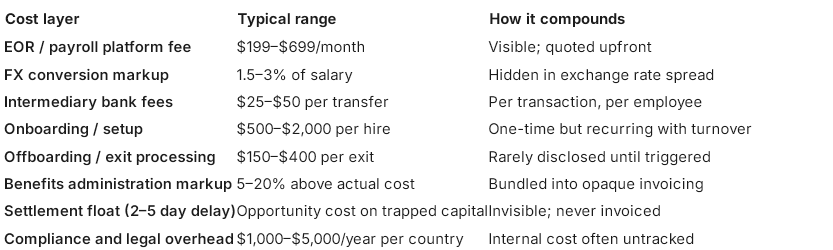
For a company paying 20 employees across five countries at an average salary of $80,000, the difference between headline pricing and actual total cost can reach $50,000 to $120,000 annually, capital that never shows up in the EOR invoice but absolutely shows up in the P&L.
FX Markups: The Cost Nobody Talks About
Foreign exchange is where international payroll providers make some of their largest margins, and where companies lose the most money without realizing it. The mechanism is simple: the provider converts funds at a rate that includes a spread over the mid-market rate, and that spread is rarely disclosed transparently.
According to Andersen research on cross-border payment statistics, the average FX conversion fee in cross-border payments is 2.5% to 3%. On an $80,000 annual salary, that translates to $2,000 to $2,400 per employee per year in currency conversion costs alone. Across a 20-person international team, FX markups can quietly consume $40,000 to $48,000 annually, more than many companies pay in total EOR platform fees.
The problem is compounded by opacity. Most providers bundle FX into the payment rather than itemizing it, making it nearly impossible for finance teams to audit the actual spread applied.
Settlement Float: The Invisible Tax
Traditional cross-border payments take two to five business days to settle through correspondent banking networks. During that window, capital is in transit, it has left the company's account but has not arrived in the employee's.
That trapped liquidity carries a real cost. Gitnux research estimates that slow cross-border settlement costs the global economy $120 billion annually in trapped capital. For individual companies, the impact is proportional but still material: a 20-person team with $160,000 in monthly payroll has roughly $32,000 to $80,000 in capital trapped in transit at any given time if using traditional wires.
Stablecoin settlement and real-time payment rails eliminate this float entirely. When payroll settles in minutes rather than days, working capital stays liquid and the opportunity cost disappears.
"The companies doing the most sophisticated cost analysis in 2026 are the ones that stopped looking at payroll as a single line item," said Chiara Munaretto, Co-Founder and Managing Partner of Stablecoin Insider. "When you actually break down the FX spread, the float, the onboarding costs, and the compliance overhead, the total cost of ownership looks nothing like the per-employee fee they were quoted. That gap is exactly where stablecoin rails and modern platforms are creating the most value."
How Modern Payment Infrastructure Changes the Math
The cost structure of international payroll is being reshaped by three forces: stablecoin settlement, real-time payment networks, and transparent pricing platforms.
Stablecoin rails, particularly USDC and USDT, which processed $33 trillion in combined transaction volume in 2025, bypass correspondent banking entirely. There are no intermediary bank fees, no multi-day settlement delays, and FX conversion happens transparently at or near the mid-market rate. For companies with the infrastructure to use them, stablecoins reduce the variable cost layer of international payroll to near zero.
Real-time payment networks like FedNow, SEPA Instant, and the PayNow-UPI bridge are also compressing settlement times from days to seconds within connected corridors. While these networks still operate within the banking system, they eliminate float and reduce the window during which capital is trapped.
And a growing number of payroll platforms now offer transparent, itemized pricing that separates the platform fee from FX, benefits, and compliance costs, giving finance teams the visibility to model true total cost of ownership for the first time.
What Finance Teams Should Be Modeling
The shift for companies in 2026 is from per-employee pricing comparisons to total cost of ownership analysis. That means modeling every layer of cost: platform fees, FX spread, banking fees, onboarding and offboarding, benefits markups, compliance overhead, and settlement float.
The companies getting this right are the ones asking their providers to itemize every cost component, and comparing the true total against modern alternatives including stablecoin-native payroll platforms and hybrid fiat-crypto infrastructure that give employees withdrawal flexibility while reducing the employer's cost stack.
FAQs:
1. What is the real cost of paying international teams in 2026?
The true cost typically exceeds the headline EOR or payroll platform fee by 40% to 60%. Hidden costs include FX conversion markups of 1.5–3%, intermediary bank fees of $25–$50 per transfer, onboarding charges of $500–$2,000 per hire, benefits administration markups of 5–20%, and settlement float on capital trapped in transit for two to five days.
2. What are the biggest hidden costs in international payroll?
FX conversion markups and settlement float are the largest hidden expenses. FX spreads alone can cost $2,000–$2,400 per employee annually on an $80,000 salary, and settlement float traps tens of thousands of dollars in capital at any given time for companies using traditional banking rails.
3. How do stablecoins reduce international payroll costs?
Stablecoin settlement bypasses correspondent banking entirely, eliminating intermediary bank fees, reducing FX conversion costs through transparent near-mid-market rates, and settling payments in minutes rather than days. This removes both the direct fees and the opportunity cost of trapped capital.
4. How much do EOR services cost in 2026?
EOR platform fees range from $199 to $699+ per employee per month depending on the provider and country. However, the total cost including FX spreads, benefits markups, onboarding, and compliance overhead can push effective per-employee costs significantly higher than the quoted rate.
5. How can companies reduce the cost of paying international teams?
Companies should request fully itemized cost breakdowns from providers, model total cost of ownership rather than comparing headline fees, evaluate stablecoin and real-time payment rails as settlement alternatives, and choose platforms with transparent FX pricing and no bundled markups.