Why the tip of the knife does the cutting on an atv flail mower, not the engine
The grass stops growing, and the year's neglect becomes visible
By the middle of September British paddocks and amenity ground have stopped putting on length, which is exactly when the summer becomes legible. Docks and thistles that were hidden in the sward are now standing above it, bramble has crept a metre further out of every hedge line, and the ground is still firm enough to carry a machine. An atv flail mower exists for that fortnight, and what determines whether it copes is a number almost nobody quotes.
Cutting is done by speed, not by force
A flail knife does not shear material the way a pair of blades does. It arrives at the stem hard enough that the stem fails before it can move out of the way, which makes the cut an impact rather than a slice.
Impact energy depends on how fast the knife is travelling when it lands, and it depends on it steeply. Doubling tip speed does not double the energy each knife delivers; it quadruples it, because kinetic energy rises with the square of velocity. Engine power decides how quickly that speed is restored after a cut, but the cut itself was paid for by speed alone.
This is why a machine that sounds like it is working hard can still leave stems bent rather than severed. The rotor has been dragged below the speed at which its knives carry enough energy, and no amount of throttle helps until it recovers.
A small rotor starts at a geometric disadvantage
Tip speed is rotor diameter multiplied by rotational speed, which means the two can be traded against each other but never escaped. A tractor flail with a large drum reaches working tip speed at modest revolutions, because every single turn carries the knife a long way around the circumference.
A compact machine has no such luxury. A small drum covers far less distance per revolution, so it has to spin considerably faster to put the knife tip through the same metres per second. The geometry cannot be argued with; it can only be compensated for with revolutions.
That compensation has consequences. Bearings see more cycles per hour, and any imbalance is felt far more strongly, since out-of-balance force also rises with the square of speed. On a small rotor a single missing knife is not a cosmetic problem.
Why an atv flail mower gasoline engine changes the arithmetic
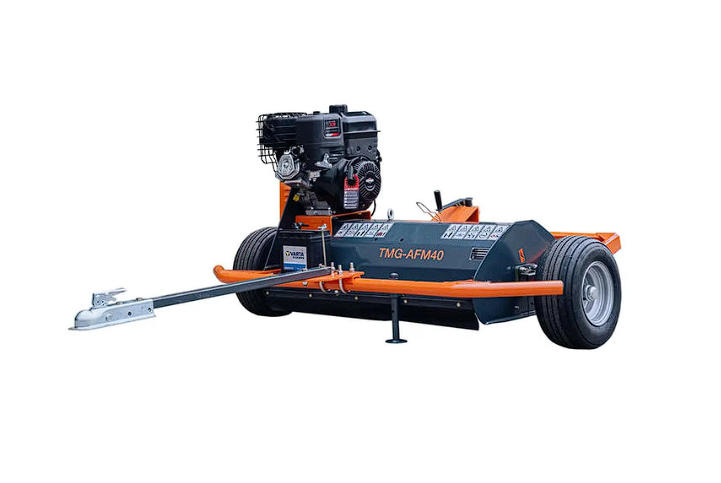
A quad has no power take-off, so a towed machine carries its own engine. That sounds like a limitation and is closer to an advantage, because it breaks the link between ground speed and rotor speed entirely.
On a tractor-mounted flail the two share a throttle, so slowing down to deal with heavy material also slows the rotor unless the operator manages both together. An independently powered rotor holds its speed while the tow vehicle crawls, which is precisely the combination heavy material asks for.
The cost is a second engine to maintain, fuel and start, and a machine heavier at the drawbar than a bare implement would be. It also means two service intervals to remember rather than one, which is the part most often discovered in the spring rather than planned for in the autumn.
Ground speed becomes the only adjustment left
Once the rotor holds its own speed, the operator has exactly one lever over cut quality, and it is how fast the machine is walked into the material. Everything arriving at the rotor per second is ground speed multiplied by how dense the sward is, and the rotor can only absorb so much of it before tip speed starts to fall.
That is why an experienced operator on an atv flail mower slows down in a thick patch and speeds up again on thin ground, rather than holding a steady pace and hoping. The engine note is the instrument being read, and a drop in it means material is arriving faster than the knives can pay for.
Grouping machines by how they reach working tip speed
Specifications compare cutting width, which says how much ground is covered in a pass and nothing at all about whether the material standing on it actually gets cut. Grouping machines by how they reach a working tip speed is more honest, because it puts the geometric constraint in front of the marketing figure.
- Large drum, low revolutions: tractor flails, easy on bearings
- Small drum, high revolutions: compact and towed machines
- Very small, very high: handheld and pedestrian tools
Reading a machine this way explains its maintenance schedule rather than just its price. Anything in the second group is trading bearing life and balance tolerance for a package a tow vehicle can actually handle, and an atv flail mower sits squarely in that group by necessity rather than by choice.
What the quad contributes, and what it does not
An atv tow behind flail mower asks little of the tow vehicle in power terms, since the rotor is not drawing on it. What it does ask for is grip and weight on a wet British slope in autumn.
Weight transfer is the part that catches people out. A drawbar mounted high pulls the front of the quad light as the load comes on, which is felt as vague steering exactly where steering matters. Hitching low, and loading the front rack, does more for control on a bank than any tyre change.
Cutting height is a land management decision
Flails are used on amenity and conservation ground because they leave material chopped small enough to break down in place rather than lying in a smothering swath. That is why the height an atv flail mower is set to matters well beyond tidiness.
Many land managers now avoid a close cut on rough ground until later in the season, and time the work around nesting rather than around the calendar. Setting the skids higher costs a pass in appearance and returns it in what survives underneath.
When hiring makes more sense than owning
A flail is a machine with a long working life and a short annual duty cycle, which is the profile that suits sharing. An atv flail mower hire arrangement covers the once or twice a year that rough ground genuinely needs cutting, and it removes the winter storage that quietly damages machines left outside.
Beyond a few hectares the calculation reverses, mostly because the hire window and the weather window rarely coincide in a British autumn. Owning buys the ability to cut on the day the ground is fit, and that is worth more than the day rate suggests. Specifications for rotor diameter and knife weight are published per model by TMG Industrial, and those two figures tell you more about what a machine will cut than its width ever will.