AI Agent Use Cases for Startups: Rank Value and Risk

Imagine a small B2B startup choosing among four jobs for an AI agent: draft a competitor brief, recommend where support tickets go, assemble a one-time strategy summary, or sign off on a financial record. The first pilot should be the brief. Its output stays inside the team, and a reviewer can reject it before anyone acts on a bad conclusion. The other jobs deserve different treatment even when each sounds automatable.
Score AI agent use cases by value and review risk
Business value starts with work the team actually sees. Check how often the task arrives, how long it waits, and how many handoffs delay a usable result. For review risk, inspect the data it touches, what happens if the proposed action is wrong, and how often an exception calls for judgment. These are relative comparisons among the team's own tasks, not universal scores or a forecast of savings.
A guide toAI agent use cases ranked by value and risk offers a planning scorecard based on frequency, delay, coordination cost, data sensitivity, action risk, and exception load. Use the dimensions to question an appealing idea: a high-volume task may still be a poor first pilot if errors reach customers before anyone can catch them. The 2×2 matrix here is a way to organize that decision, not a built-in product feature.
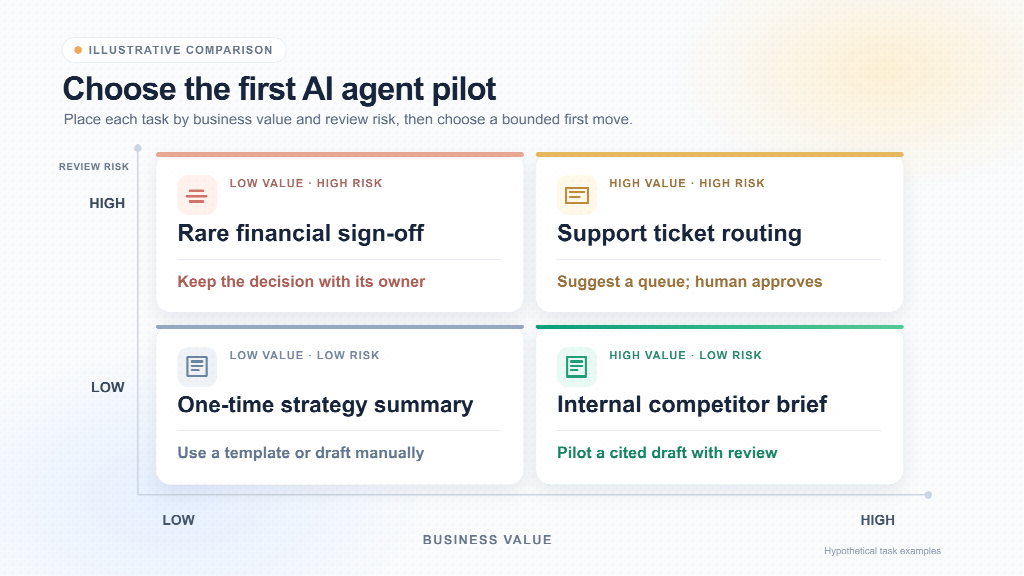
Illustrative comparison: four hypothetical startup tasks placed by business value and review risk, with a different first move for each.
The NIST AI Risk Management Framework Core calls for defining business value, examining the costs of AI errors, and documenting human oversight. It does not set a cutoff for this matrix. A founder still has to decide which mistakes the team can detect and reverse.
High value, low review risk: pilot an internal brief
Return to the hypothetical competitor brief. Suppose the team already requests this research regularly, but each request stalls while someone gathers approved public sources. Give the agent the product category, source policy, and research date. Ask for a draft that shows where each claim came from and flags missing information. The output goes to an internal reviewer, not to a public page or a customer.
The reviewer checks the sources, their dates, and whether the conclusion follows from them. A confident paragraph with no traceable evidence goes back for rework. If the input sources have changed or the draft blends products together, the team should correct the source list before expanding the pilot. This task earns an early trial because the work repeats and its first output can be discarded. Publishing it still needs a reviewer.
High value, high review risk: split recommendation from action
Support tickets may arrive often enough to justify AI automation, yet a wrong route delays a sensitive request. Start with a narrower question: which queue should a ticket enter? Let the agent suggest a queue and show the reason. A person confirms the move, while unclear or sensitive tickets go to a named owner. Compare its recommendations with the team's actual queue decisions before giving it any further authority.
The same boundary matters for tools. SpringBrand describes a shared layer of APIs and plugins for go-to-market work, including research and support-related tasks. A startup could consider such a layer for preparing inputs, or connect its existing APIs and file exports instead. Neither route decides its approval policy. Customer promises, outbound messages, and refunds need their own checks rather than inheriting approval from a routing pilot.
Queue recommendation might be useful; automatic replies are a different AI agent use case with a larger consequence when the content is wrong. Keep the first version at the review point until the exception log shows which tickets fit the agreed categories.
Low value, low review risk: keep the simple route
A one-time internal strategy summary could be easy to review and still be a poor agent project. Look at how often the work returns and what maintaining the workflow would take. If the team needs the summary once, a shared template or a short manual draft may be enough. A script might help if the same fields must be pulled repeatedly, without adding an agent to the process.
Low review risk helps, but low frequency gives the team fewer chances to learn from a pilot. Revisit the idea only if the task begins to recur or the handoffs become costly.
Low value, high review risk: leave it with an owner
A rare financial sign-off or strategy decision combines little repetition with consequences that may be hard to reverse. Keep the final decision with the responsible person. An agent might collect documents, list open questions, or prepare a summary for that person, provided the inputs are permitted and the output is checked. Signing off is a separate action.
Preparing material for a decision and holding the authority to act are separate jobs. Sorting source material is a bounded task. Changing a financial record or approving a commitment is a poor first experiment, however plausible the agent's answer looks. Record who owns the decision and where the supporting draft stops.
Run one reversible AI pilot and measure the review work
For the hypothetical brief, write down the eligible input before configuring anything: an approved list of public sources for one product category and a research date. Define the expected output as a cited internal draft. Name the person who accepts it and the point where the agent stops. Missing sources, conflicting claims, or an unknown category should go to that person rather than being filled in silently.
Start with read-only access and internal drafts. For each eligible request, record whether the brief was completed and accepted, whether a person had to intervene before the planned review, what error occurred, and how much work was needed to fix it. Keep the same definitions for the team's existing manual process. A brief that arrived fast but needed heavy correction does not count as a success.
After a small batch, inspect the actual drafts and intervention log together. If missing citations are common, narrow the source list or change the output requirement. If reviewers spend more time repairing conclusions than they spent writing the old briefs, pause the pilot. If the work stays traceable and the review burden is manageable, extend it to another internal brief before allowing a higher-risk action. The next step depends on observed rework and exceptions, not on how fluent the agent sounds.