Packaging Broker vs Manufacturer: Which Is Safer for a Multi-SKU Brand?

One smudged barcode can park forty SKUs on the dock, blow a launch window, and burn cash on relabels.
Price always matters, but real safety rests on five pillars: product integrity, consistent quality, regulatory proof, supply continuity, and cash exposure.
A factory puts you beside the press; a broker can split volume, trim minimum order quantities (MOQs), and plug capacity gaps. Neither badge is safer on its own. The guardrails you build around it are.
This guide shows you how to build those guardrails and choose the right route for every SKU.
First, define who controls what
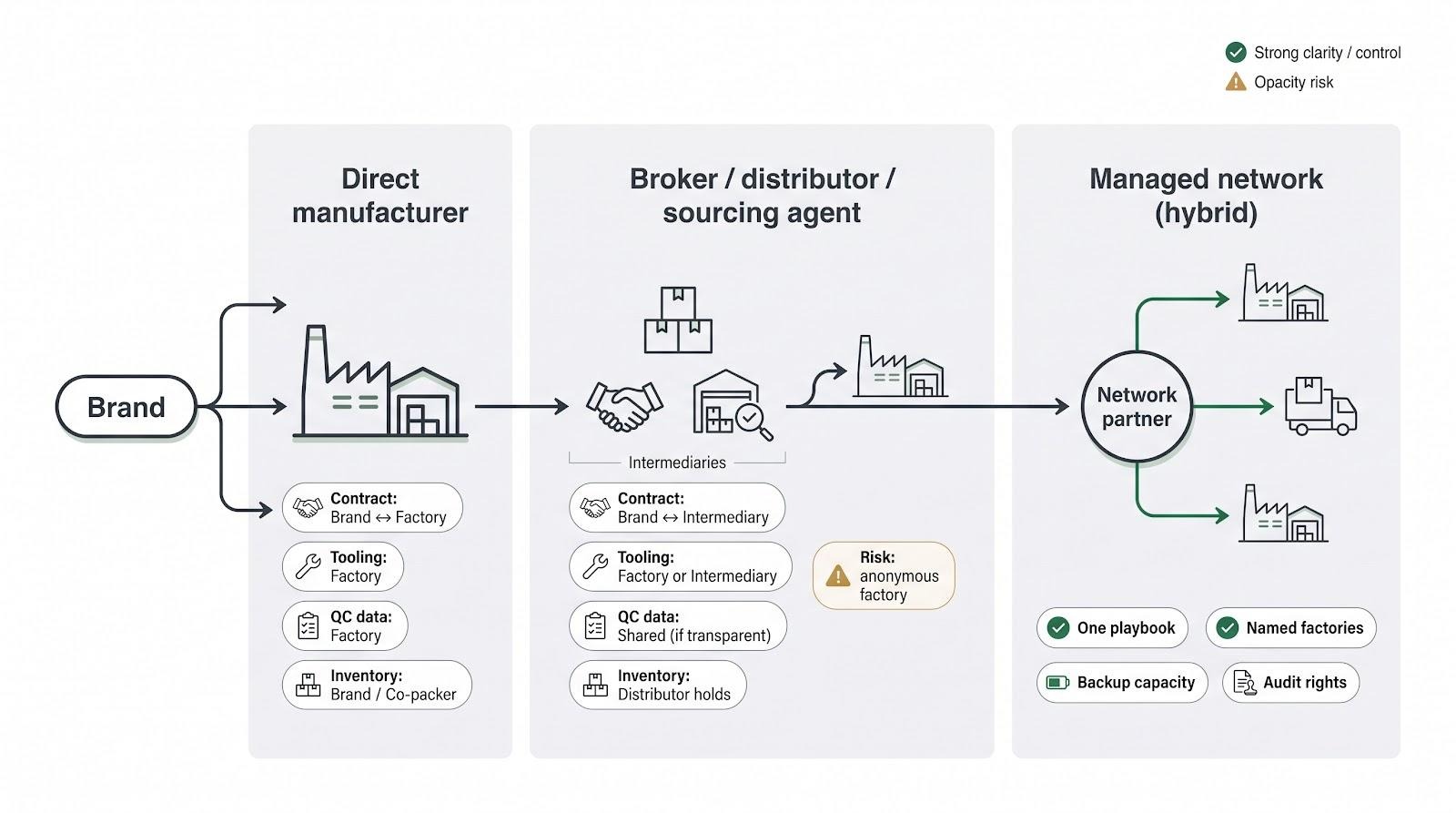
Direct manufacturer
When you buy straight from the factory, you meet the people who run the presses, mix the resin, and sign every QC report. All tooling and know-how sit under one legal roof, so you can audit, question, and escalate in real time.
That closeness pays off. Need a dye-lot tweak or a barcode regrade? You walk the floor, pull samples, and correct the issue before the truck pulls away.
Concentration cuts both ways. A single storm, labor dispute, or overloaded schedule can bottleneck every high-volume SKU. Even “vertically integrated” converters outsource coating or final pack-out, so ask which steps stay inside the fence and which ride in a subcontractor’s van.
Broker, distributor, and sourcing agent: spot the difference
Broker: connects your brief to a factory, takes a commission, and forwards documents. Goods move directly from maker to brand. The model opens smaller runs and faster pivots, but only when the broker names the plant and shares QC data.
Distributor: buys, stores, and resells finished packaging. Because inventory sits on their balance sheet, you can call off cartons tomorrow instead of waiting six weeks. The trade-off is opacity: if a defect surfaces, you still chase the upstream factory through stock records.
Sourcing agent: part scout and part project manager. An agent finds factories, translates specs, inspects shipments, and invoices a service fee. You pay the factory directly; the agent receives a pre-agreed commission. Because they rarely take title, confirm who carries liability for defects.
The hybrid or managed-network model
A managed network keeps design, sourcing, quality, and logistics on one playbook while each task runs in a specialist plant. One example is Zenpack, which combines in-house structural design with a managed, vetted production network. You brief once; a dedicated project manager routes work across that network and consolidates freight to your co-packer.
The upside is agility: a skincare launch that needs rigid glass, a paper sleeve, and a foil pouch can run on proven lines instead of forcing every part through one factory’s comfort zone. Lower MOQs, faster pilots, and built-in backup capacity follow.
The model is only as safe as its transparency. Ask for a named-factory list, audit rights, and a rule that no site changes without your sign-off. Keep the master specification in your system and make tooling ownership explicit. With those guardrails, a managed network can feel like your extended factory floor, without the overhead.
Supply continuity
A purchase order is a promise to keep shelves full. If the factory shutters during peak season, that promise vanishes, and no apology letter brings back a lost holiday slot.
A broker or managed network can spread work across certified sites. If a storm knocks out Plant A, Plant B can start with the same dielines and color standards already validated. That diversity works only when substitution rules are explicit; “any qualified factory” invites surprises.
PMMI reports that 35.5 percent of its member companies, the packaging and processing machinery suppliers, faced supply-chain disruptions in Q1 2026, up 7.8 points on the prior quarter, a reminder that backup capacity is not optional.
Take the middle path: name a primary and a pre-qualified alternate for every high-volume SKU. Lock both sites into the spec, run a trial batch at the backup each year, and store master samples side by side. What matters is switching within days, not months, while the carton looks identical on the retailer’s conveyor.
The safest answer changes by SKU
One catalog rarely deserves one sourcing door. Volume, volatility, and technical risk differ across the mix.
- A SKUs (about 10–20 percent of items, 70–80 percent of volume). Keep these high movers on a direct factory contract. The line knows the molds, QC charts stay in control, and minimums clear in a single fortnight. Lock color masters once and run repeat orders on autopilot.
- C SKUs (about 50 percent of items, under 5 percent of volume). Park long-tail and promo packs with a transparent broker or managed network. Pooled demand trims minimums and spare capacity cushions forecast misses. Write named-factory disclosure and change-control clauses into the contract.
- B SKUs (everything between). Run both lanes in parallel. Approve a backup site, store matched master samples, and fire one proof batch each year. The hybrid grid gives you speed where it counts, stability where it matters, and a ready escape hatch when the market tilts.
Segment first, then write the sourcing rules. Build a landed-cost sheet for each tier as well, because total cost, not sticker price, decides the winner.
The verdict: choose the control model, not the label
Cutting out the middleman is not a safety strategy, and betting the season on one “one-stop” pitch is no better. Safety grows from governance: clear specs, open factory doors, rehearsed backups, and contracts that put cash behind promises.
- Direct factories excel when volumes stay high, CTQs stay tight, and you own the technical playbook.
- Transparent brokers or managed networks win when SKU variety explodes or you need five materials tomorrow morning.
- Hybrid portfolios cover the middle: A SKUs direct, C SKUs through a network, B SKUs with pre-qualified alternates.
Segment the portfolio, write the rules, and enforce them. The safest path starts with the next purchase order you sign.