Why Salary Benchmarking Is the Missing Step in Your Executive Hiring Plan

Salary benchmarking is the missing step because executive offers built on outdated or single source pay data often fail at the offer stage. Benchmark first and you set ranges that attract the right candidates before the search begins.
Gartner data cited by Talentfoot Executive Search shows 48% of candidates accepted their latest offer in late 2025, down from 85% two years earlier.

What Salary Benchmarking Means for Executive Roles
Paychex defines it as "the process of comparing what you pay against what similar roles pay in your industry, region, and company size."
Executive pay is more than base salary. The HR Source survey covers base pay, incentives, benefits and perks across 47 top management positions.
Its last edition drew on 1,667 U.S. organizations and pay data for 9,722 executives.
Where Executive Offers Break Down
Shawn Cole, President and Co-Founder of Cowen Partners Executive Search, writes: "Most executive searches don't fail in interviews. They fail at the offer. Compensation committees are relying on data they should have left far behind."
A Talentfoot poll of 400+ executives shows pay is only part of the picture. Even with competitive pay, many would still decline.
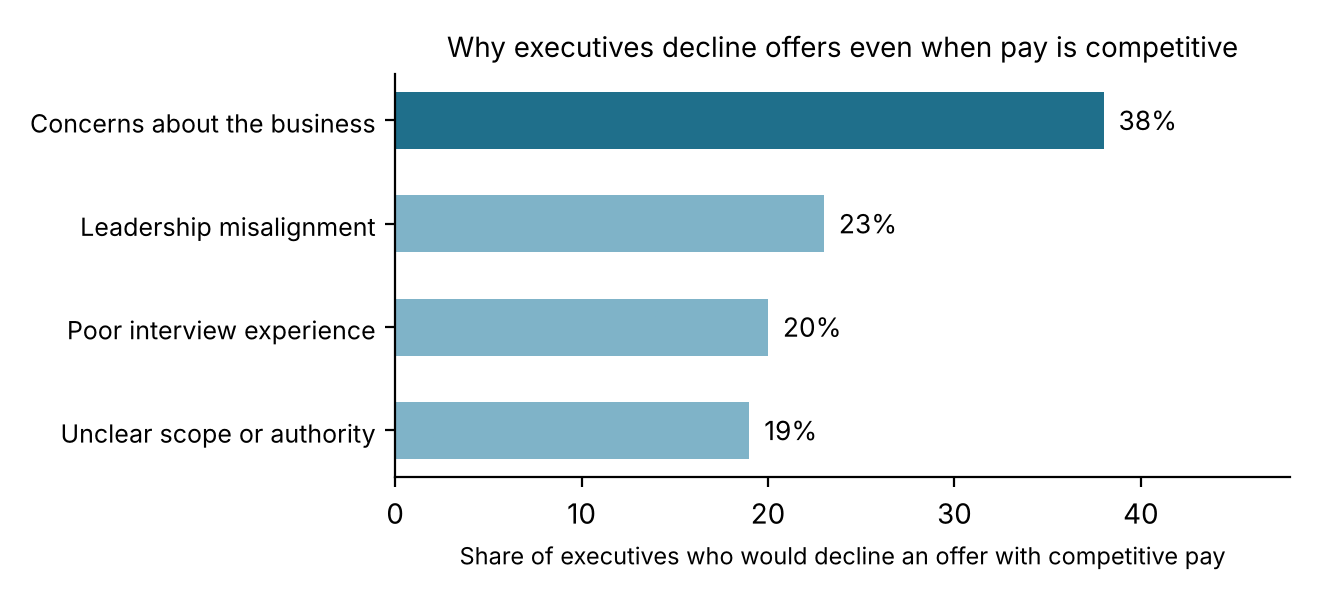
Source: Talentfoot Executive Search poll of 400+ executives.
Keith Johnstone, Vice President of Marketing at Talentfoot, puts it this way: "Compensation gets you into the conversation. It rarely closes."
That is why benchmarking comes first. It gets pay right so the other factors can decide the hire.

How to Benchmark an Executive Role
- Match the role to market job descriptions by responsibilities, not just titles.
- Define a peer group by industry, region and company size.
- Collect data from at least two sources.
- Compare current pay with the 25th, 50th and 75th percentiles.
- Set a minimum, midpoint and maximum, with the midpoint at your target market position.
For a quick overview of the process, watch How To Conduct Salary Benchmarking?.
Choosing Data Sources
Sector specific data fills the gaps in broad surveys. Recruiters such as Chris Edward Consulting publish free salary benchmarks for AV, physical security, UC and data center roles, with regional data and counteroffer guidance.
When to Benchmark Again
Paychex calls an annual review "a minimum, not a finish line." It lists earlier triggers:
- High voluntary turnover, especially when exit interviews cite pay.
- A new position with no internal pay history.
- A merger or acquisition, or rapid growth.
Mergers deserve extra care. This BusinessAge piece on the talent crisis after the M&A boom explains why key staff leave once uncertainty sets in.
Turnover is costly too. Paychex puts average costs at $10,200 to $23,000 per employee, depending on business size.
Mistakes to Avoid
Final Thoughts
Benchmarking turns executive pay from a guess into a range you can defend. It covers total pay, uses more than one source and is repeated at least once a year.
Make it step one of your hiring plan. For more business advice, browse the Opinion and News sections of BusinessAge.
Your Questions Answered
What is salary benchmarking?
It compares what you pay with what similar roles pay in your industry, region and company size.
How often should executive pay be benchmarked?
At least once a year, with earlier reviews after turnover spikes, new roles, mergers or rapid growth.
How many data sources should I use?
Use at least two, and favor sources that update often because pay data goes stale quickly.
Why do executives decline offers when pay is competitive?
In the Talentfoot poll, the top reason was concern about the business at 38%, followed by leadership misalignment at 23%.